







Question: i. iii. Suppose that A, B. and C are binary random variables and that we observe T = 1000 samples from theirjoint distribution P(A, B,
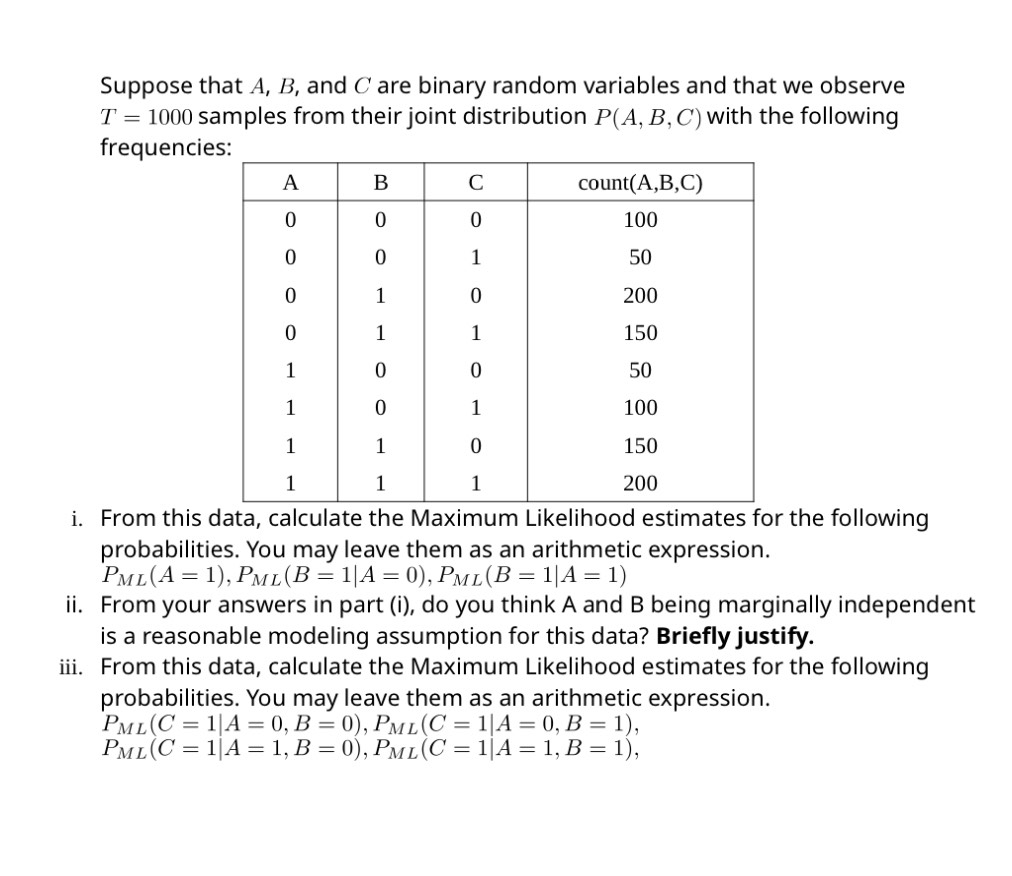
i. iii. Suppose that A, B. and C are binary random variables and that we observe T = 1000 samples from theirjoint distribution P(A, B, C) with the following frequencies: H l count(A,B,C) 0 0 0 1 0 0 0 1 1 0 1 1 1 U II. H- From this data, calculate the Maximum Likelihood estimates for the following probabilities. You may leave them as an arithmetic expression. PML(A = 1)1PML(B = 1|A = U):PML(B = 1|A = 1) From your answers in part (i), do you think A and B being marginally independent is a reasonable modeling assumption for this data? Briey justify. From this data, calculate the Maximum Likelihood estimates for the following probabilities. You may leave them as an arithmetic expression. PML(C = 1|A = 0,3 = 0), PML(C = 1|A = 0,3 =1), PML(C = 1|A = 1,3 =0)1PML(C = 1|A = 1,3 = 1)
Step by Step Solution
There are 3 Steps involved in it

Get step-by-step solutions from verified subject matter experts
 Study Help