







Question: I ILITUM . 2 Question 5 (1 points): Consider the following code that uses semaphores: sem_t a, b; int x = 0; void foo() {
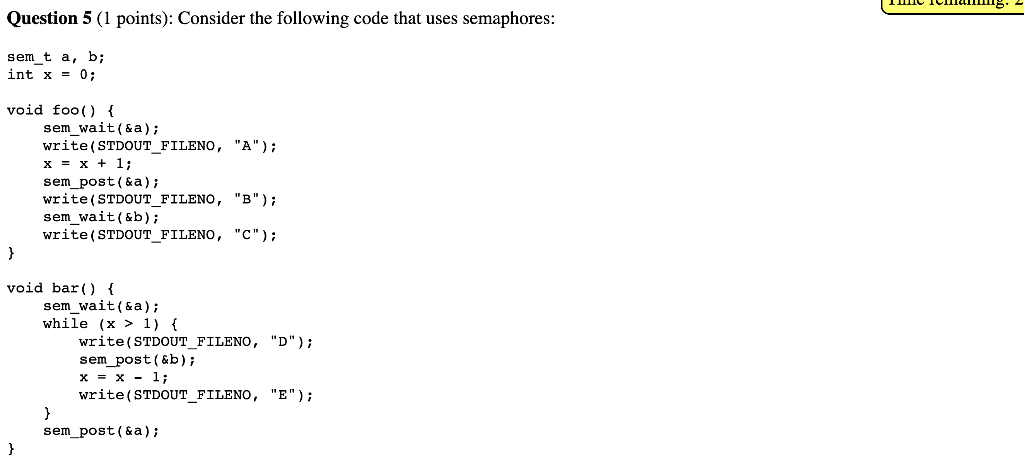
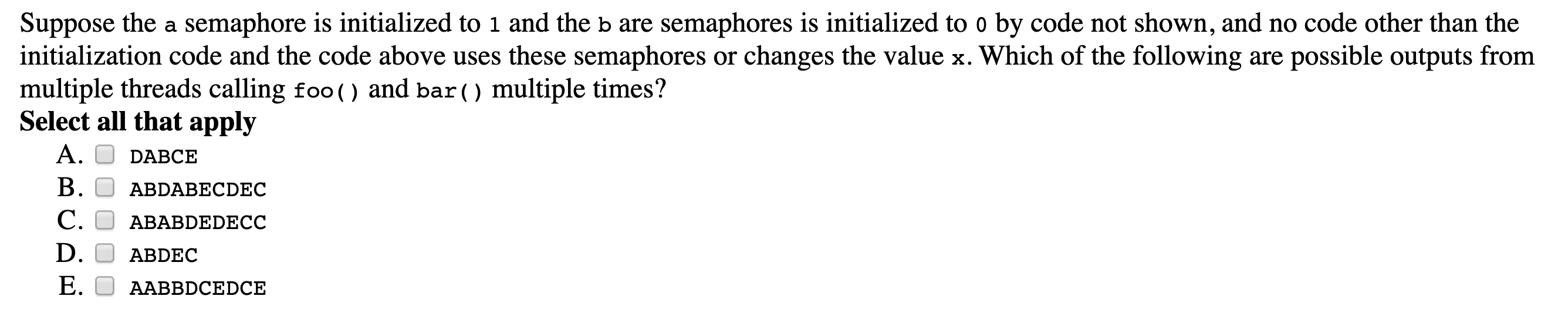
I ILITUM . 2 Question 5 (1 points): Consider the following code that uses semaphores: sem_t a, b; int x = 0; void foo() { sem_wait(&a); write(STDOUT_FILENO, "A"); x = x + 1; sem_post(&a); write(STDOUT_FILENO, "B"); sem_wait(&b); write(STDOUT_FILENO, "C"); void bar() { sem_wait(&a); while (x > 1) { write(STDOUT_FILENO, "D"); sem_post(&b); x = x - 1; write(STDOUT_FILENO, "E"); sem_post(&a); Suppose the a semaphore is initialized to 1 and the b are semaphores is initialized to o by code not shown, and no code other than the initialization code and the code above uses these semaphores or changes the value x. Which of the following are possible outputs from multiple threads calling foo() and bar() multiple times? Select all that apply A. ODABCE B. ABDABECDEC C. ABABDEDECC D. ABDEC E. O AABBDCEDCE I ILITUM . 2 Question 5 (1 points): Consider the following code that uses semaphores: sem_t a, b; int x = 0; void foo() { sem_wait(&a); write(STDOUT_FILENO, "A"); x = x + 1; sem_post(&a); write(STDOUT_FILENO, "B"); sem_wait(&b); write(STDOUT_FILENO, "C"); void bar() { sem_wait(&a); while (x > 1) { write(STDOUT_FILENO, "D"); sem_post(&b); x = x - 1; write(STDOUT_FILENO, "E"); sem_post(&a); Suppose the a semaphore is initialized to 1 and the b are semaphores is initialized to o by code not shown, and no code other than the initialization code and the code above uses these semaphores or changes the value x. Which of the following are possible outputs from multiple threads calling foo() and bar() multiple times? Select all that apply A. ODABCE B. ABDABECDEC C. ABABDEDECC D. ABDEC E. O AABBDCEDCE
Step by Step Solution
There are 3 Steps involved in it

Get step-by-step solutions from verified subject matter experts
 Study Help