







Question: I initially solved the first part of the problem by using (T_inner wall - T_outer wall) instead of the (T_chamber - T_inner wall) to solve
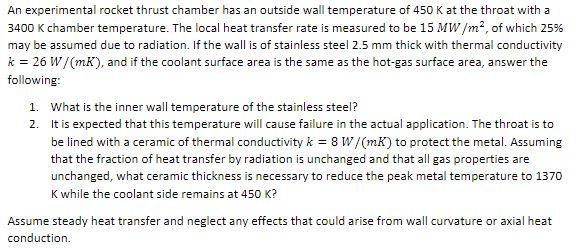
I initially solved the first part of the problem by using (T_inner wall - T_outer wall) instead of the (T_chamber - T_inner wall) to solve for T_inner wall which gave me 1892K. But I'm not sure if that's correct. I just really need the 2nd part done because I'm not sure if I'm solving it correctly.
An experimental rocket thrust chamber has an outside wall temperature of 450 K at the throat with a 3400 K chamber temperature. The local heat transfer rate is measured to be 15 MW/m2, of which 25% may be assumed due to radiation. If the wall is of stainless steel 2.5 mm thick with thermal conductivity k = 26 W/(mK), and if the coolant surface area is the same as the hot-gas surface area, answer the following: 1. What is the inner wall temperature of the stainless steel? 2. It is expected that this temperature will cause failure in the actual application. The throat is to be lined with a ceramic of thermal conductivity k = 8 W/(mK) to protect the metal. Assuming that the fraction of heat transfer by radiation is unchanged and that all gas properties are unchanged, what ceramic thickness is necessary to reduce the peak metal temperature to 1370 K while the coolant side remains at 450 K? Assume steady heat transfer and neglect any effects that could arise from wall curvature or axial heat conduction
Step by Step Solution
There are 3 Steps involved in it

Get step-by-step solutions from verified subject matter experts
 Study Help