Question: I. IT. Chapter 7 Opening Section The opening section compares the development rates for China and India. China has a greater population, more high net
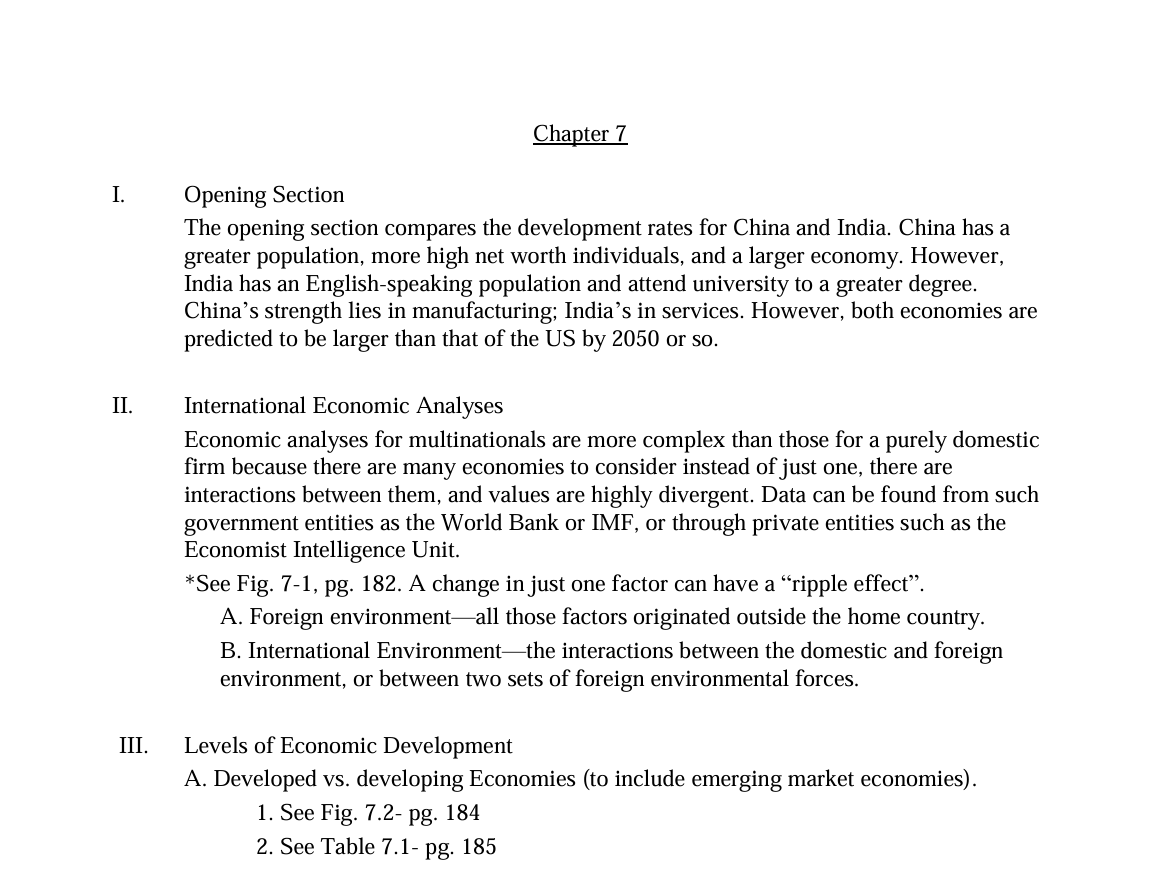
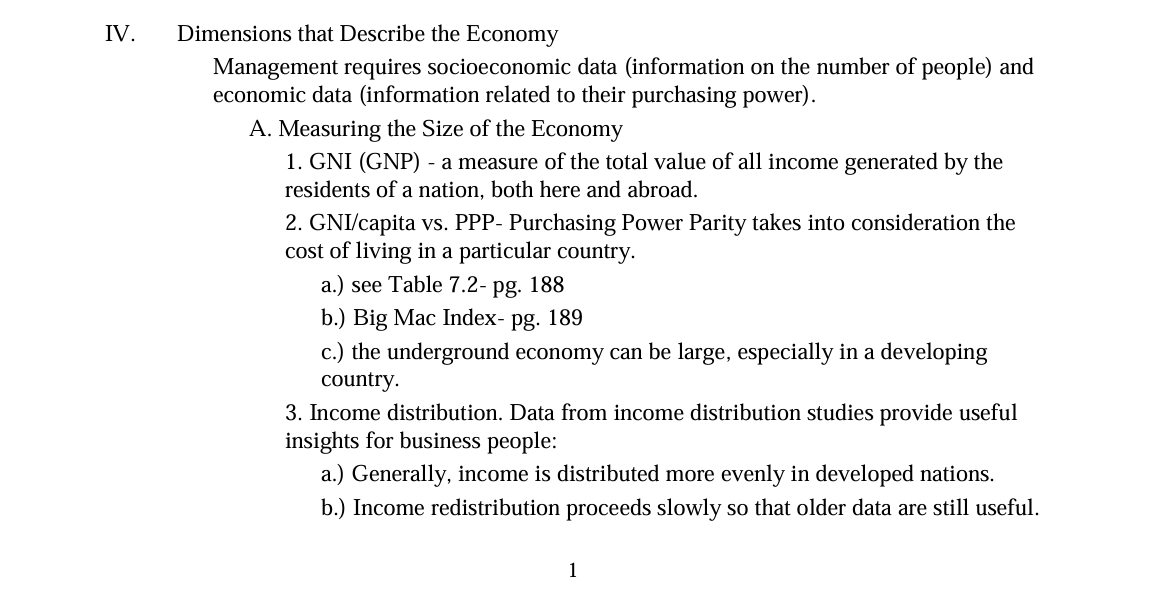
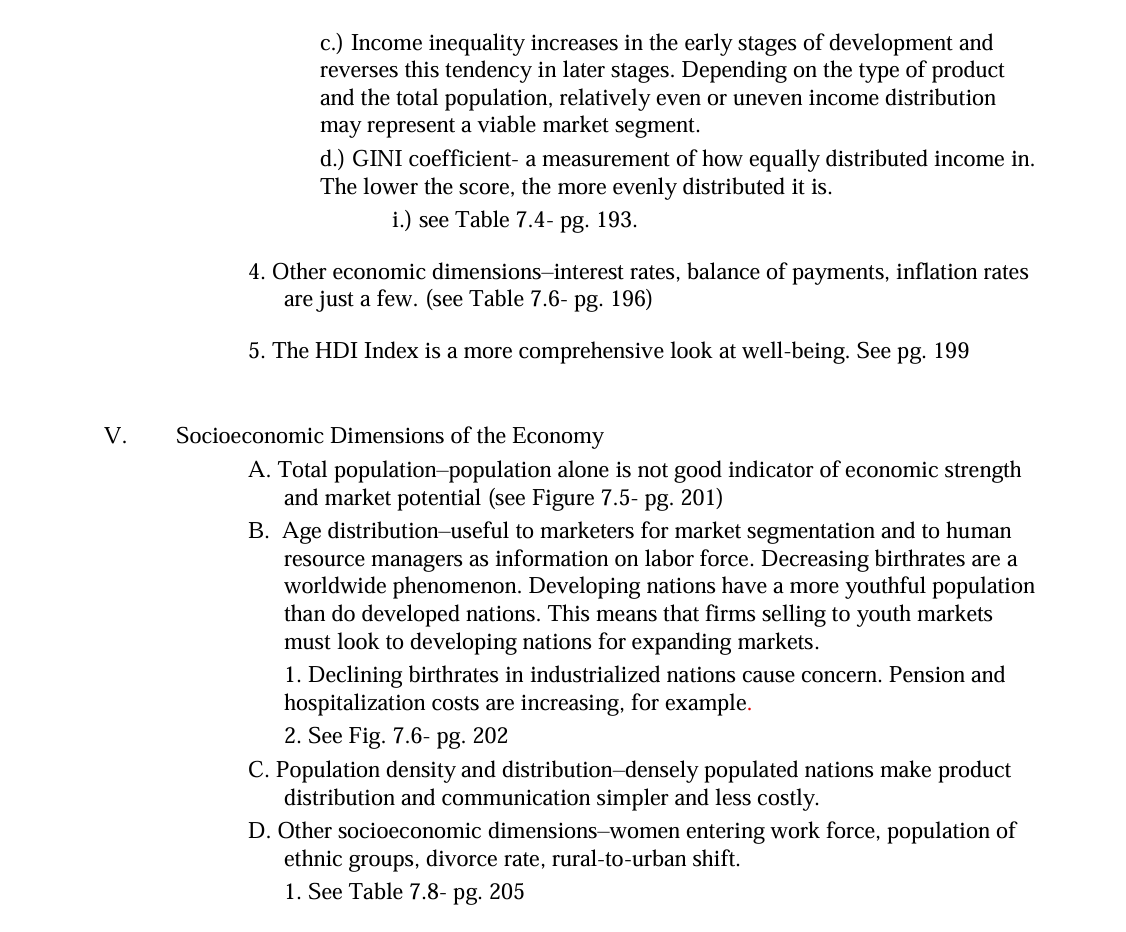
I. IT. Chapter 7 Opening Section The opening section compares the development rates for China and India. China has a greater population, more high net worth individuals, and a larger economy. However, India has an English-speaking population and attend university to a greater degree. China's strength lies in manufacturing; India's in services. However, both economies are predicted to be larger than that of the US by 2050 or so. International Economic Analyses Economic analyses for multinationals are more complex than those for a purely domestic firm because there are many economies to consider instead of just one, there are interactions between them, and values are highly divergent. Data can be found from such government entities as the World Bank or IMF, or through private entities such as the Economist Intelligence Unit. *See Fig. 7-1, pg. 182. A change in just one factor can have a \"ripple effect\". A. Foreign environmentall those factors originated outside the home country. B. International Environmentthe interactions between the domestic and foreign environment, or between two sets of foreign environmental forces. Levels of Economic Development A. Developed vs. developing Economies (to include emerging market economies). 1. See Fig. 7.2- pg. 184 2. See Table 7.1- pg. 185 IV. Dimensions that Describe the Economy Management requires socioeconomic data (information on the number of people) and economic data (information related to their purchasing power). A. Measuring the Size of the Economy 1. GNI (GNP) - a measure of the total value of all income generated by the residents of a nation, both here and abroad. 2. GNI/capita vs. PPP- Purchasing Power Parity takes into consideration the cost of living in a particular country. a.) see Table 7.2- pg. 188 b.) Big Mac Index- pg. 189 c.) the underground economy can be large, especially in a developing country. 3. Income distribution. Data from income distribution studies provide useful insights for business people: a.) Generally, income is distributed more evenly in developed nations. b.) Income redistribution proceeds slowly so that older data are still useful. c.) Income inequality increases in the early stages of development and reverses this tendency in later stages. Depending on the type of product and the total population, relatively even or uneven income distribution may represent a viable market segment. d.) GINI coefficient- a measurement of how equally distributed income in. The lower the score, the more evenly distributed it is. i.) see Table 7.4- pg. 193. 4, Other economic dimensionsinterest rates, balance of payments, inflation rates are just a few. (see Table 7.6- pg. 196) 5. The HDI Index is a more comprehensive look at well-being. See pg. 199 V. Socioeconomic Dimensions of the Economy A. Total populationpopulation alone is not good indicator of economic strength and market potential (see Figure 7.5- pg. 201) B. Age distributionuseful to marketers for market segmentation and to human resource managers as information on labor force. Decreasing birthrates are a worldwide phenomenon. Developing nations have a more youthful population than do developed nations. This means that firms selling to youth markets must look to developing nations for expanding markets. 1. Declining birthrates in industrialized nations cause concern. Pension and hospitalization costs are increasing, for example. 2. See Fig. 7.6- pg. 202 C. Population density and distributiondensely populated nations make product distribution and communication simpler and less costly. D. Other socioeconomic dimensionswomen entering work force, population of ethnic groups, divorce rate, rural-to-urban shift. 1. See Table 7.8- pg. 205
Step by Step Solution
There are 3 Steps involved in it
1 Expert Approved Answer
Step: 1 Unlock
Question Has Been Solved by an Expert!
Get step-by-step solutions from verified subject matter experts
Step: 2 Unlock
Step: 3 Unlock
Students Have Also Explored These Related Accounting Questions!









 Study Help