







Question: SET A = a + 4b IF A = 0 SET A TO 20 SET B TO B = 2x/a - xo SET TO
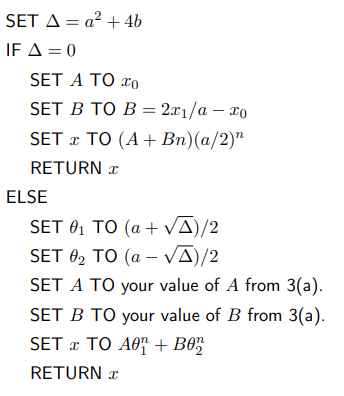
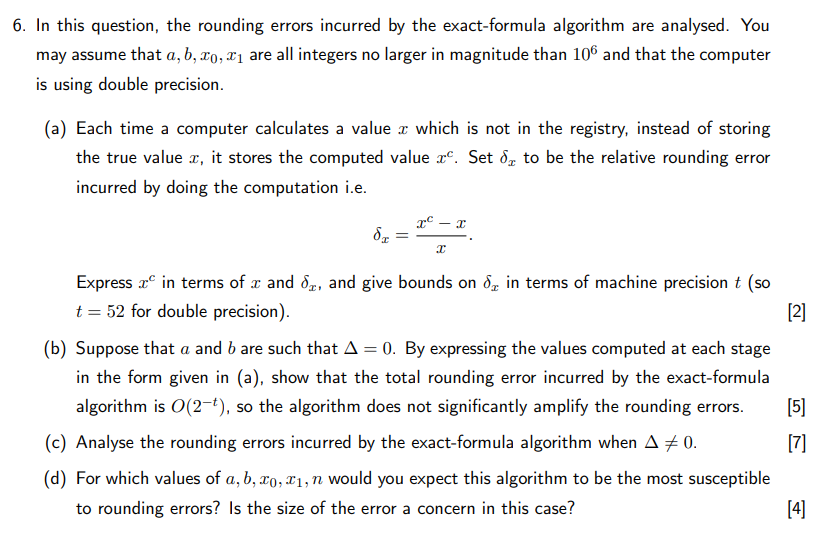
SET A = a + 4b IF A = 0 SET A TO 20 SET B TO B = 2x/a - xo SET TO (A + Bn)(a/2)" x RETURN x ELSE SET 0 TO (a + A)/2 SET 0 TO (a - A)/2 SET A TO your value of A from 3(a). SET B TO your value of B from 3(a). SET TO A0+ B02 RETURN x 6. In this question, the rounding errors incurred by the exact-formula algorithm are analysed. You may assume that a, b, xo, are all integers no larger in magnitude than 106 and that the computer is using double precision. (a) Each time a computer calculates a value x which is not in the registry, instead of storing the true value x, it stores the computed value . Set d to be the relative rounding error incurred by doing the computation i.e. da = xc - - I Express in terms of x and d, and give bounds on d in terms of machine precision t (so t = 52 for double precision). [2] (b) Suppose that a and b are such that A = 0. By expressing the values computed at each stage in the form given in (a), show that the total rounding error incurred by the exact-formula algorithm is O(2-t), so the algorithm does not significantly amplify the rounding errors. (c) Analyse the rounding errors incurred by the exact-formula algorithm when A 0. (d) For which values of a, b, x0, x, n would you expect this algorithm to be the most susceptible to rounding errors? Is the size of the error a concern in this case? [5] [7] [4]
Step by Step Solution
3.49 Rating (142 Votes )
There are 3 Steps involved in it
a The relative rounding error incurred by computi... View full answer

Get step-by-step solutions from verified subject matter experts
 Study Help