







Question: I JUST NEED HELP WITH 2 A,B AND 3. I ALREADY HAVE 1 IceKreme Inc. makes ice cream machines for sale to ice cream parlours.
I JUST NEED HELP WITH 2 A,B AND 3. I ALREADY HAVE 1
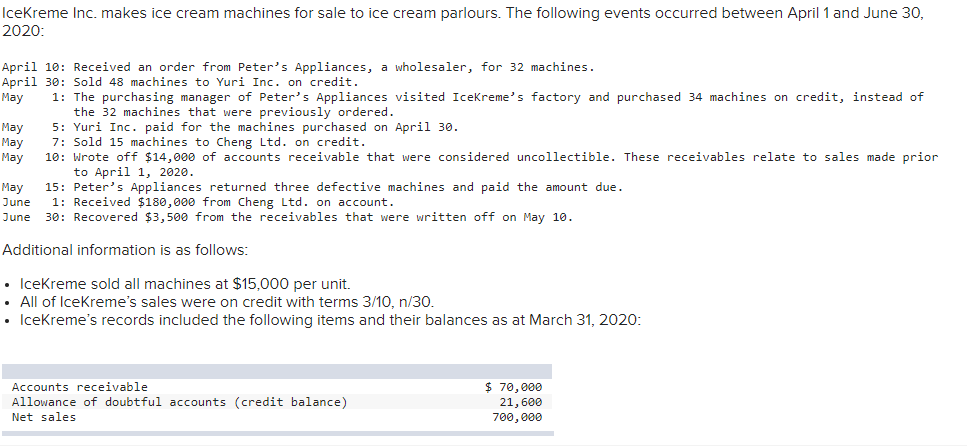
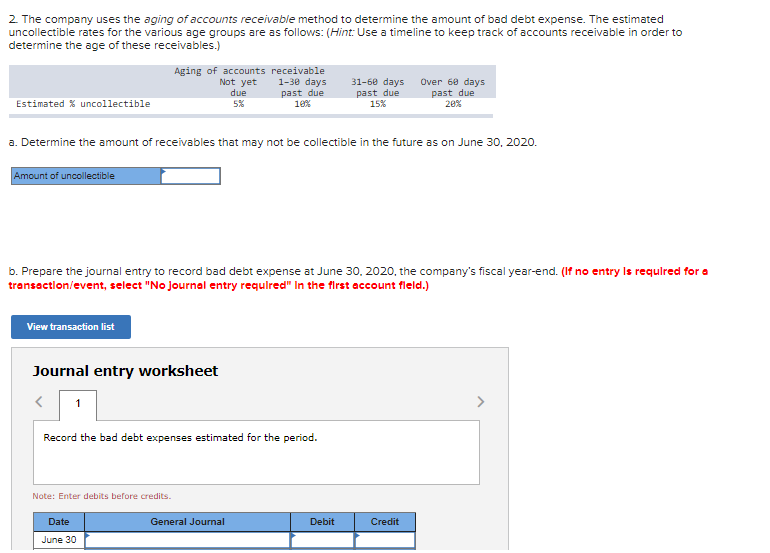

IceKreme Inc. makes ice cream machines for sale to ice cream parlours. The following events occurred between April 1 and June 30, 2020: April 10: Received an order from Peter's Appliances, a wholesaler, for 32 machines. April 30: Sold 48 machines to Yuri Inc. on credit. May 1: The purchasing manager Peter's Appliances visited IceKreme's factory and purchased 34 machines on credit, instead of the 32 machines that were previously ordered. May 5: Yuri Inc. paid for the machines purchased on April 30. May 7: Sold 15 machines to Cheng Ltd. on credit. May 10: Wrote off $14,000 of accounts receivable that were considered uncollectible. These receivables relate to sales made prior to April 1, 2020. May 15: Peter's Appliances returned three defective machines and paid the amount due. June 1: Received $180,000 from Cheng Ltd. on account. June 30: Recovered $3,500 from the receivables that were written off on May 10. Additional information is as follows: IceKreme sold all machines at $15,000 per unit. All of IceKreme's sales were on credit with terms 3/10, n/30. IceKreme's records included the following items and their balances as at March 31, 2020: Accounts receivable $ 70,000 Allowance of doubtful accounts (credit balance) 21,600 Net sales 700,000 2. The company uses the aging of accounts receivable method to determine the amount of bad debt expense. The estimated uncollectible rates for the various age groups are as follows: (Hint: Use a timeline to keep track of accounts receivable in order to determine the age of these receivables.) Aging of accounts receivable Not yet 1-30 days Over 60 days due 5% Estimated % uncollectible 31-60 days past due 15% past due 10% past due 20% a. Determine the amount of receivables that may not be collectible in the future as on June 30, 2020. Amount of uncollectible b. Prepare the journal entry to record bad debt expense at June 30, 2020, the company's fiscal year-end. (If no entry is required for a transaction/event, select "No Journal entry required" in the first account field.) View transaction list Journal entry worksheet 1 Record the bad debt expenses ated for the period. Note: Enter debits before credits. Date June 30 General Journal Debit Credit 3. IceKreme's net accounts receivable were $180,000 at June 30, 2019. Calculate IceKreme's average collection period for fiscal year 2020. (Use 365 days a year. Round Intermediate calculations to 2 decimal places. Round the final answer to 1 decimal place.) Average collection period days
Step by Step Solution
There are 3 Steps involved in it

Get step-by-step solutions from verified subject matter experts
 Study Help