







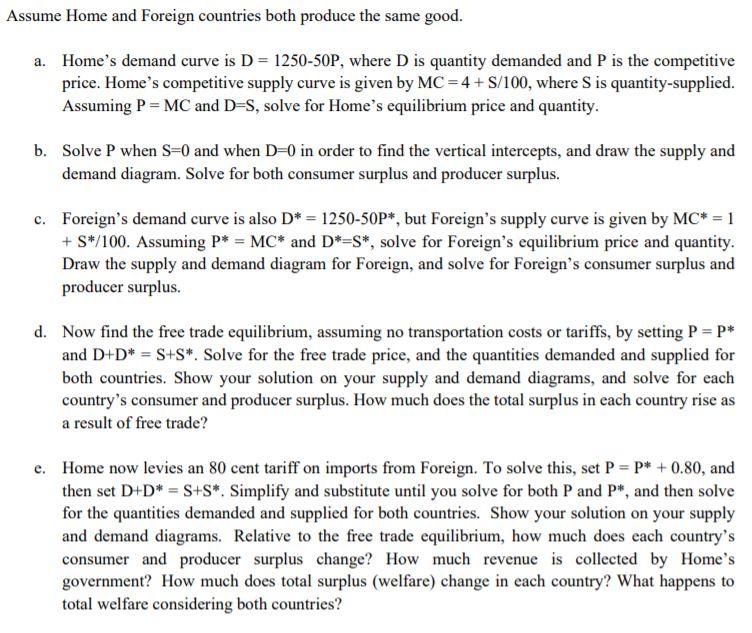
Question: I just need part E done. Below the image I'll post my answers to part C&D of the question in case you need those C)
I just need part E done. Below the image I'll post my answers to part C&D of the question in case you need those
C) Foreign Demand : D* =1250 -50 P*
Home Supply: MC*= P* = 1 +S*/100 or S = 100(P*-1)
Putting D* =S*, we get : 1250 -50 P* = 100(P*-1)
=> 1250 -50P* = 100P* -100 => 150P = 1350
=> P* = 1350/150 = $9
Foreign equilibrium price = $9 => Foreign equilibrium quantity = 100(9-1) = 100*8 = 800 units
When S= 0, P = 1
When D =0, P = 25
Consumer surplus = area under demand curve and the equilibrium price = 1/2* (25-9) *800 = 0.5 *16*800 = $6400
Producer surplus = area over supply function and equilibrium price = 1/2 *(9-1)*800 = 0.5 *8*800 = $3200
Total Surplus = $9600
D) Total Demand D' = D + D* = 1250 -50P + 1250 -50 P = 2500 -100 P
Total Supply S'= S + S* = 100(P-4) + 100(P-1) = 200P -500
Free trade equilibrium: D+D* = S+S*
2500-100P = 200P -500 =.> 3000 = 300P
=> PFT = 3000/300 = $10
D = D* = 1250-50(10) = 1250 -500 = 750 units
Total Demand = 2*750 = 1500 units
S = 100(10-4) = 600 units
S* = 100(10-1) = 900 units
Total supply =1500 units
Home:
Consumer surplus = area under demand curve and the equilibrium price = 1/2* (25-10) *750 = 0.5 *15*750 = $5625
Producer surplus = area over supply function and equilibrium price = 1/2 *(10-4)*750 = 0.5 *6*750 = $2250
Total surplus = 7875
Foreign:
Consumer surplus = area under demand curve and the equilibrium price = 1/2* (25-10) *750 = 0.5 *15*750 = $5625
Producer surplus = area over supply function and equilibrium price = 1/2 *(10-1)*750 = 0.5 *9*750 = $3375
Total surplus = $9000
Change in home total surplus = $(7875 - 7350) = $525
Change in foreign total surplus = $(9000 - 9600) = -$600
Assume Home and Foreign countries both produce the same good. a. Home's demand curve is D = 1250-50P, where D is quantity demanded and P is the competitive price. Home's competitive supply curve is given by MC = 4 + S/100, where S is quantity-supplied. Assuming P = MC and D-S, solve for Home's equilibrium price and quantity. b. Solve P when S=0 and when D=0 in order to find the vertical intercepts, and draw the supply and demand diagram. Solve for both consumer surplus and producer surplus. c. Foreign's demand curve is also D* = 1250-50P*, but Foreign's supply curve is given by MC* = 1 + S*/100. Assuming P* = MC* and D*=S*, solve for Foreign's equilibrium price and quantity. Draw the supply and demand diagram for Foreign, and solve for Foreign's consumer surplus and producer surplus. d. Now find the free trade equilibrium, assuming no transportation costs or tariffs, by setting P=P* and D+D* = S+S*. Solve for the free trade price, and the quantities demanded and supplied for both countries. Show your solution on your supply and demand diagrams, and solve for each country's consumer and producer surplus. How much does the total surplus in each country rise as a result of free trade? e. Home now levies an 80 cent tariff on imports from Foreign. To solve this, set P=P* +0.80, and then set D+D* = S+S*. Simplify and substitute until you solve for both P and P*, and then solve for the quantities demanded and supplied for both countries. Show your solution on your supply and demand diagrams. Relative to the free trade equilibrium, how much does each country's consumer and producer surplus change? How much revenue is collected by Home's government? How much does total surplus (welfare) change in each country? What happens to total welfare considering both countries
Step by Step Solution
There are 3 Steps involved in it

Get step-by-step solutions from verified subject matter experts
 Study Help