Question: I just need question 1 please (: When Your Boss Makes You Pay for Being Fat LESLIE KWOH Learning Outcomes Alerrading this article, you will
I just need question 1 please (:
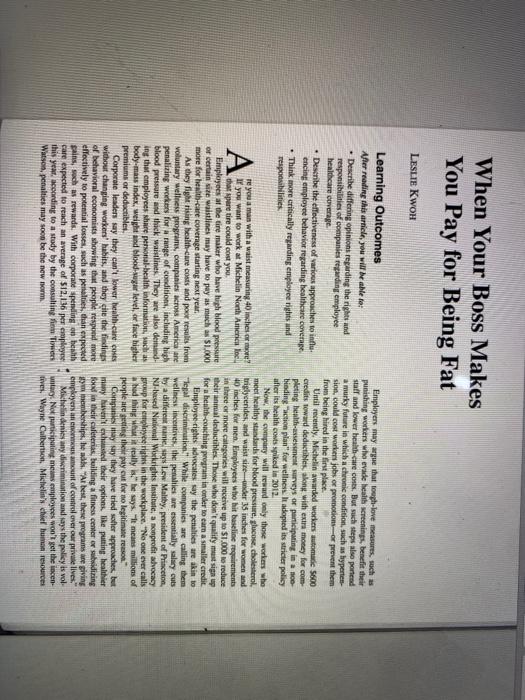
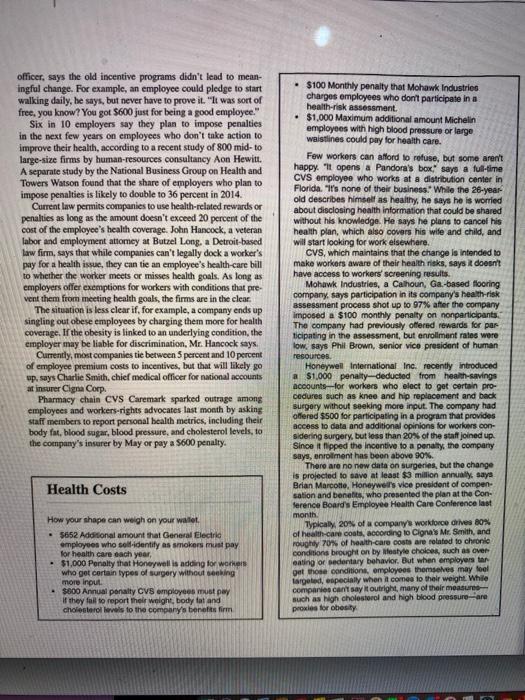
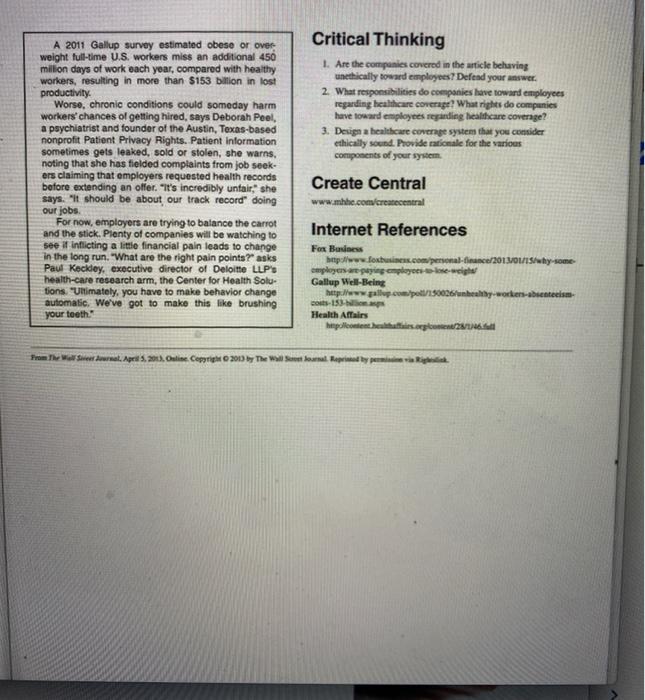
When Your Boss Makes You Pay for Being Fat LESLIE KWOH Learning Outcomes Alerrading this article, you will be able to - Describe differing opinions regarding the rights and responsibilities of companies regarding employee healthcare coverage Describe the effectiveness of various approaches to influ encing employee behavior regarding healthcare coverage Think more critically regarding employee rights and responsibilities A: te you a man with a waist measuring 40 inches If you want to work at Michelin North America locul charpere tire could cost you Employees at the tire maker who have high blood pre or certain side waistlines may have to pay as much as $1.000 more for health care coverage starting next year. As they fighting health-care costs and poor results from voluntary wellness programs, companies across Americane penalizing work for a range of conditions, including high blood pressure and thick waistlines. They are also demand ing that employees share personalbealth information, such as body mass index, weight and bleedugar level, a face higher premiums or deductibles Corporate leaders say they can't lower health care costs without changing workers' habits, and they cite the findings of behavioral economists showing that people respond more effectively to potential losses, such as pelaties, than expected pains.sochas rewards. With corporate spending on health care expected to reach an average of $12.136 per employee this year, according to a study by the consulting Time Watson, penalties may soon be the new som Employers may argue that touch-love measures, such as punishing workers who evade health screenings, benefit their staff and lower health care cons. But such steps also partend a murky future in which a chronic condition, such as hypertes sion, could cost worken jobs or promotions or prevent them from being hired in the first place Until recently. Michelin awarded workers automatic 5600 credits owad deductibles along with extra money for com pleting health-assement surveys or participating in a no bieding action plan" for wellness. It adopted its stricter policy after its health cow spiked in 2012 Now the company will reward only those workers who meet heality standards for blood pressure, glucose cholesterol triglycerides, and waist ander 35 inches for women and 40 inches for men. Employees who hit baseline requirements in three or more categories will receive up to $1,000 to reduce their annual deductibles. Those who don't quality must sign up for a health-coaching program in order to earn a smaller credit Employee rights advocates say the penalties are in to Tegal discrimination while companies are calling them wellness incentives, the penalties are essentially salay cuts ty a different man, was low Maltby, president of Princeton N-based National Workelights Institute, a nonprofit avocacy group for employees in the workplace. "No one ever calls a hod thing willy she says. "It means millions of people are going the pay cut for so legitimate Company way they have tried softer approaches, but many haven't exhausted their options like putting healthier found in their cafeteras, building a fitness center er subsidiring y memberships, head. Arbest, these programs are giving employer anmous amount of control over our private lives Michelin denies any dirimination and says the policy is vol Noring menemployees won't get the incen- tives. Wayne Culbertson, Michelin che human resources officer, says the old incentive programs didn't lead to mean- ingful change. For example, an employee could pledge to start walking daily, he says, but never have to prove it. "It was sort of free, you know? You got $600 just for being a good employee. Six in 10 employers say they plan to impose penalties in the next few years on employees who don't take action to improve their health, according to a recent study of 800 mid- to large-size firms by human resources consultancy Aon Hewitt A separate study by the National Business Group on Health and Towers Watson found that the share of employers who plan to impose penalties is likely to double to 36 percent in 2014. Current law permits companies to use health-related rewards or penalties as long as the amount doesn't exceed 20 percent of the cost of the employee's health coverage. John Hancock, a veteran labor and employment attomey at Butzel Long, a Detroit-based law firm, says that while companies can't legally dock a worker's pay for a health issue, they can tie an employee's health-care bill to whether the worker meets or misses health goals. As long as employers offer exemptions for workers with conditions that pre- vent them from meeting health goals, the firms are in the clear The situation is less clear if, for example, a company ends up singling out obese employees by charging them more for health coverage. If the obesity is linked to an underlying condition, the employer may be liable for discrimination, Mr. Hancock says. Currently, most companies tic between 5 percent and 10 percent of employee premium costs to incentives, but that will likely go up, says Charlie Smith, chief medical officer for national accounts at insurer Cigna Corp Pharmacy chain CVS Caremark sparked outrage among employees and workers-rights advocates last month by asking staff members to report personal health metrics, including their body fat, blood sugar, blood pressure, and cholesterol levels, to the company's insurer by Mayor pay a 5600 penalty $100 Monthly penalty that Mohawk Industries charges employees who don't participate in a health-risk assessment. $1,000 Maximum additional amount Michelin employees with high blood pressure or large waistlines could pay for health care. Few workers can afford to refuse, but some aren't happy. It opens a Pandora's box" says a full-time CVS employee who works at a distribution center in Florida. "It's none of their business. While the 26-year- old describes himself as healthy, he says he is worried about disclosing health information that could be shared without his knowledge. He says he plans to cancel his health plan, which also covers his wife and child, and will start looking for work elsewhere. CVS, which maintains that the change is intended to make workers aware of their health risks, says it doesn't have access to workers' screening results. Mohawk Industries, a Calhoun, Ga-based flooring company, says participation in its company's health-risk assessment process shot up to 97% after the company imposed a $100 monthly penalty on nonparticipants The company had previously offered rewards for per ticipating in the assessment, but enrollment rates were low, says Phil Brown, senior vice president of human resources Honeywell International Inc. recently introduced a $1,000 penalty-deducted from health-savings accounts for workers who elect to get certain pro- cedures such as knee and hip replacement and back surgery without seeking more input. The company had offered $500 for participating in a program that provides access to data and additional opinions for workers con- sidering surgery, but less than 20% of the staff joined up. Since it flipped the Incentive to a penalty, the company says, enrolment has been above 90%. There are no new data on surgeries, but the change is projected to save at least 3 million annually. saya Brian Marcotte, Honeywell's vice president of compen. sation and benefits, who presented the plan at the Con- ference Board's Employee Health Care Conference last month. Typically 20% of a company workforce drives 80% of healthcare costs, according to Cigna's Mr. Smith, and roughly 70% of health-care costs are related to chronie conditions brought on by festyle choices, such as over eating or sedentary behavior. But when employers to get those conditions, employees themselves may feel Irgeted, especially when it comes to their weight. While companies can't say it outright, many of their measure such as high cholesterol and high blood pressure are proxies for obesity Health Costs How your shape can weigh on your wallet 5652 Additional amount that General Electric employees who self-identity as smokers must pay for health care each year, - $1,000 Penalty that Honeywell is adding for workers who get certain types of surgery without seeking more input $800 Annual penalty CVS employees must pay if they fail to report their weight, body fat and cholesterol levels to the company's benefits firm Critical Thinking 1. Are the companies covered in the article behaving unethically toward employees? Defend your answer. 2. What responsibilities do companies have toward employees regarding healthcare coverage? What rights do companies have toward employees regarding healthcare coverage? 3. Design a healthcare coverage system that you consider ethically sound. Provide rationale for the various components of your system A 2011 Gallup survey estimated obese or over weight full-time U.S. workers miss an additional 450 milion days of work each year, compared with healthy workers, resulting in more than $153 billion in lost productivity Worse, chronic conditions could someday harm workers' chances of getting hired, says Deborah Peel, a psychiatrist and founder of the Austin, Texas-based nonprofit Patient Privacy Rights. Patient Information sometimes gets leaked, sold or stolen, she warns, noting that she has fielded complaints from job seek. ers claiming that employers requested health records before extending an offer. It's incredibly unfair," she says. "It should be about our track record doing our jobs For now, employers are trying to balance the carrot and the stick. Plenty of companies will be watching to see it inflicting a little financial pain leads to change in the long run. "What are the right pain points? asks Paul Keckley, executive director of Deloitte LLP's health-care research arm, the Center for Health Solu- tions Ultimately, you have to make behavior change automatic. We've got to make this like brushing your teeth Create Central www.mhhc.com/createcentral Internet References Fox Business httpwww.fox.com personalmance/201101/why-some employers are paying oployees to lose weighs Gallup Well-Being http://www.galle 2/150026unhealthy-workers-absenteeism- co-15- Health Affairs hepollcontent ies.org/2016 From The Serral. April, 2013. Online Copyright 2013 by The World









 Study Help