







Question: i just need question 2 Question 3 (40 marks) A. With the help of a neat, illustrated diagram, describe the development of boundary layer profiles
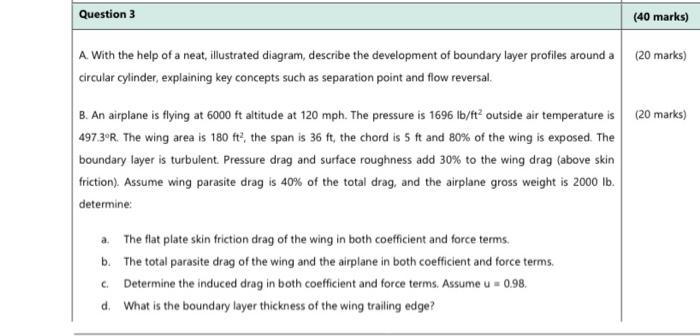
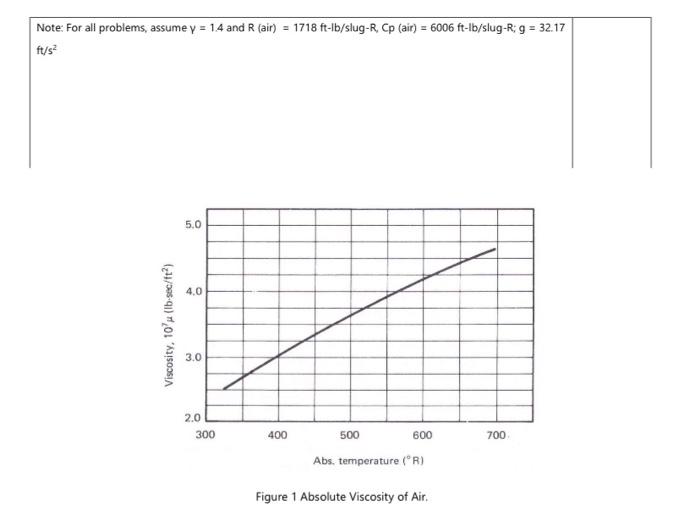
Question 3 (40 marks) A. With the help of a neat, illustrated diagram, describe the development of boundary layer profiles around a (20 marks) circular cylinder, explaining key concepts such as separation point and flow reversal. B. An airplane is flying at 6000ft altitude at 120mph. The pressure is 1696lb/ft2 outside air temperature is (20 marks) 497.3 R. The wing area is 180ft2, the span is 36ft, the chord is 5ft and 80% of the wing is exposed. The boundary layer is turbulent. Pressure drag and surface roughness add 30% to the wing drag (above skin friction). Assume wing parasite drag is 40% of the total drag, and the airplane gross weight is 2000lb. determine: a. The flat plate skin friction drag of the wing in both coefficient and force terms. b. The total parasite drag of the wing and the airplane in both coefficient and force terms. c. Determine the induced drag in both coefficient and force terms. Assume u=0.98. d. What is the boundary layer thickness of the wing trailing edge? Note: For all problems, assume y=1.4 and R (air) =1718ftlb/ slug R,Cp (air) =6006ftlb/slugR;g=32.17 ft/s2 Figure 1 Absolute Viscosity of Air. Question 3 (40 marks) A. With the help of a neat, illustrated diagram, describe the development of boundary layer profiles around a (20 marks) circular cylinder, explaining key concepts such as separation point and flow reversal. B. An airplane is flying at 6000ft altitude at 120mph. The pressure is 1696lb/ft2 outside air temperature is (20 marks) 497.3 R. The wing area is 180ft2, the span is 36ft, the chord is 5ft and 80% of the wing is exposed. The boundary layer is turbulent. Pressure drag and surface roughness add 30% to the wing drag (above skin friction). Assume wing parasite drag is 40% of the total drag, and the airplane gross weight is 2000lb. determine: a. The flat plate skin friction drag of the wing in both coefficient and force terms. b. The total parasite drag of the wing and the airplane in both coefficient and force terms. c. Determine the induced drag in both coefficient and force terms. Assume u=0.98. d. What is the boundary layer thickness of the wing trailing edge? Note: For all problems, assume y=1.4 and R (air) =1718ftlb/ slug R,Cp (air) =6006ftlb/slugR;g=32.17 ft/s2 Figure 1 Absolute Viscosity of Air
Step by Step Solution
There are 3 Steps involved in it

Get step-by-step solutions from verified subject matter experts
 Study Help