Question: I just need the multiple choice answer for these 5 questions! no explanations needed :) QUESTIONS Business marketers analyzing the level of logistical service requirements

I just need the multiple choice answer for these 5 questions! no explanations needed :) I just need the multiple choice answer for these
I just need the multiple choice answer for these
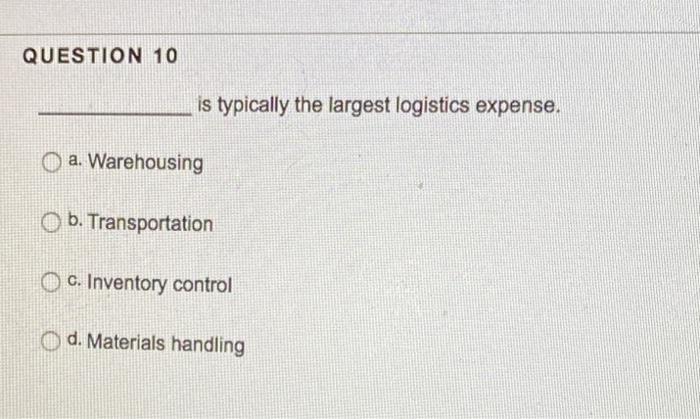
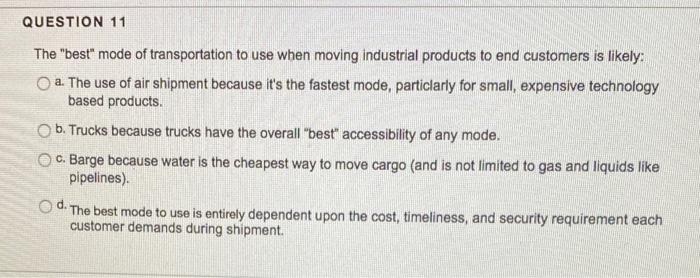
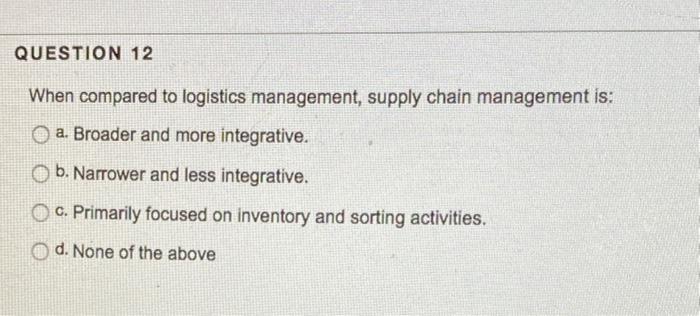
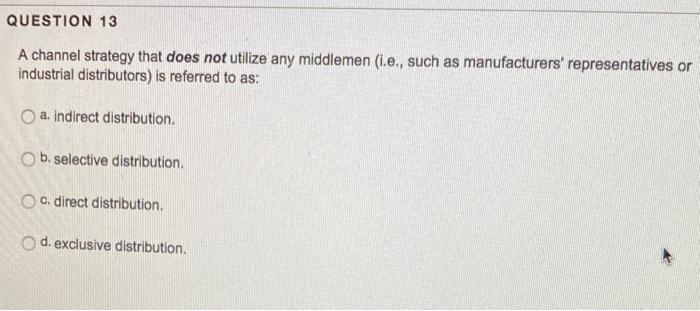
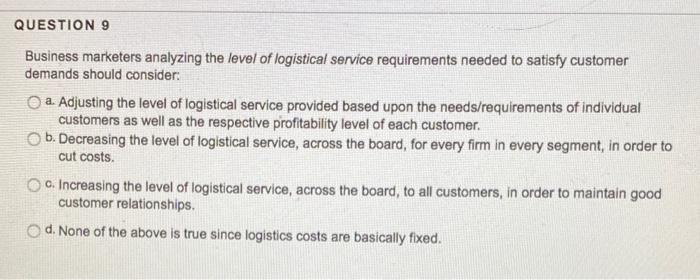
QUESTIONS Business marketers analyzing the level of logistical service requirements needed to satisfy customer demands should consider: a. Adjusting the level of logistical service provided based upon the needs/requirements of individual customers as well as the respective profitability level of each customer. b. Decreasing the level of logistical service, across the board, for every firm in every segment, in order to cut costs. o. Increasing the level of logistical service, across the board, to all customers, in order to maintain good customer relationships, d. None of the above is true since logistics costs are basically fixed. QUESTION 10 is typically the largest logistics expense. a. Warehousing b. Transportation c. Inventory control d. Materials handling QUESTION 11 The "best" mode of transportation to use when moving industrial products to end customers is likely: a. The use of air shipment because it's the fastest mode, particlarly for small, expensive technology based products. b. Trucks because trucks have the overall "best" accessibility of any mode. C. Barge because water is the cheapest way to move cargo (and is not limited to gas and liquids like pipelines). d. The best mode to use is entirely dependent upon the cost, timeliness, and security requirement each customer demands during shipment. QUESTION 12 When compared to logistics management, supply chain management is: a. Broader and more integrative. b. Narrower and less integrative. c. Primarily focused on inventory and sorting activities. d. None of the above QUESTION 13 A channel strategy that does not utilize any middlemen (i.e., such as manufacturers' representatives or industrial distributors) is referred to as: a. indirect distribution. b. selective distribution. o direct distribution d. exclusive distribution

Step by Step Solution

There are 3 Steps involved in it

1 Expert Approved Answer
Step: 1 Unlock blur-text-image

Question Has Been Solved by an Expert!

Get step-by-step solutions from verified subject matter experts

Step: 2 Unlock
Step: 3 Unlock

Students Have Also Explored These Related General Management Questions!