Question: I just want the answer for question one case 14.2 Dell Direct and Not-So-Direct winess in 1984, he he e Michael Dell started his Texas-based
I just want the answer for question one
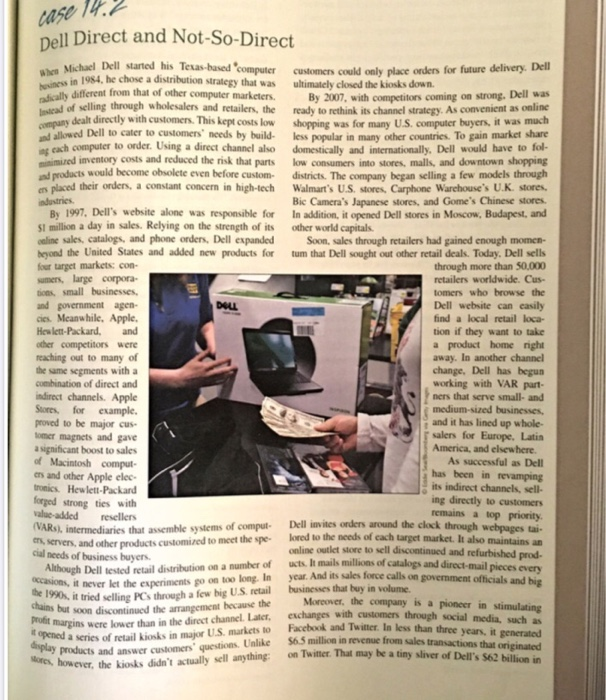
case 14.2 Dell Direct and Not-So-Direct winess in 1984, he he e Michael Dell started his Texas-based computer in 1954, he chose a distribution strategy that was ically different from that of other computer marketers. ad of selling through wholesalers and retailers, the y dealt directly with customers. This kept costs low allowed Dell to cater to customers' needs by build- e cach computer to order. Using a direct channel also mired inventory costs and reduced the risk that parts products would become obsolete even before custom s placed their orders, a constant concern in high-tech dustries. DALL By 1997. Dell's website alone was responsible for 51 million a day in sales. Relying on the strength of its aline sales, catalogs, and phone orders, Dell expanded and the United States and added new products for four target markets: con- sumers, large corpora tions, small businesses, and government agen- cies. Meanwhile, Apple, Hewlett-Packard, and other competitors were reaching out to many of the same segments with a combination of direct and indirect channels. Apple Stores, for example. proved to be major cus Tomer magnets and gave a significant boost to sales of Macintosh comput- crs and other Apple elec tronics. Hewlett-Packard forged strong ties with value-added resellers VARs, intermediaries that assemble systems of comput cs, servers, and other products customized to meet the spe- cial needs of business buyers. Although Dell del distribution on a number of long. In casions, it never let the experiments go on too long. In 19 . it tried selling PCs through a few big U.S. retail cause the chains but soon discontinued the arrangement because Later profit margins were lower than in the direct channel. Later. e a ts to opened a series of retail kiosks in major U.S. mars play products and answer customers' questions. Unlike fes, however, the kiosks didn't actually sell anything customers wuld only place orders for future delivery. De ultimately closed the kiosks down. By 2007, with competitors coming on strong. Dell was ready to rethink its channel strategy. As convenient as online shoppine was for many US computer buyers, it was much less popular in many other countries. To gain market share domestically and internationally. Dell would have to fol- low consumers into stores, malls, and downtown shopping districts. The company began selling a few models through Walmart's US stores, Carphone Warehouse's UK stores. Bic Camera's Japanese stores, and Gome's Chinese stores. In addition, it opened Dell stores in Moscow, Budapest, and other world capitals. Soon, sales through retailers had ained enough momen tum that Dell sought out other retail deals. Today, Dell sells through more than 50,000 retailers worldwide. Cus- tomers who browse the Dell website can casily find a local retail loca- tion if they want to take a product home right away. In another channel change, Dell has begun working with VAR part- ners that serve small- and medium-sized businesses, and it has lined up whole salers for Europe, Latin America, and elsewhere. As successful as Dell has been in revamping its indirect channels, sell- ing directly to customers remains a top priority Dell invites orders around the clock through lored to the needs of cach target market. It also maintains a online outlet store to sell discontinued and refurbished prod. cts. It mails millions of cataloes and din mails millions of catalogs and direct mail pieces every year. And its sales force calls on government officials and big year. And its sales force calls on govem businesses that buy in volume Moreover, the company is a pioneer in stimulating exchanges with customers through social media, such as Facebook and Twitter In less than three years it need $6.5 million in revenue from salestra million in revenue from sales transactions that originated on Twitter. That may be a tiny sliver of on Twitter. That may be a tiny sliver of Dell's 562 billion in 482 P arts Distribution Decisions usive distributors ropriate for Dell mual revenue, but it demonstrates the company's flexibil ity in adapting to shifts in customer behavior and environ- mental forces, such as technological advances. The company also maintains a Social Media Listening Command Center to monitor conversations about the brand and its goods and services. With market share and profit-margin challenges still facing the company, and global demand just picking up steam after a long difficult recession, watch for Dell to make more channel adjustments in the coming years." Questions for Discussion Is Dell using intensive, selective, or exclusive di for its market coverage? Why is this appropriate products and target markets? 2. How does Dell's preference for direct channel decisions about physical distribution? 3. What issues in channel conflict might arise from I current distribution arrangements? direct channels affects