







Question: I know how to do induction but it looks different from what I have seen before! I am not sure clearly what is basis part
I know how to do induction but it looks different from what I have seen before! I am not sure clearly what is basis part or what is inductive hypothesis in this proof. Also what does 'by symmetry' mean? Is it same with 'without loss of generality'? In general I don't follow this proof at all.
Could you please explain to me this proof in easier and detailed way?
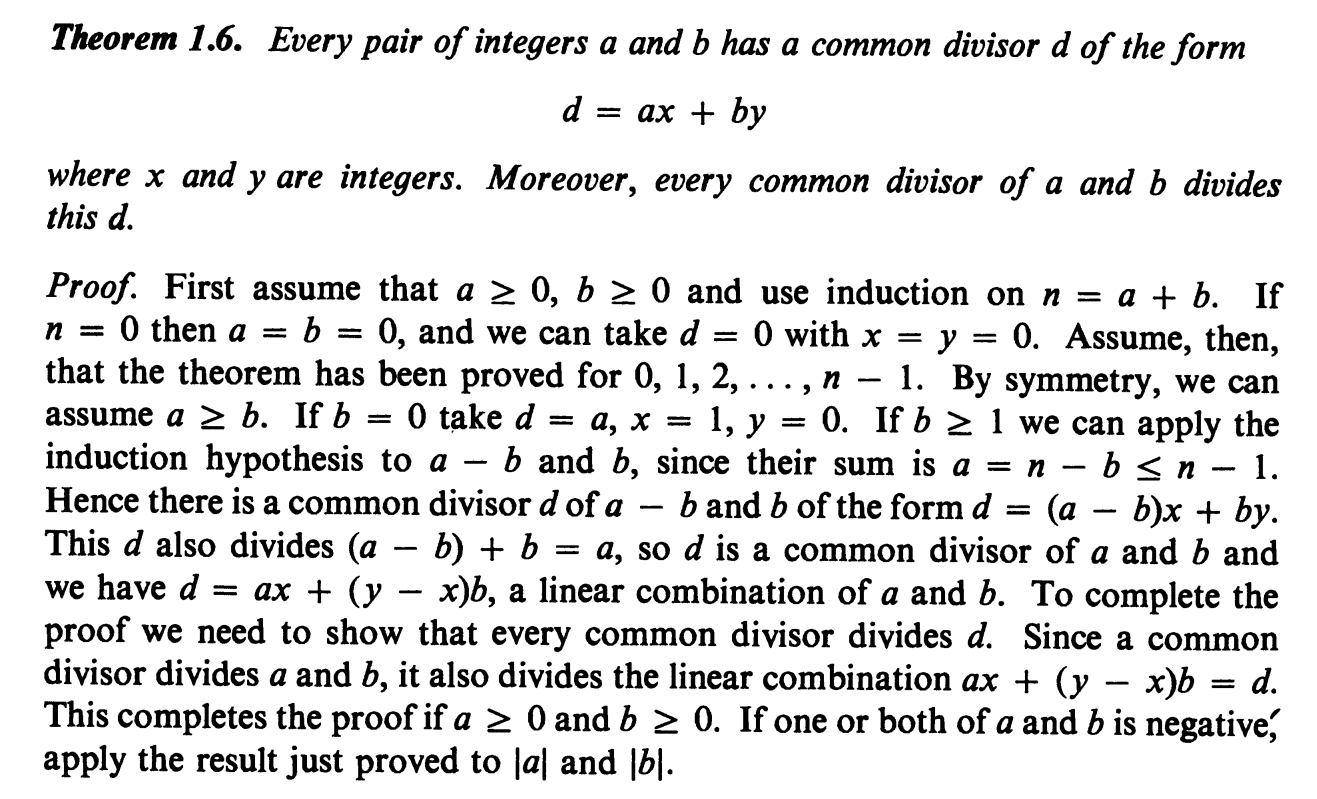
Theorem 1.6. Every pair of integers a and b has a common divisor d of the form d = ax + by where x and y are integers. Moreover, every common divisor of a and b divides this d. Proof. First assume that a 2 0, b 2 0 and use induction on n = a + b. If n = 0 then a = b = 0, and we can take d = 0 with x = y = 0. Assume, then, that the theorem has been proved for 0, 1, 2, ..., n - 1. By symmetry, we can assume a > b. If b = 0 take d = a, x = 1, y = 0. If b 2 1 we can apply the induction hypothesis to a - b and b, since their sum is a = n - b
Step by Step Solution
There are 3 Steps involved in it

Get step-by-step solutions from verified subject matter experts
 Study Help