







Question: I. Matching ( 101 point =10 points ) 1. Ethnocentrism 6. Social stratification 2. Rule of law 7. Polycentrism 3. Masculinity-femininity index 8. Rule of
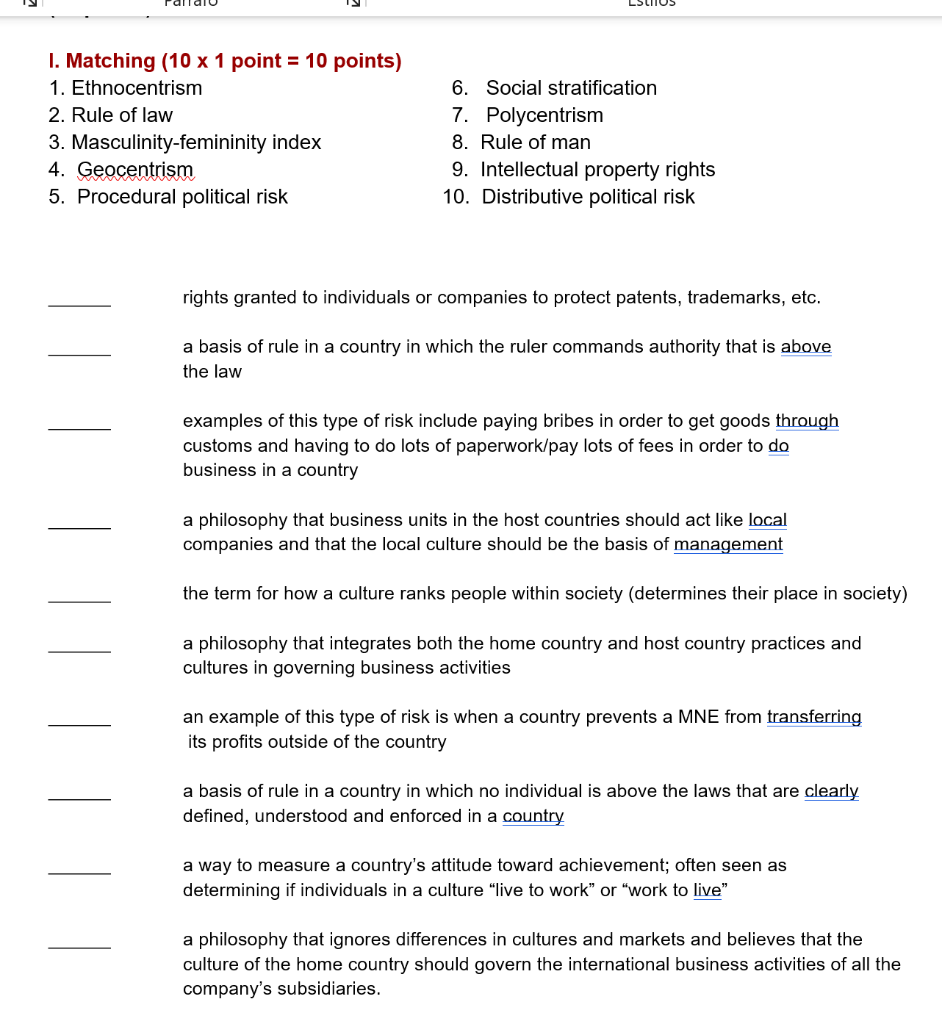
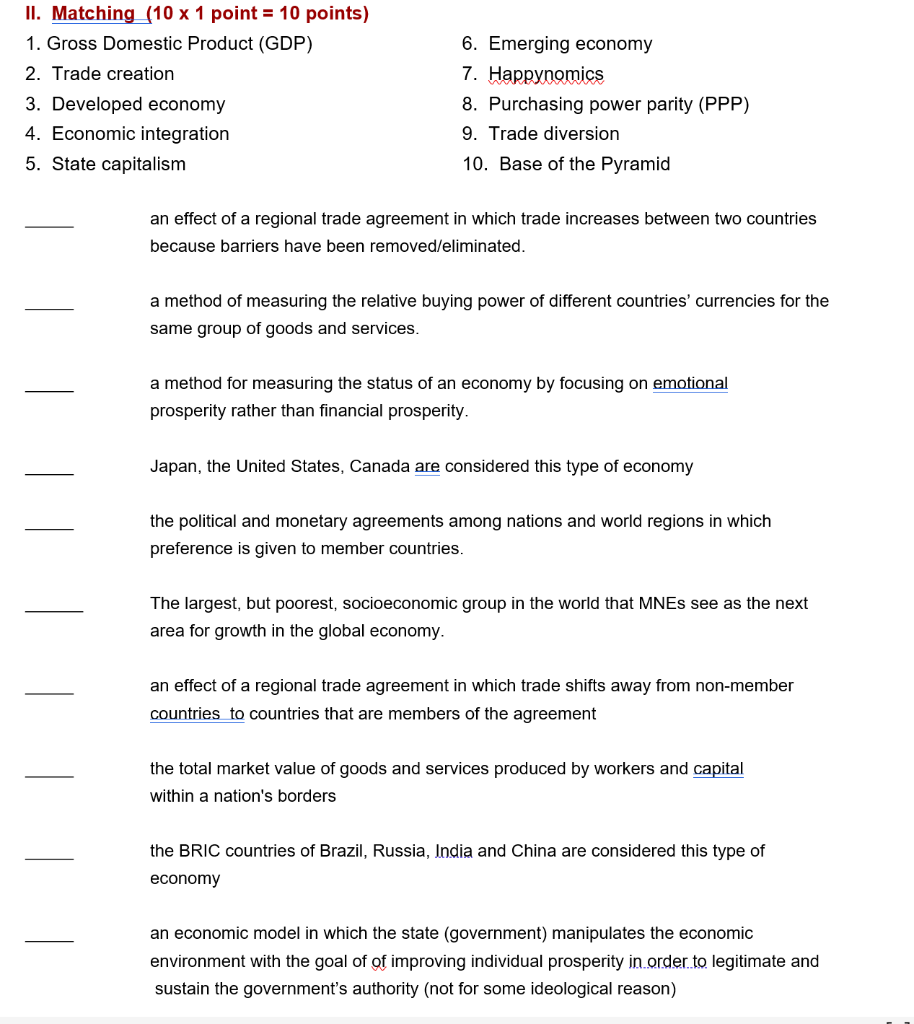
I. Matching ( 101 point =10 points ) 1. Ethnocentrism 6. Social stratification 2. Rule of law 7. Polycentrism 3. Masculinity-femininity index 8. Rule of man 4. Geocentrism 9. Intellectual property rights 5. Procedural political risk 10. Distributive political risk rights granted to individuals or companies to protect patents, trademarks, etc. a basis of rule in a country in which the ruler commands authority that is above the law examples of this type of risk include paying bribes in order to get goods through customs and having to do lots of paperwork/pay lots of fees in order to do business in a country a philosophy that business units in the host countries should act like local companies and that the local culture should be the basis of management the term for how a culture ranks people within society (determines their place in society) a philosophy that integrates both the home country and host country practices and cultures in governing business activities an example of this type of risk is when a country prevents a MNE from transferring its profits outside of the country a basis of rule in a country in which no individual is above the laws that are clearly defined, understood and enforced in a country a way to measure a country's attitude toward achievement; often seen as determining if individuals in a culture "live to work" or "work to live" a philosophy that ignores differences in cultures and markets and believes that the culture of the home country should govern the international business activities of all the company's subsidiaries. II. Matching (101 point =10 points ) 1. Gross Domestic Product (GDP) 6. Emerging economy 2. Trade creation 7. Happynomics 3. Developed economy 8. Purchasing power parity (PPP) 4. Economic integration 9. Trade diversion 5. State capitalism 10. Base of the Pyramid an effect of a regional trade agreement in which trade increases between two countries because barriers have been removed/eliminated. a method of measuring the relative buying power of different countries' currencies for the same group of goods and services. a method for measuring the status of an economy by focusing on emotional prosperity rather than financial prosperity. Japan, the United States, Canada are considered this type of economy the political and monetary agreements among nations and world regions in which preference is given to member countries. The largest, but poorest, socioeconomic group in the world that MNEs see as the next area for growth in the global economy. an effect of a regional trade agreement in which trade shifts away from non-member countries to countries that are members of the agreement the total market value of goods and services produced by workers and capital within a nation's borders the BRIC countries of Brazil, Russia, India and China are considered this type of economy an economic model in which the state (government) manipulates the economic environment with the goal of of improving individual prosperity in order to legitimate and sustain the government's authority (not for some ideological reason)
Step by Step Solution
There are 3 Steps involved in it

Get step-by-step solutions from verified subject matter experts
 Study Help