







Question: I. MODIFIED TRUE OR FALSE. Write TRUE if the statement is always correct. If the statement is false, correct the underlined word / s to
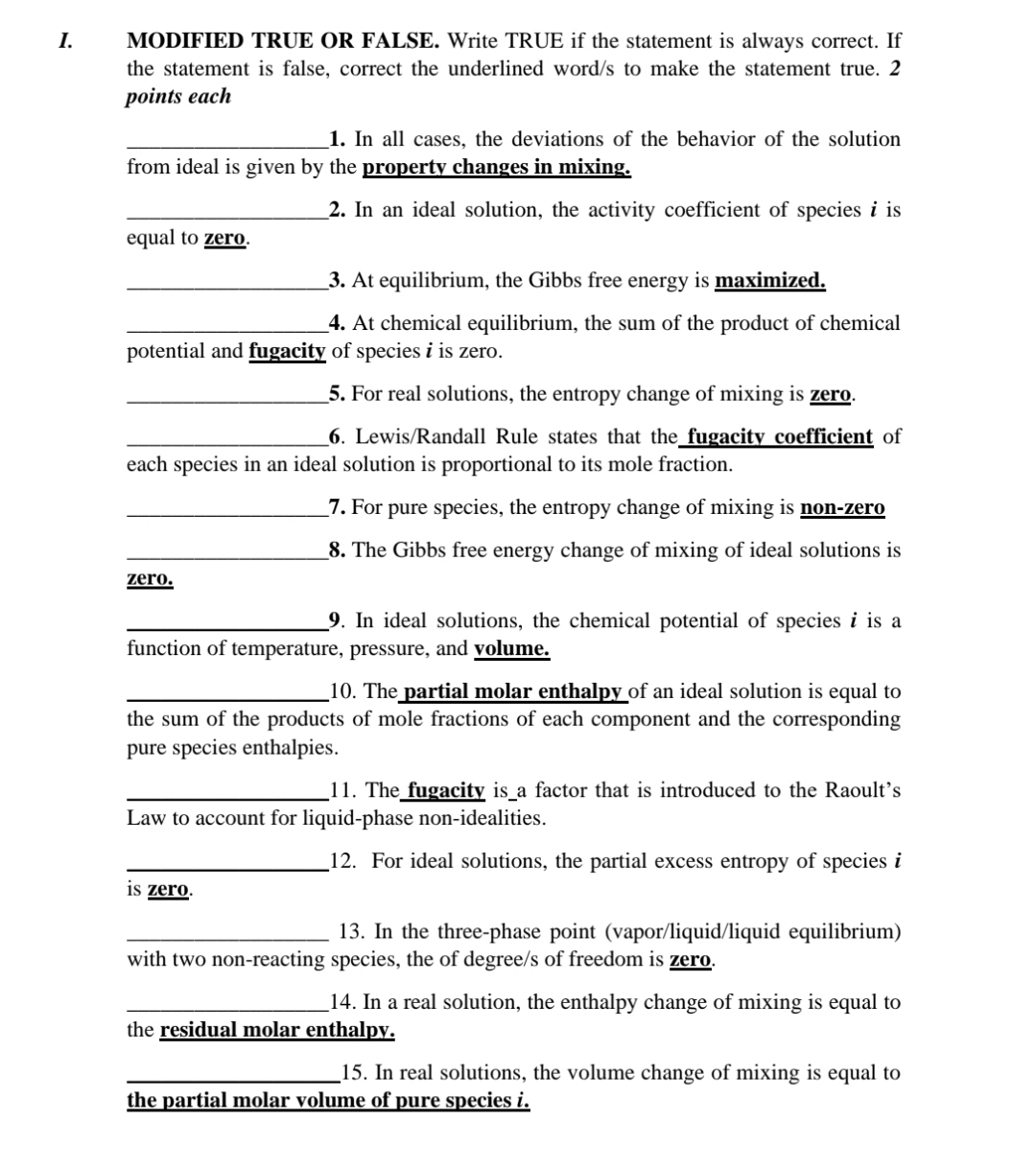
I. MODIFIED TRUE OR FALSE. Write TRUE if the statement is always correct. If the statement is false, correct the underlined words to make the statement true. points each
I. In all cases, the deviations of the behavior of the solution from ideal is given by the property changes in mixing.
In an ideal solution, the activity coefficient of species is equal to zero.
At equilibrium, the Gibbs free energy is maximized.
At chemical equilibrium, the sum of the product of chemical potential and fugacity of species is zero.
For real solutions, the entropy change of mixing is zero.
LewisRandall Rule states that the fugacity coefficient of each species in an ideal solution is proportional to its mole fraction.
For pure species, the entropy change of mixing is nonzero
The Gibbs free energy change of mixing of ideal solutions is
zero.
In ideal solutions, the chemical potential of species is a function of temperature, pressure, and volume.
The partial molar enthalpy of an ideal solution is equal to the sum of the products of mole fractions of each component and the corresponding pure species enthalpies.
The fugacity isa factor that is introduced to the Raoult's Law to account for liquidphase nonidealities.
For ideal solutions, the partial excess entropy of species is zero.
In the threephase point vaporliquidliquid equilibrium with two nonreacting species, the of degrees of freedom is zero.
In a real solution, the enthalpy change of mixing is equal to the residual molar enthalpy.
In real solutions, the volume change of mixing is equal to the partial molar volume of pure species
Step by Step Solution
There are 3 Steps involved in it
1 Expert Approved Answer
Step: 1 Unlock

Question Has Been Solved by an Expert!
Get step-by-step solutions from verified subject matter experts
Step: 2 Unlock
Step: 3 Unlock
 Study Help