







Question: I Multiple choice question: (20 points, 2 points each) 1. Double taxation refers to: A) all partners paying equal taxes on profits. B) corporations paying
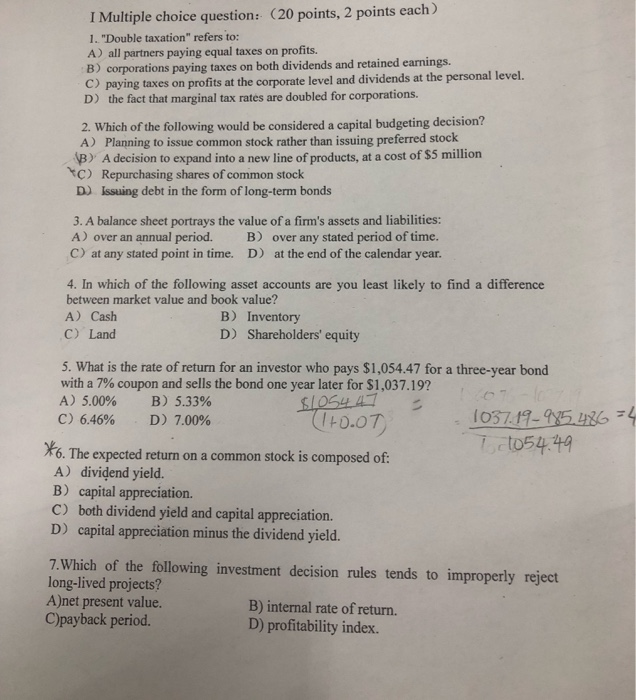
I Multiple choice question: (20 points, 2 points each) 1. "Double taxation" refers to: A) all partners paying equal taxes on profits. B) corporations paying taxes on both dividends and retained earnings. C) paying taxes on profits at the corporate level and dividends at the personal level. D) the fact that marginal tax rates are doubled for corporations. 2. Which of the following would be considered a capital budgeting decision? A) Planning to issue common stock rather than issuing preferred stock B) A decision to expand into a new line of products, at a cost of $5 million C) Repurchasing shares of common stock D) Issuing debt in the form of long-term bonds 3. A balance sheet portrays the value of a firm's assets and liabilities: A) over an annual period. C) at any stated point in time. D) at the end of the calendar year. B) over any stated period of time. 4. In which of the following asset accounts are you least likely to find a difference between market value and book value? B) Inventory D) Shareholders' equity A) Cash C) Land 5. What is the rate of return for an investor who pays $1,054.47 for a three-year bond with a 7% coupon and sells the bond one year later for $1,037.19? A) 5.00% C) 6.46% $1054 47 T+0.0T) B) 5.33% 1037.19-995.486 =4 Tet054.49 D) 7.00% X6. The expected return on a common stock is composed of: A) dividend yield. B) capital appreciation. C) both dividend yield and capital appreciation. D) capital appreciation minus the dividend yield. 7.Which of the following investment decision rules tends to improperly reject long-lived projects? A)net present value. C)payback period. B) internal rate of return. D) profitability index
Step by Step Solution
There are 3 Steps involved in it

Get step-by-step solutions from verified subject matter experts
 Study Help