







Question: I need 6 & 7, 5 and the code to generate m(t) included for reference. 5) Repeat 3) and 4) for the AM signal u(t)
I need 6 & 7, 5 and the code to generate m(t) included for reference.
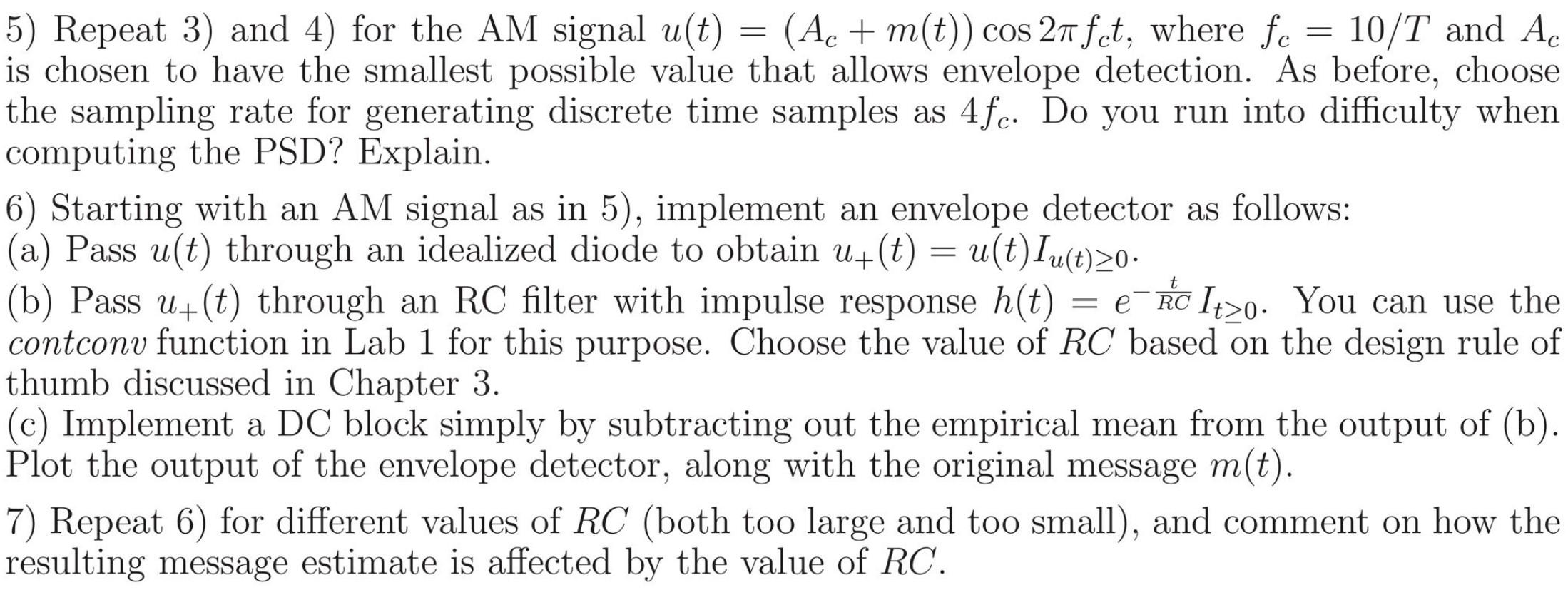
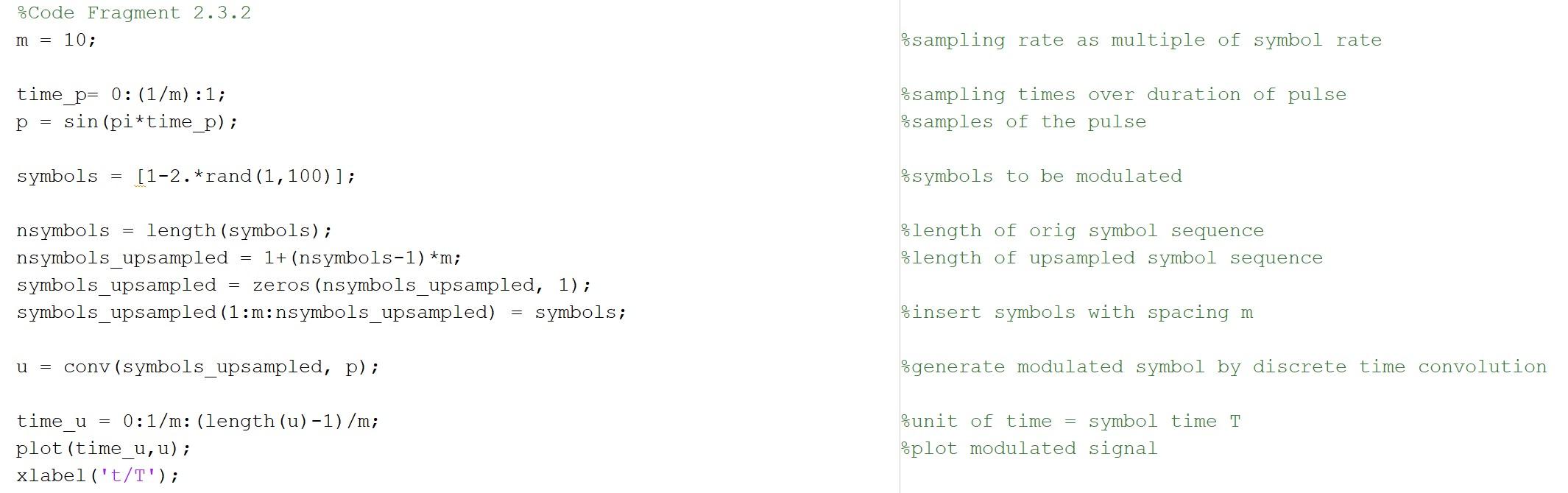
5) Repeat 3) and 4) for the AM signal u(t) = (Ac + m(t)) cos 27 fct, where fc = 10/T and Ac is chosen to have the smallest possible value that allows envelope detection. As before, choose the sampling rate for generating discrete time samples as 4fc. Do you run into difficulty when computing the PSD? Explain. 6) Starting with an AM signal as in 5), implement an envelope detector as follows: (a) Pass u(t) through an idealized diode to obtain u+(t) = u(t)Iu(t)>0. (b) Pass u+(t) through an RC filter with impulse response h(t) = e RC 1120. You can use the contconv function in Lab 1 for this purpose. Choose the value of RC based on the design rule of thumb discussed in Chapter 3. (c) Implement a DC block simply by subtracting out the empirical mean from the output of (b). Plot the output of the envelope detector, along with the original message m(t). 7) Repeat 6) for different values of RC (both too large and too small), and comment on how the resulting message estimate is affected by the value of RC. Code Fragment 2.3.2 m = 10; sampling rate as multiple of symbol rate time p= 0: (1/m):1; p = sin(pi*time_p); sampling times over duration of pulse samples of the pulse symbols [1-2.*rand (1,100)]; %symbols to be modulated %length of orig symbol sequence %length of upsampled symbol sequence - nsymbols length (symbols); nsymbols_upsampled 1+ (nsymbols-1) *m; symbols_upsampled zeros (nsymbols_upsampled, 1); symbols_upsampled (1:m:nsymbols_upsampled) symbols; = %insert symbols with spacing m u = conv (symbols_upsampled, p); egenerate modulated symbol by discrete time convolution time u 0:1/m:(length (u)-1)/m; plot (time_u, u); xlabel('t/T'); %unit of time = symbol time T plot modulated signal 5) Repeat 3) and 4) for the AM signal u(t) = (Ac + m(t)) cos 27 fct, where fc = 10/T and Ac is chosen to have the smallest possible value that allows envelope detection. As before, choose the sampling rate for generating discrete time samples as 4fc. Do you run into difficulty when computing the PSD? Explain. 6) Starting with an AM signal as in 5), implement an envelope detector as follows: (a) Pass u(t) through an idealized diode to obtain u+(t) = u(t)Iu(t)>0. (b) Pass u+(t) through an RC filter with impulse response h(t) = e RC 1120. You can use the contconv function in Lab 1 for this purpose. Choose the value of RC based on the design rule of thumb discussed in Chapter 3. (c) Implement a DC block simply by subtracting out the empirical mean from the output of (b). Plot the output of the envelope detector, along with the original message m(t). 7) Repeat 6) for different values of RC (both too large and too small), and comment on how the resulting message estimate is affected by the value of RC. Code Fragment 2.3.2 m = 10; sampling rate as multiple of symbol rate time p= 0: (1/m):1; p = sin(pi*time_p); sampling times over duration of pulse samples of the pulse symbols [1-2.*rand (1,100)]; %symbols to be modulated %length of orig symbol sequence %length of upsampled symbol sequence - nsymbols length (symbols); nsymbols_upsampled 1+ (nsymbols-1) *m; symbols_upsampled zeros (nsymbols_upsampled, 1); symbols_upsampled (1:m:nsymbols_upsampled) symbols; = %insert symbols with spacing m u = conv (symbols_upsampled, p); egenerate modulated symbol by discrete time convolution time u 0:1/m:(length (u)-1)/m; plot (time_u, u); xlabel('t/T'); %unit of time = symbol time T plot modulated signal
Step by Step Solution
There are 3 Steps involved in it

Get step-by-step solutions from verified subject matter experts
 Study Help