







Question: I need a detailed solution please CASE CHAPTER 3: DEVELOPING THE MANAGEMENT PROBLEM THE INTER MAGNUS GROUP INTRODUCTION MAGNUS is an international retaller offering a
I need a detailed solution please 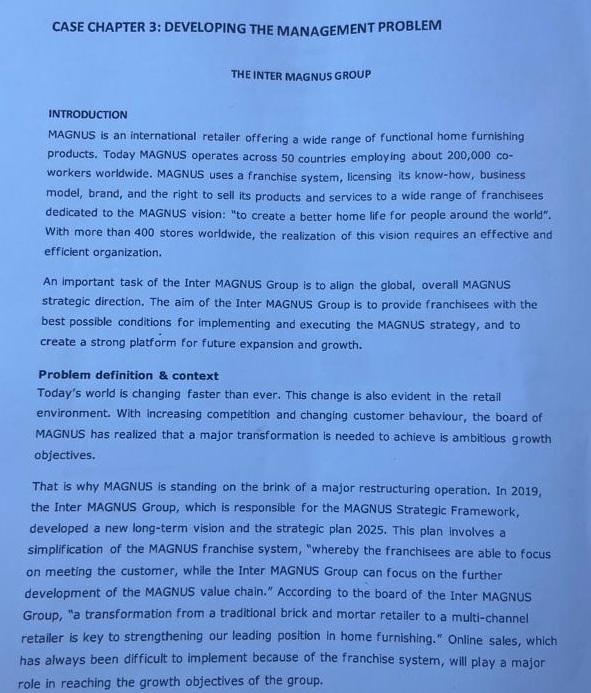
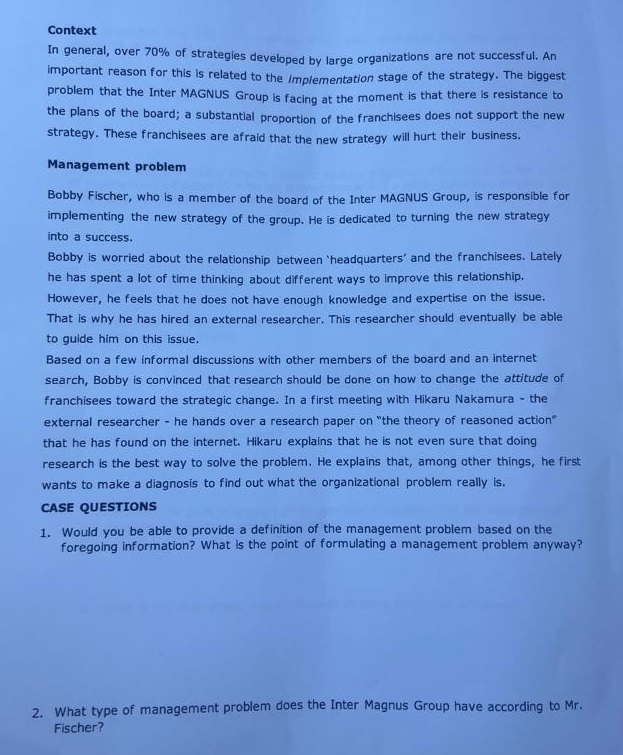
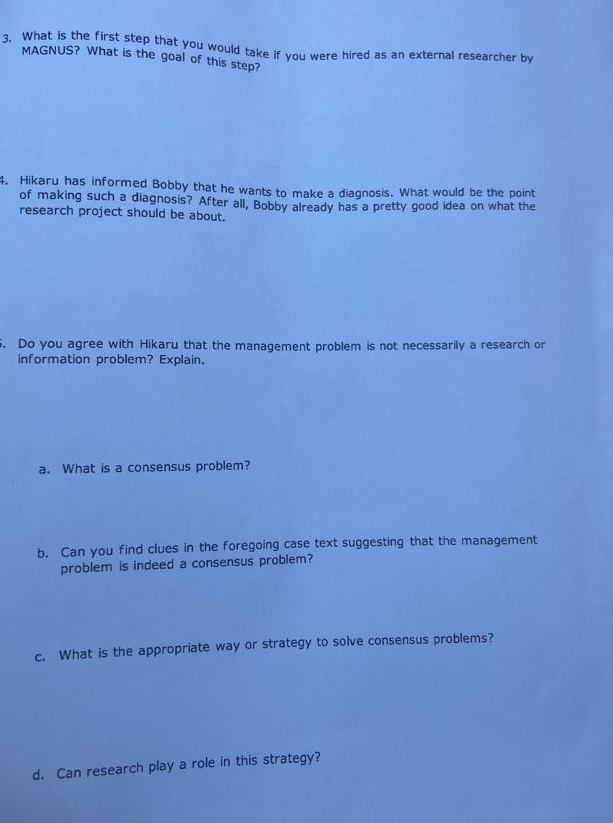
CASE CHAPTER 3: DEVELOPING THE MANAGEMENT PROBLEM THE INTER MAGNUS GROUP INTRODUCTION MAGNUS is an international retaller offering a wide range of functional home furnishing products. Today MAGNUS operates across 50 countries employing about 200,000 coworkers worldwide. MAGNUS uses a franchise system, licensing its know-how, business model, brand, and the right to sell its products and services to a wide range of franchisees dedicated to the MAGNUS vision: "to create a better home life for people around the world". With more than 400 stores worldwide, the realization of this vision requires an effective and efficient organization. An important task of the Inter MAGNUS Group is to align the global, overall MAGNUS strategic direction. The aim of the Inter MAGNUS Group is to provide franchisees with the best possible conditions for implementing and executing the MAGNUS strategy, and to create a strong platform for future expansion and growth. Problem definition & context Today's world is changing faster than ever. This change is also evident in the retail environment. With increasing competition and changing customer behavlour, the board of MAGNUS has realized that a major transformation is needed to achieve is ambitious growth objectives. That is why MAGNUS is standing on the brink of a major restructuring operation. In 2019, the Inter MAGNUS Group, which is responsible for the MAGNUS Strategic Framework, developed a new long-term vision and the strategic plan 2025. This plan involves a simplification of the MAGNUS franchise system, "whereby the franchisees are able to focus on meeting the customer, while the Inter MAGNUS Group can focus on the further development of the MAGNUS value chain." According to the board of the Inter MAGNUS Group, "a transformation from a traditional brick and mortar retailer to a multi-channel retailer is key to strengthening our leading position in home furnishing." Online sales, which has always been difficult to implement because of the franchise system, will play a major role in reaching the growth objectives of the group. In general, over 70% of strategies developed by large organizations are not successful. An important reason for this is related to the implementation stage of the strategy. The biggest problem that the Inter MAGNUS Group is facing at the moment is that there is resistance to the plans of the board; a substantial proportion of the franchisees does not support the new strategy. These franchisees are afraid that the new strategy will hurt their business. Management problem Bobby Fischer, who is a member of the board of the Inter MAGNUS Group, is responsible for implementing the new strategy of the group. He is dedicated to turning the new strategy into a success. Bobby is worried about the relationship between 'headquarters' and the franchisees. Lately he has spent a lot of time thinking about different ways to improve this relationship. However, he feels that he does not have enough knowledge and expertise on the issue. That is why he has hired an external researcher. This researcher should eventually be able to guide him on this issue. Based on a few informal discussions with other members of the board and an internet search, Bobby is convinced that research should be done on how to change the attitude of franchisees toward the strategic change. In a first meeting with Hikaru Nakamura - the external researcher - he hands over a research paper on "the theory of reasoned action" that he has found on the internet. Hikaru explains that he is not even sure that doing research is the best way to solve the problem. He explains that, among other things, he first wants to make a diagnosis to find out what the organizational problem really is. CASE QUESTIONS 1. Would you be able to provide a definition of the management problem based on the foregoing information? What is the point of formulating a management problem anyway? 2. What type of management problem does the Inter Magnus Group have according to Mr. Fischer? 3. What is the first step that you would take if you were hired as an external researcher by MAGNUS? What is the goal of this step? 4. Hikaru has informed Bobby that he wants to make a diagnosis. What would be the point of making such a diagnosis? After all, Bobby already has a pretty good idea on what the research project should be about. Do you agree with Hikaru that the management problem is not necessarily a research or information problem? Explain. a. What is a consensus problem? b. Can you find clues in the foregoing case text suggesting that the management problem is indeed a consensus problem? c. What is the appropriate way or strategy to solve consensus problems? d. Can research play a role in this strategy
Step by Step Solution
There are 3 Steps involved in it

Get step-by-step solutions from verified subject matter experts
 Study Help