







Question: i need a matlab code built for the Lattice Boltzmann method. Here is a summary for the algorithm. here is some more information as well
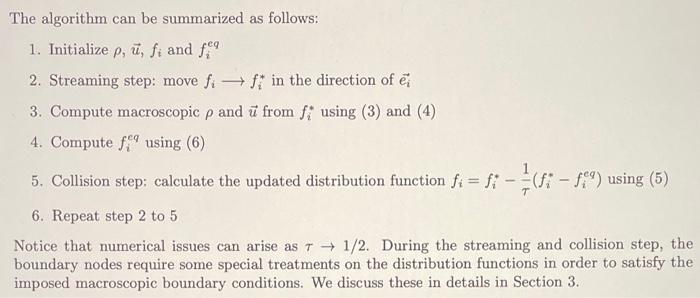
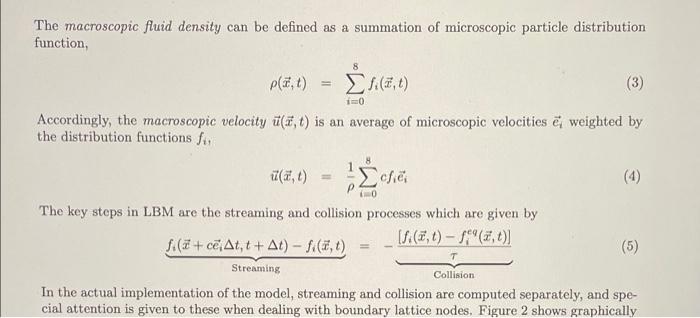
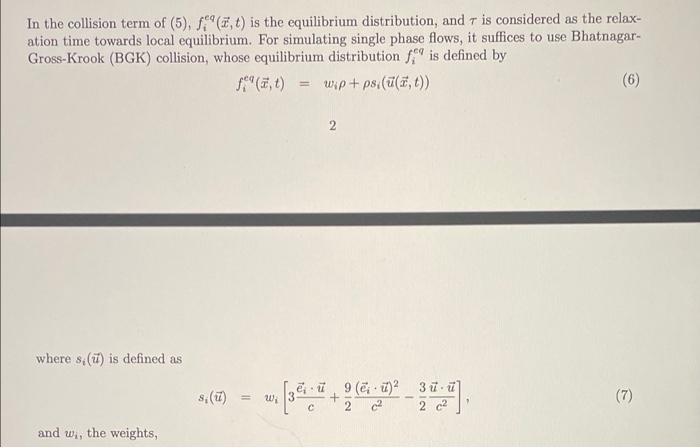
The algorithm can be summarized as follows: 1. Initialize p, , fi and fem 2. Streaming step: move fi fit in the direction of e 3. Compute macroscopic p and from f using (3) and (4) 4. Compute f using (6) 5. Collision step: calculate the updated distribution function fi= f : - (-: $9) using (5) T 6. Repeat step 2 to 5 Notice that numerical issues can arise as 7 + 1/2. During the streaming and collision step, the boundary nodes require some special treatments on the distribution functions in order to satisfy the imposed macroscopic boundary conditions. We discuss these in details in Section 3. The macroscopic fluid density can be defined as a summation of microscopic particle distribution function, pat) . (7, 1) (3) 100 Accordingly, the macroscopic velocity (,t) is an average of microscopic velocities weighted by the distribution functions for t(, t) + Cofiel 0 5 The key steps in LBM are the streaming and collision processes which are given by f. (+ce At, t + At) - 1,1) (S. 1) - " (5,0)] (5) Streaming Collision In the actual implementation of the model, streaming and collision are computed separately, and spe- cial attention is given to these when dealing with boundary lattice nodes, Figure 2 shows graphically In the collision term of (5), SCG, t) is the equilibrium distribution, and is considered as the relax- ation time towards local equilibrium. For simulating single phase flows, it suffices to use Bhatnagar- Gross-Krook (BGK) collision, whose equilibrium distribution is defined by (@t) wip+ps (li,t)) (6) 2 where s(u) is defined as w 9 ( @u)2 3 + 2 c2 2 c2 (7) and w, the weights
Step by Step Solution
There are 3 Steps involved in it

Get step-by-step solutions from verified subject matter experts
 Study Help