



Question: I need a memo and all numbers on the spreadsheet. I can find the same question but this spreadsheet is slightly different. Chapter 5 CASE
I need a memo and all numbers on the spreadsheet. I can find the same question but this spreadsheet is slightly different.
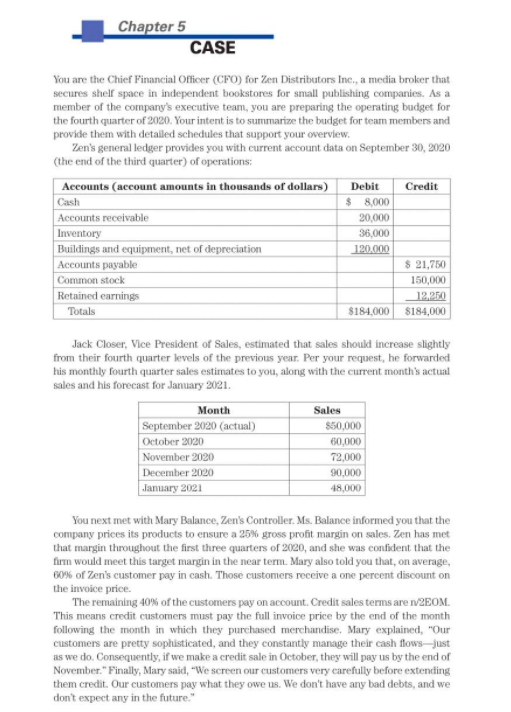
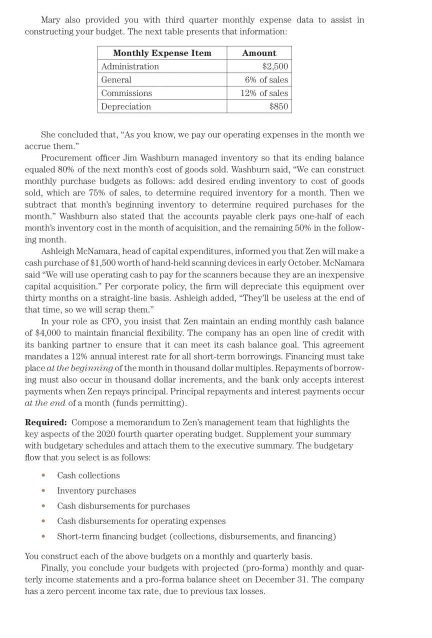
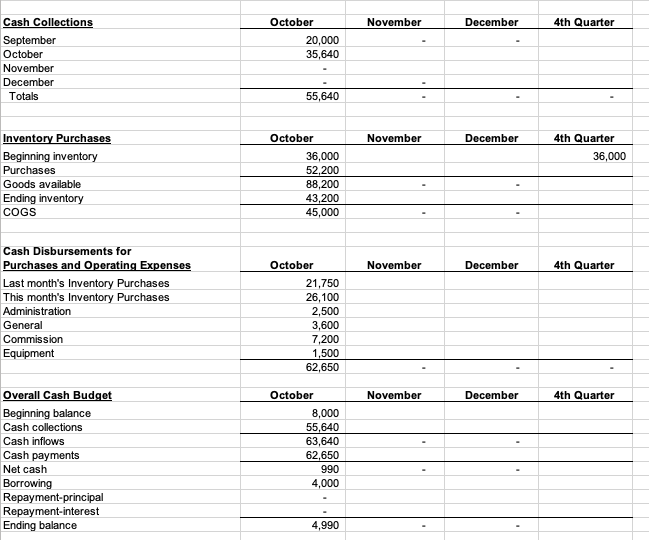
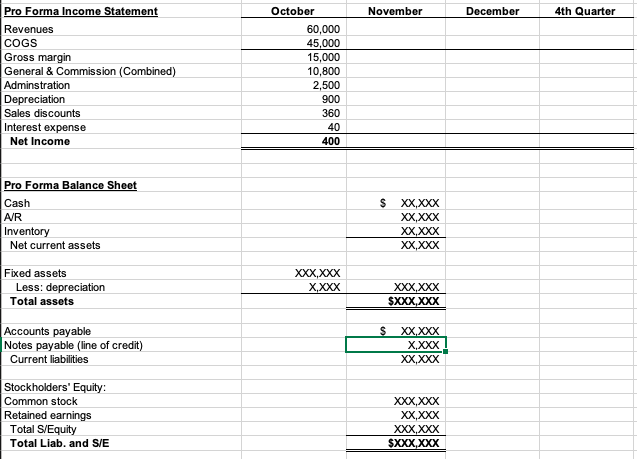
Chapter 5 CASE You are the Chief Financial Officer (CFO) for Zen Distributors Inc., a media broker that secures shelf space in independent bookstores for small publishing companies. As a member of the company's executive team, you are preparing the operating budget for the fourth quarter of 2020. Your intent is to summarize the budget for team members and provide them with detailed schedules that support your overview. Zen's general ledger provides you with current account data on September 30, 2020 (the end of the third quarter) of operations: Accounts (account amounts in thousands of dollars) Debit Credit $ 8.000 Accounts receivable 20.000 Inventory 36.000 Buildings and equipment, net of depreciation 120.000 Accounts payable $ 21,750 Common stock 150,000 Retained earnings 12/250 Totals $184,000 $184,000 Jack Closer, Vice President of Sales, estimated that sales should increase slightly from their fourth quarter levels of the previous year. Per your request, he forwarded his monthly fourth quarter sales estimates to you, along with the current month's actual sales and his forecast for January 2021. Month Sales September 2020 (actual) $50,000 October 2020 60,000 November 2020 72,000 December 2020 90.000 January 2021 48.000 You next met with Mary Balance, Zen's Controller. Ms. Balance informed you that the company prices its products to ensure a 25% gross profit margin on sales. Zen has met that margin throughout the first three quarters of 2020, and she was confident that the firm would meet this target margin in the near term. Mary also told you that, on average, 60% of Zen's customer pay in cash. Those customers receive a one percent discount on the invoice price The remaining 40% of the customers pay on account. Credit sales terms are 1/2EOM. This means credit customers must pay the full invoice price by the end of the month following the month in which they purchased merchandise. Mary explained, "Our customers are pretty sophisticated, and they constantly manage their cash flows-just as we do. Consequently, if we make a credit sale in October, they will pay us by the end of November." Finally, Mary said, "We screen our customers very carefully before extending them credit. Our customers pay what they owe us. We don't have any bad debts, and we don't expect any in the future." Mary also provided you with third quarter monthly expense data to assist in constructing your budget. The next table presents that information: Monthly Expense Item Administration General Commissions Depreciation Amount $2.500 6% of sales 12% of sales $950 She concluded that, "As you know, we pay our operating expenses in the month we accrue them." Procurement officer Jim Washburn managed inventory so that its ending balance equaled 80% of the next month's cost of goods sold. Washburn said, "We can construct monthly purchase budgets as follows: add desired ending inventory to cost of goods sold, which are 78% of sales, to determine required inventory for a month. Then we subtract that month's beginning inventory to determine required purchases for the month." Washburn also stated that the accounts payable clerk pays one-half of each month's inventory cost in the month of acquisition, and the remaining 60% in the follow- ing month Ashleigh McNamara, head of capital expenditures, informed you that Zen will make a cash purchase of $1,500 worth of hand-hell scanning devices in early October. McNamara said "We will use operating cash to pay for the scanners because they are an inexpensive capital acquisition" Per corporate policy, the firm will depreciate this equipment over thirty months on a straight-line basis. Ashleigh added, "They'll be useless at the end of that time, so we will scrap them." In your role as CFO, you insist that Zen maintain an ending monthly cash balance of $4,000 to maintain financial flexibility. The company has an open line of credit with its banking partner to ensure that it can meet its cash balance goal. This agreement mandates a 12% annual interest rate for all short-term borrowings Financing must take place at the beginning of the month in thousand dollar multiples. Repayments of borrow ing must also occur in thousand dollar increments, and the bank only accepts interest payments when Zen repays principal. Principal repayments and interest payments occur at the end of a month (unds permitting) Required: Compose a memorandum to Zen's management team that highlights the key aspects of the 2020 fourth quarter operating budget. Supplement your summary with budgetary schedules and attach them to the executive summary. The budgetary flow that you select is as follows: Cash collections Inventory purchases Cash disbursements for purchases Cash disbursements for operating expenses Short-term financing budget (collections, disbursements, and financing) You construct each of the above budgets on a monthly and quarterly basis. Finally, you conclude your budgets with projected (pro-forma) monthly and quar- terly income statements and a pro-forma balance sheet on December 31. The company has a zero percent income tax rate, due to previous tax losses. November December 4th Quarter Cash Collections September October November December Totals October 20,000 35,640 55,640 November December 4th Quarter 36,000 Inventory Purchases Beginning inventory Purchases Goods available Ending inventory COGS October 36,000 52,200 88,200 43,200 45,000 November December 4th Quarter Cash Disbursements for Purchases and Operating Expenses Last month's Inventory Purchases This month's Inventory Purchases Administration General Commission Equipment October 21,750 26,100 2,500 3,600 7,200 1,500 62,650 November December 4th Quarter Overall Cash Budget Beginning balance Cash collections Cash inflows Cash payments Net cash Borrowing Repayment-principal Repayment-interest Ending balance October 8,000 55,640 63,640 62,650 990 4,000 4,990 November December 4th Quarter Pro Forma Income Statement Revenues COGS Gross margin General & Commission (Combined) Adminstration Depreciation Sales discounts Interest expense Net Income October 60,000 45,000 15,000 10,800 2,500 900 360 40 400 Pro Forma Balance Sheet Cash AVR Inventory Net current assets $ XX,XXX XX, XXX XX,XXX XX, XXX XXX, XXX X.XXX XXX,XXX $XXX XXX Fixed assets Less: depreciation Total assets Accounts payable Notes payable (line of credit) Current liabilities Stockholders' Equity: Common stock Retained earnings Total S/Equity Total Liab. and S/E $ XX.XXX X.XXX XX, XXX XXX,XXX XX,XXX XXX,XXX $XXX XXX
Step by Step Solution
There are 3 Steps involved in it

Get step-by-step solutions from verified subject matter experts