







Question: I NEED A NEW ANSWER! DO NOT COPY FROM OTHER CHEGG POST! WILL GIVE DOWN VOTE IF COPIED AND PASTE FROM OTHER CHEGG POST OR
I NEED A NEW ANSWER! DO NOT COPY FROM OTHER CHEGG POST!
WILL GIVE DOWN VOTE IF COPIED AND PASTE FROM OTHER CHEGG POST OR SITE!
READ THE ARTICLE "Truth in menus: Managing hospitality risk" FIRST BEFORE ANSWERING THE QUESTION:
QUESTION: why the accuracy of information on menus is critical to providing a duty of care to restaurant customers?
ARTICLE:
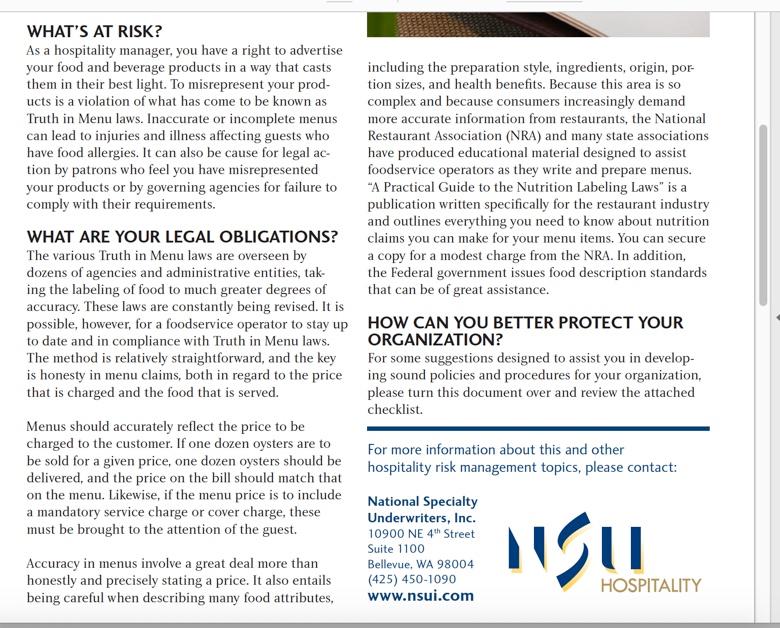
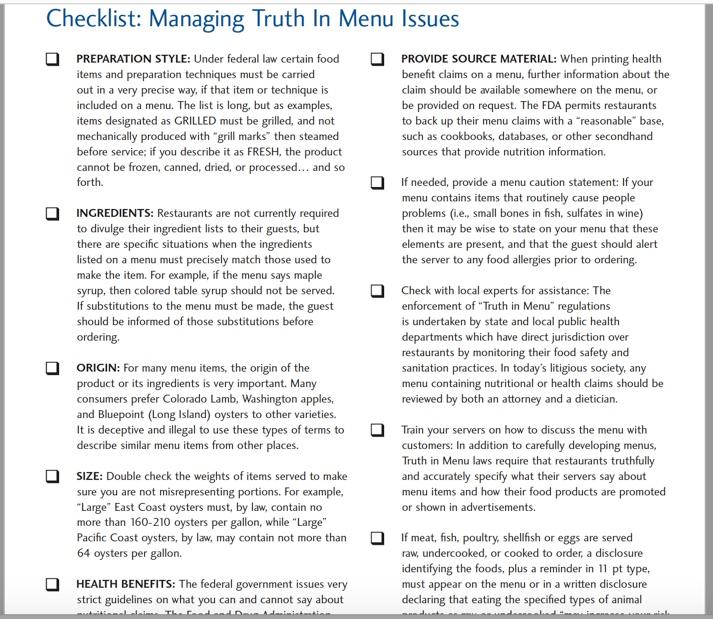
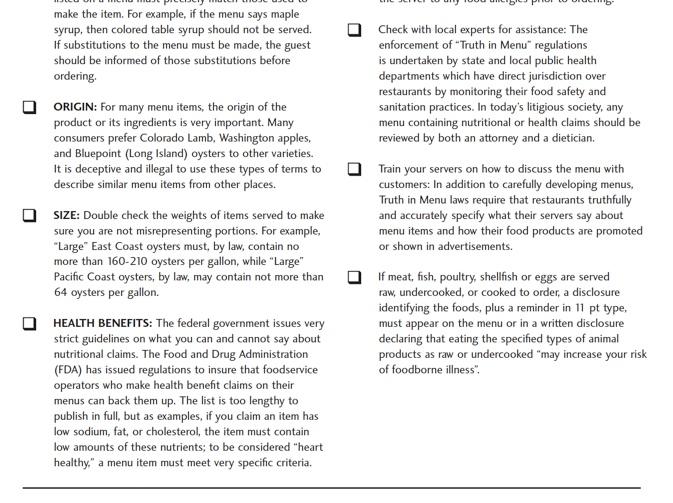
WHAT'S AT RISK? As a hospitality manager, you have a right to advertise your food and beverage products in a way that casts including the preparation style, ingredients, origin, porthem in their best light. To misrepresent your prod- tion sizes, and health benefits. Because this area is so ucts is a violation of what has come to be known as complex and because consumers increasingly demand Truth in Menu laws. Inaccurate or incomplete menus more accurate information from restaurants, the National can lead to injuries and illness affecting guests who Restaurant Association (NRA) and many state associations have food allergies. It can also be cause for legal ac- have produced educational material designed to assist tion by patrons who feel you have misrepresented foodservice operators as they write and prepare menus. your products or by governing agencies for failure to "A Practical Guide to the Nutrition Labeling Laws" is a comply with their requirements. publication written specifically for the restaurant industry WHAT ARE YOUR LEGAL OBLIGATIONS? andoutlineseverythingyouneedtoknowaboutnutritionclaimsyoucanmakeforyourmenuitems.Youcansecure The various Truth in Menu laws are overseen by a copy for a modest charge from the NRA. In addition, dozens of agencies and administrative entities, tak- the Federal government issues food description standards ing the labeling of food to much greater degrees of that can be of great assistance. accuracy. These laws are constantly being revised. It is possible, however, for a foodservice operator to stay up HOW CAN YOU BETTER PROTECT YOUR to date and in compliance with Truth in Menu laws. ORGANIZATION? The method is relatively straightforward, and the key For some suggestions designed to assist you in developis honesty in menu claims, both in regard to the price ing sound policies and procedures for your organization, that is charged and the food that is served. please turn this document over and review the attached checklist. Menus should accurately reflect the price to be charged to the customer. If one dozen oysters are to For more information about this and other be sold for a given price, one dozen oysters should be hospitality risk management topics, please contact: delivered, and the price on the bill should match that on the menu. Likewise, if the menu price is to include a mandatory service charge or cover charge, these National Specialty mustbebroughttotheattentionoftheguest.10900NE4thStreet AccuracyinmenusinvolveagreatdealmorethanBellevue,WA98004Suite1100 honestly and precisely stating a price. It also entails (425) 450-1090 being careful when describing many food attributes, www.nsui.com Checklist: Managing Truth In Menu Issues PREPARATION STYLE: Under federal law certain food PROVIDE SOURCE MATERIAL: When printing health items and preparation techniques must be carried benefit claims on a menu, further information about the out in a very precise way, if that item or technique is claim should be available somewhere on the menu, or included on a menu. The list is long, but as examples, be provided on request. The FDA permits restaurants items designated as GRILLED must be grilled, and not to back up their menu claims with a "reasonable" base, mechanically produced with "grill marks" then steamed such as cookbooks, databases, or other secondhand before service; if you describe it as FRESH, the product sources that provide nutrition information. cannot be frozen, canned, dried, or processed.... and so forth. If needed, provide a menu caution statement: If your menu contains items that routinely cause people INGREDIENTS: Restaurants are not currently required problems (i.e., small bones in fish, sulfates in wine) to divulge their ingredient lists to their guests, but then it may be wise to state on your menu that these there are specific situations when the ingredients elements are present, and that the guest should alert listed on a menu must precisely match those used to the server to any food allergies prior to ordering. make the item. For example, if the menu says maple syrup, then colored table syrup should not be served. Check with local experts for assistance: The If substitutions to the menu must be made, the guest enforcement of "Truth in Menu" regulations should be informed of those substitutions before is undertaken by state and local public health ordering. departments which have direct jurisdiction over restaurants by monitoring their food safety and ORIGIN: For many menu items, the origin of the sanitation practices. In today's litigious society, any product or its ingredients is very important. Many menu containing nutritional or health claims should be consumers prefer Colorado Lamb, Washington apples, reviewed by both an attorney and a dietician. and Bluepoint (Long Island) oysters to other varieties. It is deceptive and illegal to use these types of terms to Train your servers on how to discuss the menu with describe similar menu items from other places. customers: In addition to carefully developing menus, Truth in Menu laws require that restaurants truthfully SIZE: Double check the weights of items served to make and accurately specify what their servers say about sure you are not misrepresenting portions. For example, menu items and how their food products are promoted "Large" East Coast oysters must, by law, contain no or shown in advertisements. more than 160-210 oysters per gallon, while "Large" Pacific Coast oysters, by law, may contain not more than If meat, fish, poultry, shellfish or eggs are served 64 oysters per gallon. raw, undercooked, or cooked to order, a disclosure identifying the foods, plus a reminder in 11 pt type, HEALTH BENEFITS: The federal government issues very must appear on the menu or in a written disclosure strict guidelines on what you can and cannot say about declaring that eating the specified types of animal make the item. For example, if the menu says maple syrup, then colored table syrup should not be served. Check with local experts for assistance: The If substitutions to the menu must be made, the guest enforcement of "Truth in Menu" regulations should be informed of those substitutions before is undertaken by state and local public health ordering. departments which have direct jurisdiction over restaurants by monitoring their food safety and ORICIN: For many menu items, the origin of the sanitation practices. In today's litigious society, any product or its ingredients is very important. Many menu containing nutritional or health claims should be consumers prefer Colorado Lamb, Washington apples, reviewed by both an attorney and a dietician. and Bluepoint (Long Island) oysters to other varieties. It is deceptive and illegal to use these types of terms to Train your servers on how to discuss the menu with describe similar menu items from other places. customers: In addition to carefully developing menus, Truth in Menu laws require that restaurants truthfully SIZE: Double check the weights of items served to make and accurately specify what their servers say about sure you are not misrepresenting portions. For example, menu items and how their food products are promoted "Large" East Coast oysters must, by law, contain no or shown in advertisements. more than 160-210 oysters per gallon, while "Large" Pacific Coast oysters, by law, may contain not more than If meat, fish, poultry, shellfish or eggs are served 64 oysters per gallon. raw, undercooked, or cooked to order, a disclosure identifying the foods, plus a reminder in 11 pt type, HEALTH BENEFITS: The federal government issues very must appear on the menu or in a written disclosure strict guidelines on what you can and cannot say about declaring that eating the specified types of animal nutritional claims. The Food and Drug Administration products as raw or undercooked "may increase your risk (FDA) has issued regulations to insure that foodservice of foodborne illness". operators who make health benefit claims on their menus can back them up. The list is too lengthy to publish in full, but as examples, if you claim an item has low sodium, fat, or cholesterol, the item must contain low amounts of these nutrients; to be considered "heart healthy," a menu item must meet very specific criteria
Step by Step Solution
There are 3 Steps involved in it

Get step-by-step solutions from verified subject matter experts
 Study Help