Question: I NEED A THOROUGH EXPLANATION, ALMOST LIKE A REPORT, ABOUT THE DIFFERENCE BETWEEN THESE TWO QUESTION, SPECIFCALLY THE MANOMETER ASPECT OF THE QUESTION. I REALLY
I NEED A THOROUGH EXPLANATION, ALMOST LIKE A REPORT, ABOUT THE DIFFERENCE BETWEEN THESE TWO QUESTION, SPECIFCALLY THE MANOMETER ASPECT OF THE QUESTION. I REALLY NEED AS MUCH DETAIL AS POSSIBLE.
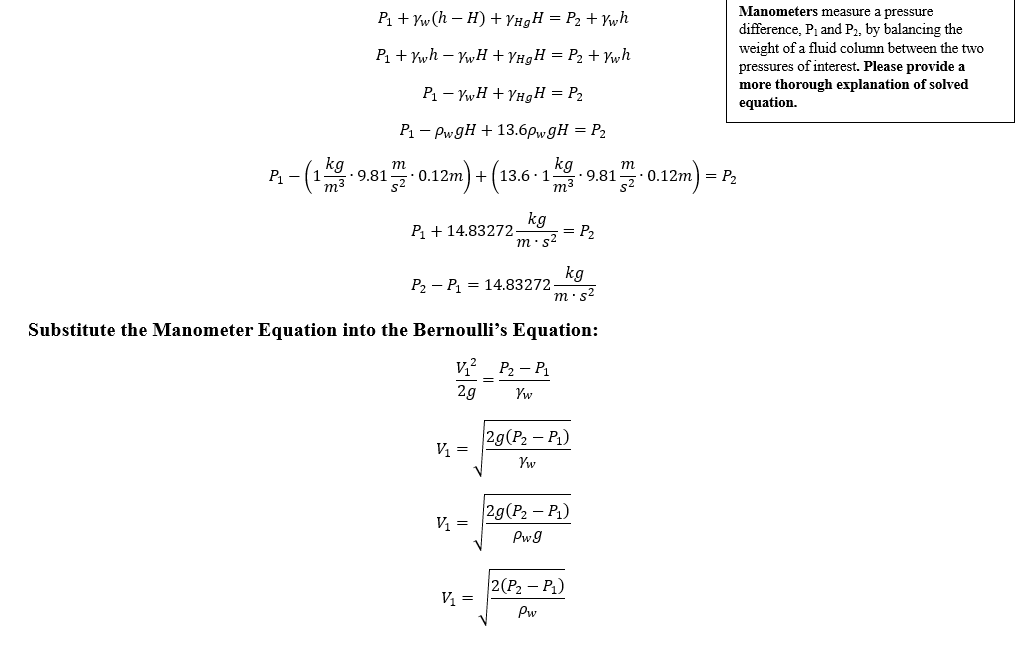
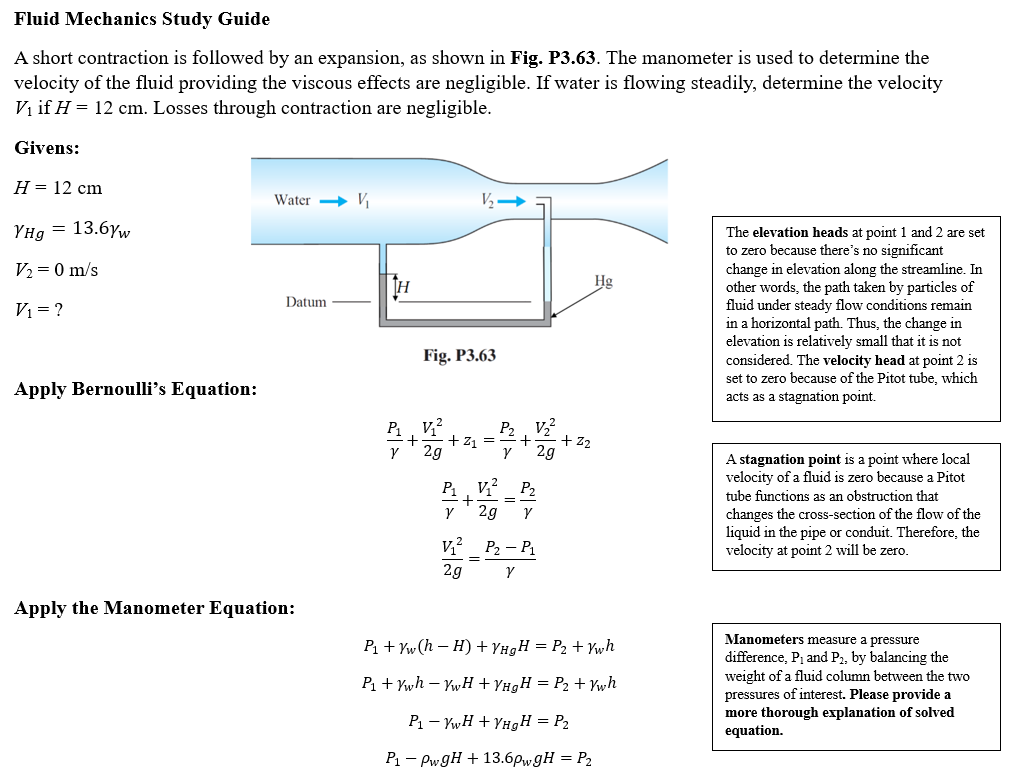
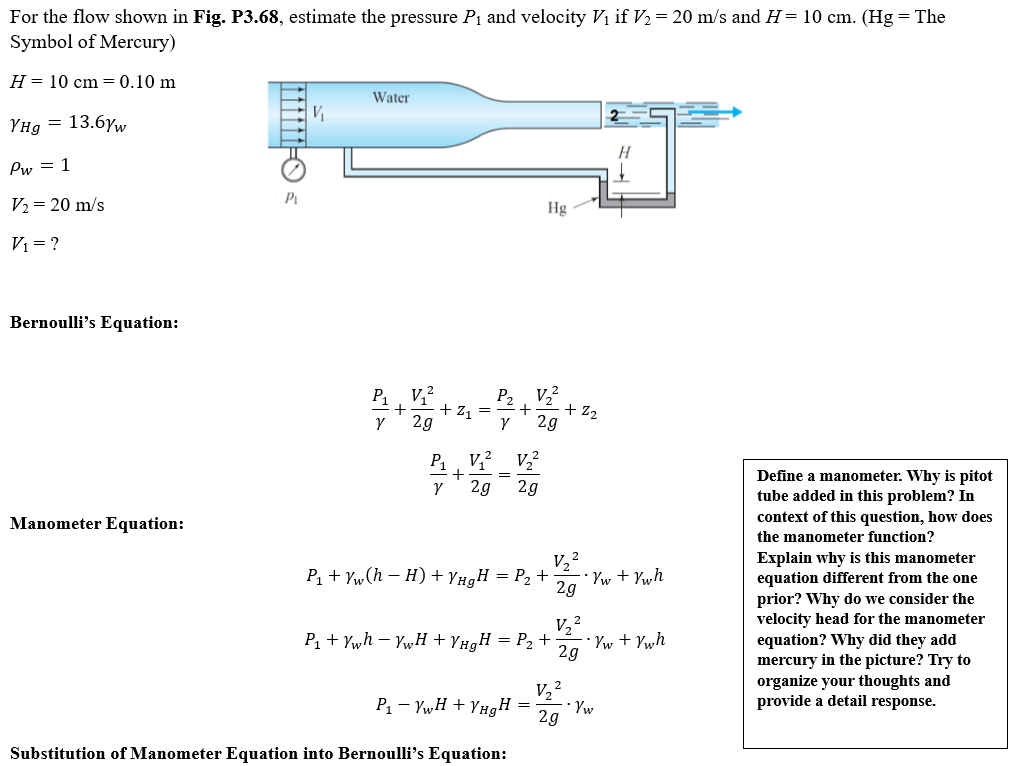
P1 + 1w(h - H) + YHgH = P2 + Vwh Manometers measure a pressure difference, P, and P2, by balancing the P1 + Ywh - VwH + YugH = P2 + Ywh weight of a fluid column between the two pressures of interest. Please provide a P1 - VwH + YHgH = P2 more thorough explanation of solved equation. P1 - PwgH + 13.6pwgH = P2 m 3 P1 - 1- .9.81 2. $2 . 0.12m) + 13.6 . 1-3 149 . 9.81 - . 0.12m = P2 kg P1 + 14.83272 = P2 m . $2 kg P2 - P1 = 14.83272 m . $2 Substitute the Manometer Equation into the Bernoulli's Equation: V P2 - P1 2g Yw V1 = 2g(P2 - P1) Yw 2g(P2 - P1) V1 = Pwg V1 = 2(P2 - P1) PwFluid Mechanics Study Guide A short contraction is followed by an expansion, as shown in Fig. P3.63. The manometer is used to determine the velocity of the fluid providing the viscous effects are negligible. If water is flowing steadily, determine the velocity Vi if H = 12 cm. Losses through contraction are negligible. Givens: H = 12 cm Water - V, V2- YHg = 13.67w The elevation heads at point 1 and 2 are set to zero because there's no significant V2 =0 m/s change in elevation along the streamline. In TH Hg other words, the path taken by particles of V1 = ? Datum fluid under steady flow conditions remain in a horizontal path. Thus, the change in elevation is relatively small that it is not Fig. P3.63 considered. The velocity head at point 2 is Apply Bernoulli's Equation: set to zero because of the Pitot tube, which acts as a stagnation point. P1 V1 + 21= P2 V2 + Z2 y + 29 V 29 A stagnation point is a point where local velocity of a fluid is zero because a Pitot P1 P2 tube functions as an obstruction that V + 29 -2 changes the cross-section of the flow of the liquid in the pipe or conduit. Therefore, the P2 - P1 velocity at point 2 will be zero. 2g Y Apply the Manometer Equation: P1 + Yw(h - H) + YngH = P2 + Ywh Manometers measure a pressure difference, P1 and P2, by balancing the P1 + Ywh - YwH+ YngH = P2 + Ywh weight of a fluid column between the two pressures of interest. Please provide a P1 - VwH + VHgH = P2 more thorough explanation of solved equation. P1 - PwgH + 13.6pwgH = P>For the flow shown in Fig. P3.68, estimate the pressure P1 and velocity V1 if V2 = 20 m's and H = 10 cm. (Hg = The Symbol of Mercury) H = 10 cm = 0.10 m Water VI YHg = 13.67w H Pw = 1 V2 = 20 m/'s Hg V1 = ? Bernoulli's Equation: P1 P2 + + 21 V2 + 2 2 y V 29 P1 V, 2 Define a manometer. Why is pitot y 2g 29 tube added in this problem? In Manometer Equation: context of this question, how does the manometer function? V, 2 Explain why is this manometer P1 + Vw(h - H) + YngH = P2 + 29 . Yw + Ywh equation different from the one prior? Why do we consider the V2 2 velocity head for the manometer P1 + ywh - VwH + VugH = P2+ 20 . Yw + Ywh equation? Why did they add mercury in the picture? Try to V, 2 organize your thoughts and P1 - VWH+ YugH =- provide a detail response. 29 . Yw Substitution of Manometer Equation into Bernoulli's Equation
Step by Step Solution
There are 3 Steps involved in it
1 Expert Approved Answer
Step: 1 Unlock
Question Has Been Solved by an Expert!
Get step-by-step solutions from verified subject matter experts
Step: 2 Unlock
Step: 3 Unlock
Students Have Also Explored These Related Law Questions!









 Study Help