



Question: I need an answer and explanation only for Questions 5 & 6. In the store you visit, customers arrive at a constant rate to the
I need an answer and explanation only for Questions 5 & 6.
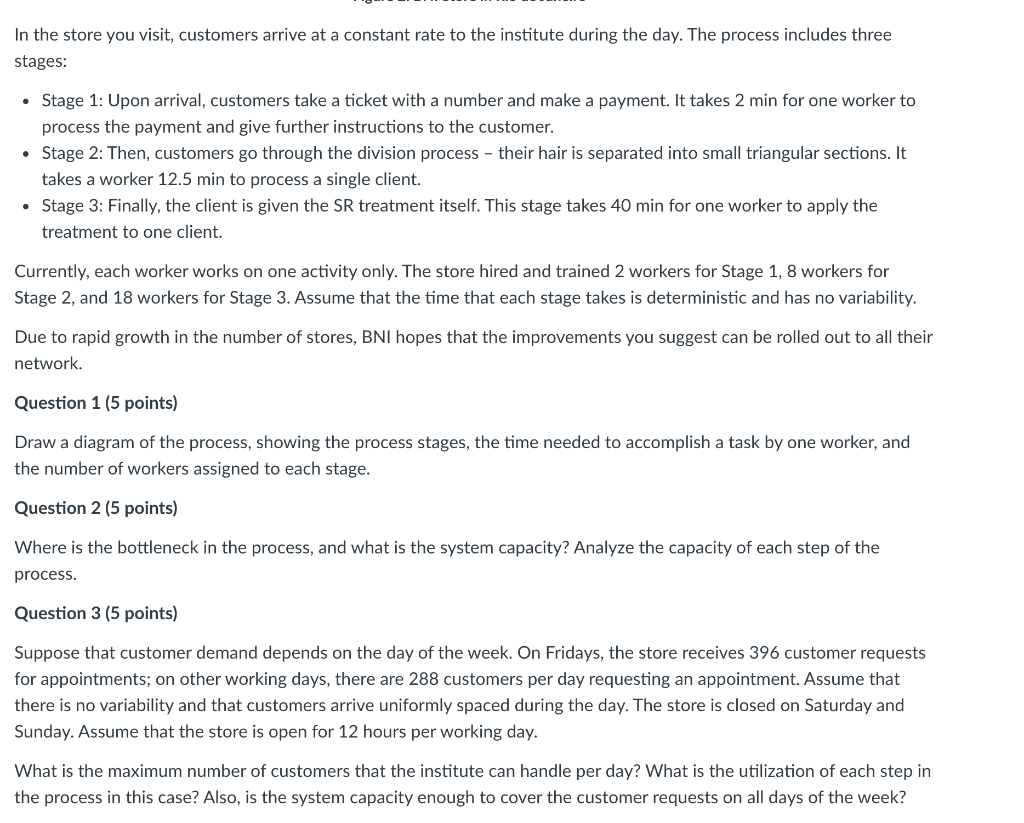
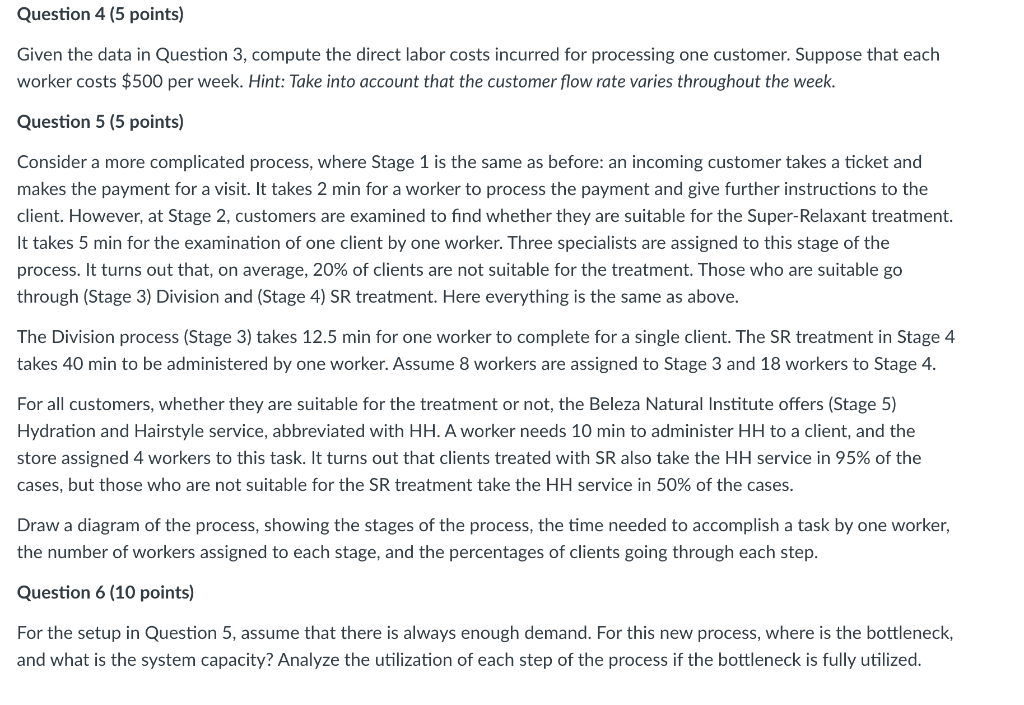
In the store you visit, customers arrive at a constant rate to the institute during the day. The process includes three stages: Stage 1: Upon arrival, customers take a ticket with a number and make a payment. It takes 2 min for one worker to process the payment and give further instructions to the customer. Stage 2: Then, customers go through the division process - their hair is separated into small triangular sections. It takes a worker 12.5 min to process a single client. Stage 3: Finally, the client is given the SR treatment itself. This stage takes 40 min for one worker to apply the treatment to one client. Currently, each worker works on one activity only. The store hired and trained 2 workers for Stage 1, 8 workers for Stage 2, and 18 workers for Stage 3. Assume that the time that each stage takes is deterministic and has no variability. Due to rapid growth in the number of stores, BNI hopes that the improvements you suggest can be rolled out to all their network. Question 1 (5 points) Draw a diagram of the process, showing the process stages, the time needed to accomplish a task by one worker, and the number of workers assigned to each stage. Question 2 (5 points) Where is the bottleneck in the process, and what is the system capacity? Analyze the capacity of each step of the process. Question 3 (5 points) Suppose that customer demand depends on the day of the week. On Fridays, the store receives 396 customer requests for appointments; on other working days, there are 288 customers per day requesting an appointment. Assume that there is no variability and that customers arrive uniformly spaced during the day. The store is closed on Saturday and Sunday. Assume that the store is open for 12 hours per working day. What is the maximum number of customers that the institute can handle per day? What is the utilization of each step in the process in this case? Also, is the system capacity enough to cover the customer requests on all days of the week? Question 4 (5 points) Given the data in Question 3, compute the direct labor costs incurred for processing one customer. Suppose that each worker costs $500 per week. Hint: Take into account that the customer flow rate varies throughout the week. Question 5 (5 points) Consider a more complicated process, where Stage 1 is the same as before: an incoming customer takes a ticket and makes the payment for a visit. It takes 2 min for a worker to process the payment and give further instructions to the client. However, at Stage 2, customers are examined to find whether they are suitable for the Super-Relaxant treatment. It takes 5 min for the examination of one client by one worker. Three specialists are assigned to this stage of the process. It turns out that, on average, 20% of clients are not suitable for the treatment. Those who are suitable go through (Stage 3) Division and (Stage 4) SR treatment. Here everything is the same as above. The Division process (Stage 3) takes 12.5 min for one worker to complete for a single client. The SR treatment in Stage 4 takes 40 min to be administered by one worker. Assume 8 workers are assigned to Stage 3 and 18 workers to Stage 4. For all customers, whether they are suitable for the treatment or not, the Beleza Natural Institute offers (Stage 5) Hydration and Hairstyle service, abbreviated with HH. A worker needs 10 min to administer HH to a client, and the store assigned 4 workers to this task. It turns out that clients treated with SR also take the HH service in 95% of the cases, but those who are not suitable for the SR treatment take the HH service in 50% of the cases. Draw a diagram of the process, showing the stages of the process, the time needed to accomplish a task by one worker, the number of workers assigned to each stage, and the percentages of clients going through each step. Question 6 (10 points) For the setup in Question 5, assume that there is always enough demand. For this new process, where is the bottleneck, and what is the system capacity? Analyze the utilization of each step of the process if the bottleneck is fully utilizedStep by Step Solution
There are 3 Steps involved in it
1 Expert Approved Answer
Step: 1 Unlock

Question Has Been Solved by an Expert!
Get step-by-step solutions from verified subject matter experts
Step: 2 Unlock
Step: 3 Unlock