





Question: I NEED AN ANSWER QUICKLY! I WILL UPVOTE! Problem 4 (20 pts) In the context of a study on the relationship between exercise intensity and

I NEED AN ANSWER QUICKLY! I WILL UPVOTE! I NEED AN ANSWER QUICKLY! I WILL UPVOTE! ProblemI NEED AN ANSWER QUICKLY! I WILL UPVOTE! Problem
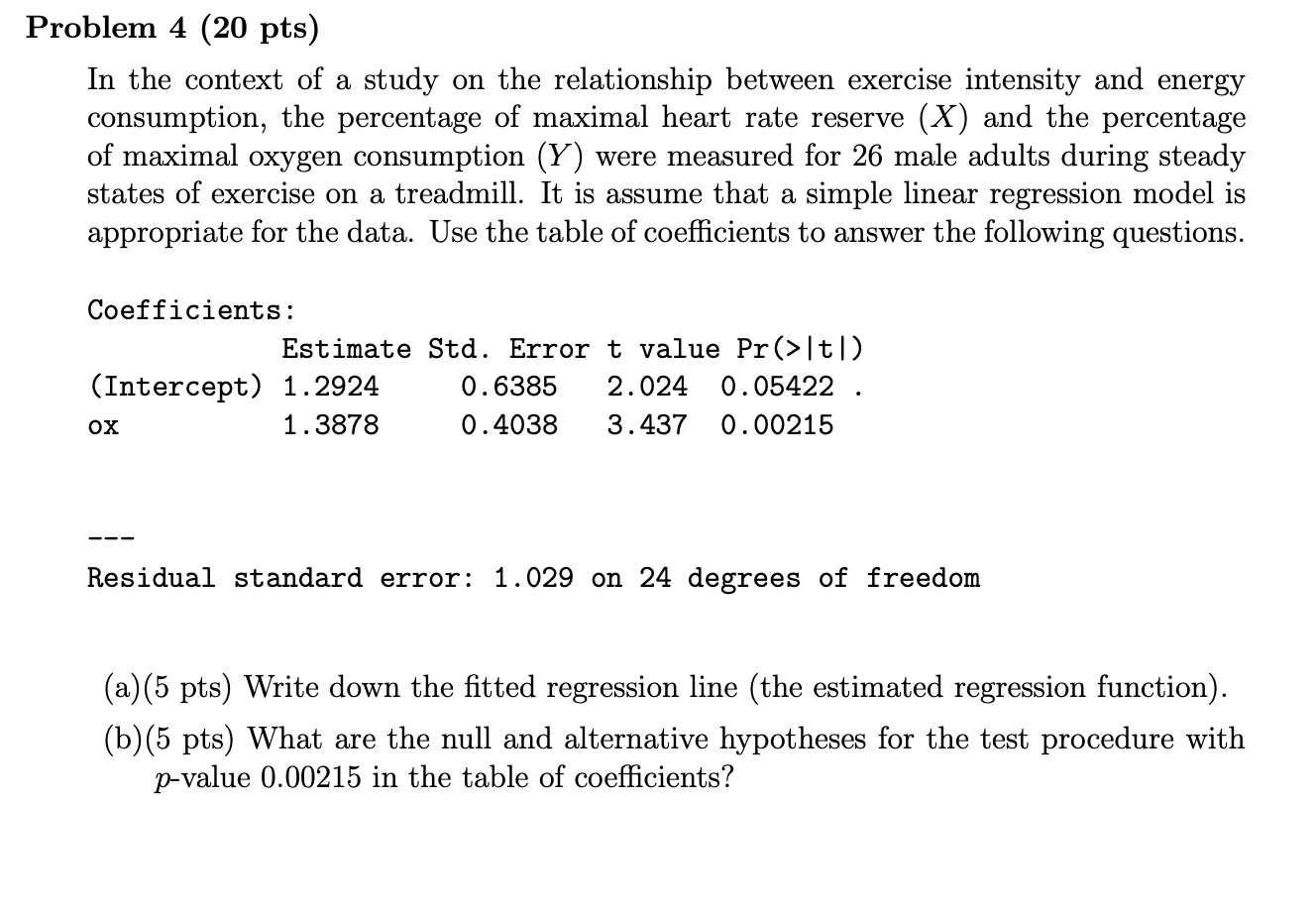
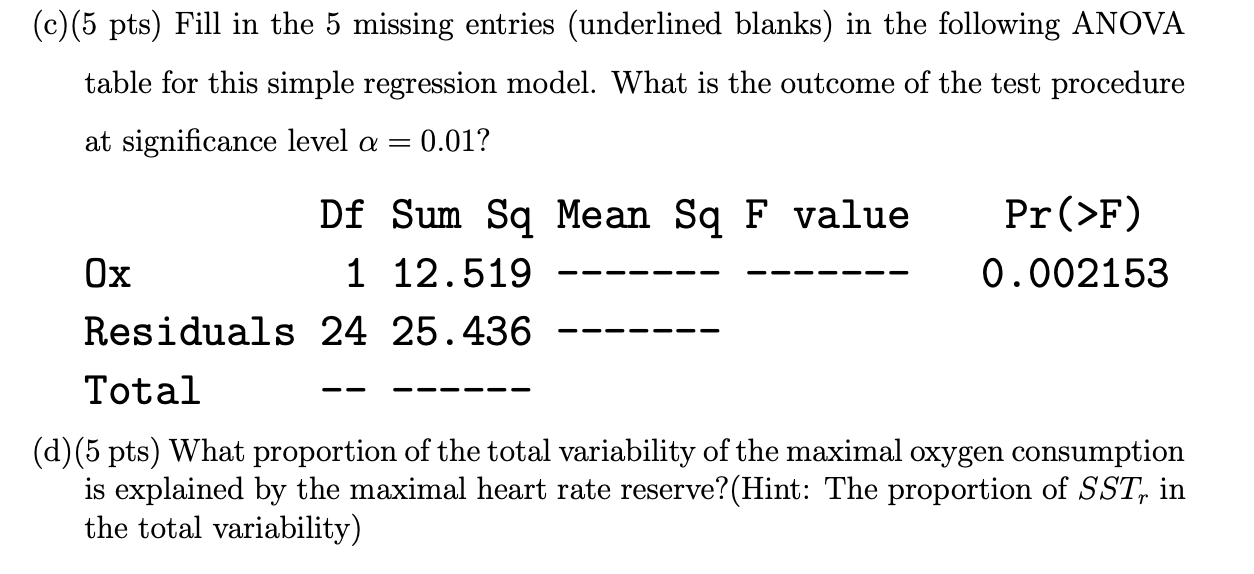
Problem 4 (20 pts) In the context of a study on the relationship between exercise intensity and energy consumption, the percentage of maximal heart rate reserve (X) and the percentage of maximal oxygen consumption (Y) were measured for 26 male adults during steady states of exercise on a treadmill. It is assume that a simple linear regression model is appropriate for the data. Use the table of coefficients to answer the following questions. Coefficients: Estimate Std. Error t value Pr(> [t]) (Intercept) 1.2924 0.6385 2.024 0.05422. 1.3878 0.4038 3.437 0.00215 Residual standard error: 1.029 on 24 degrees of freedom (a)(5 pts) Write down the fitted regression line (the estimated regression function). (b)(5 pts) What are the null and alternative hypotheses for the test procedure with p-value 0.00215 in the table of coefficients? (c)(5 pts) Fill in the 5 missing entries (underlined blanks) in the following ANOVA table for this simple regression model. What is the outcome of the test procedure at significance level a = 0.01? Pr>F) 0.002153 Df Sum Sq Mean Sq F value 1 12.519 Residuals 24 25.436 Total (d)(5 pts) What proportion of the total variability of the maximal oxygen consumption is explained by the maximal heart rate reserve? (Hint: The proportion of SST, in the total variability)

Step by Step Solution

There are 3 Steps involved in it

1 Expert Approved Answer
Step: 1 Unlock blur-text-image

Question Has Been Solved by an Expert!

Get step-by-step solutions from verified subject matter experts

Step: 2 Unlock
Step: 3 Unlock

Students Have Also Explored These Related General Management Questions!