







Question: I need answer for Ques no.1 from the attached document. Thanks in advance. MATH 127 1 HOME WORK 2 Due : Wed Oct 3 @
I need answer for Ques no.1 from the attached document. Thanks in advance.
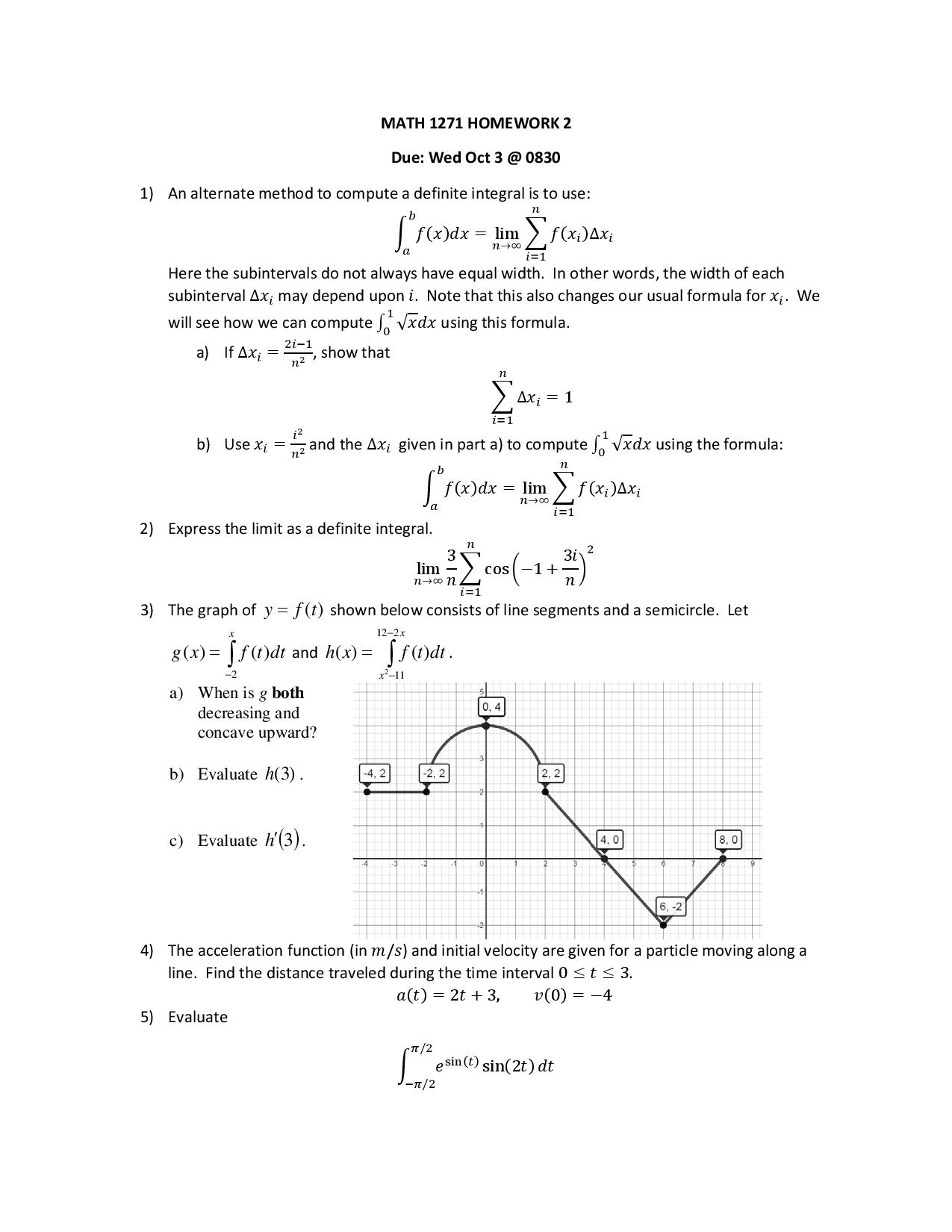
MATH 127 1 HOME WORK 2 Due : Wed Oct 3 @ 0830 1 ) An alternate method to compute a definite integral is to use :" \\ } ( x )ax = lim\\ f ( *` ) Axis 1 = 1 Here the subintervals do not always have equal width . In other words , the width of each* subinterval Ax ; may depend upon i . Note that this also changes our usual formula for *. . We* Will see how we can compute S Vidx using this formula . a ) If Ax ; = 21 - 1 72 , show that LAX ; = ] b ) Use xi = _ and the Ax ; given in part a ) to compute S Vardx using the formula :" [` ( x )ax = lim { Him > F ( X )AX , 2 ) Express the limit as a definite integral . Jim> > cos ( - 1 + 3 2 ) 9 3 ) The graph of Y = $ ( 1 ) shown below consists of line segments and a semicircle . Let 12 - 2X 8 ( * ) = [ f ( * ) at and h ( x ) = [ f ( 1 ) at* } - 11 a ) When is & both decreasing and 1 0 . 4 ] concave upward ? b) Evaluate h ( 3 ) . \\-4 . 2 ] [- 2 . 2 ) \\3 . 2 ) C ) Evaluate h ' ( 3 ) . [4 . 0] 18. 0) \\6 . - 2 4 ) The acceleration function ( in m / s ) and initial velocity are given for a particle moving along a line . Find the distance traveled during the time interval O
Step by Step Solution
There are 3 Steps involved in it

Get step-by-step solutions from verified subject matter experts
 Study Help