



Question: I need answer for the part C: Thank you. File Size (MB) Transfer Time (sec) 67 35.2 59 29.1 79 35.3 76 34.4 24 9.1
I need answer for the part C: Thank you.
| File Size (MB) | Transfer Time (sec) |
| 67 | 35.2 |
| 59 | 29.1 |
| 79 | 35.3 |
| 76 | 34.4 |
| 24 | 9.1 |
| 21 | 10.1 |
| 33 | 17.4 |
| 42 | 24.5 |
| 58 | 20.1 |
| 23 | 20.8 |
| 95 | 34.7 |
| 98 | 32.6 |
| 35 | 13.3 |
| 64 | 29.3 |
| 98 | 44.6 |
| 46 | 20.1 |
| 82 | 27.9 |
| 47 | 17.4 |
| 87 | 32.6 |
| 95 | 31.3 |
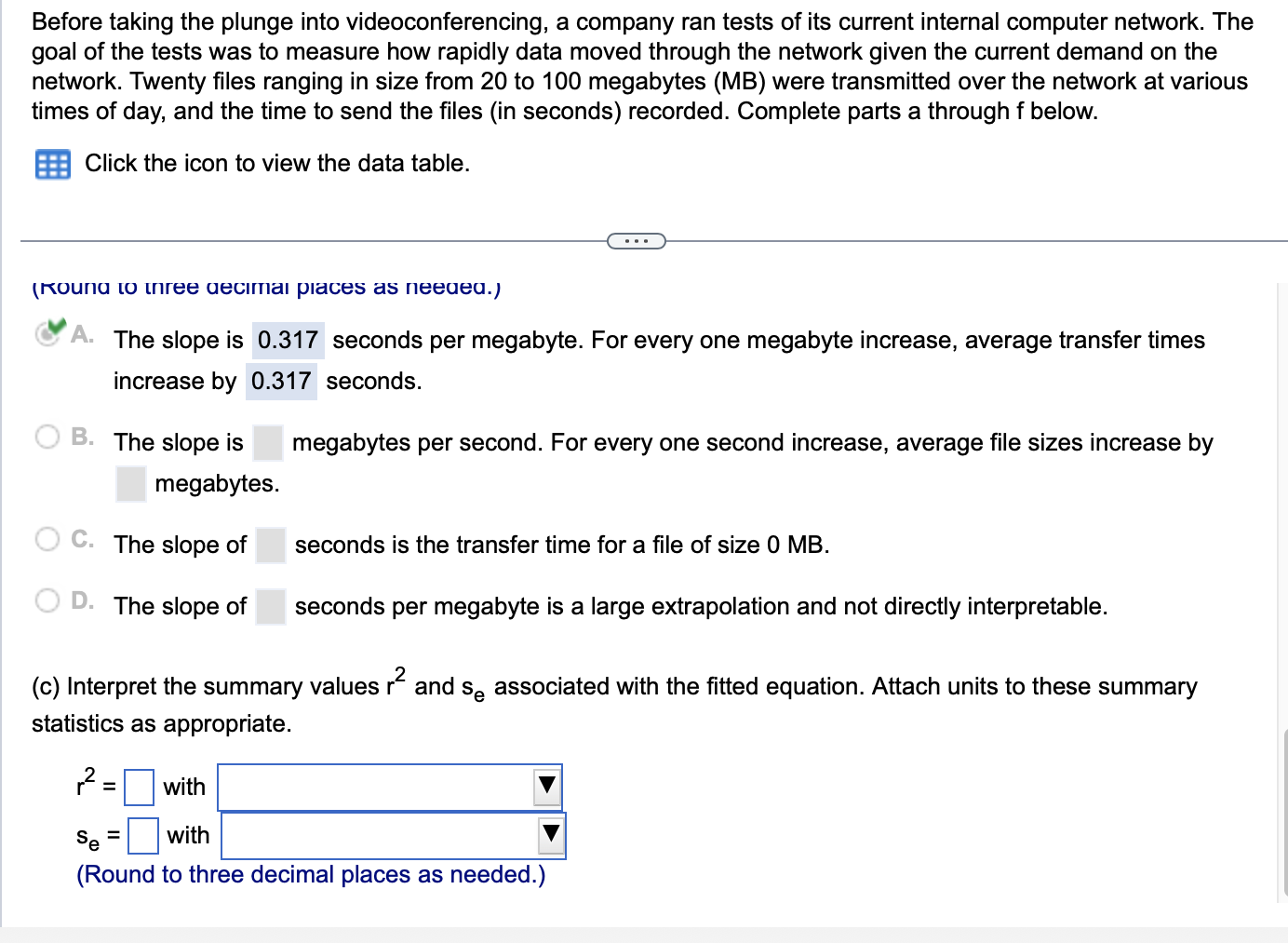
Before taking the plunge into videoconferencing, a company ran tests of its current internal computer network. The goal of the tests was to measure how rapidly data moved through the network given the current demand on the network. Twenty les ranging in size from 20 to 100 megabytes (MB) were transmitted over the network at various times of day. and the time to send the files (in seconds) recorded. Complete parts a through fbelow. @ Click the icon to View the data table. {KUUHU l0 Lnree UBUIITIHI places as {138080.} v . . . The slope IS 0.317 seconds per megabyte. For every one megabyte Increase, average transfer times increase by 0.317 seconds. The slope is megabytes per second. For every one second increase, average file sizes increase by megabytes. The slope of seconds is the transfer time for a le of size 0 MB. The slope of seconds per megabyte is a large extrapolation and not directly interpretable. (c) Interpret the summary values r2 and se associated with the tted equation. Attach units to these summary statistics as appropriate. r2 = D with S6 = D with (Round to three decimal places as needed.)
Step by Step Solution
There are 3 Steps involved in it

Get step-by-step solutions from verified subject matter experts