







Question: I NEED ANSWER TO NUMBER 4 Problem Set 2 Econ1740-Fall 2017 varo La Parra Perez DUE Tuesday 09/26/2017 in class NOTE: Whenever possible, always show
I NEED ANSWER TO NUMBER 4
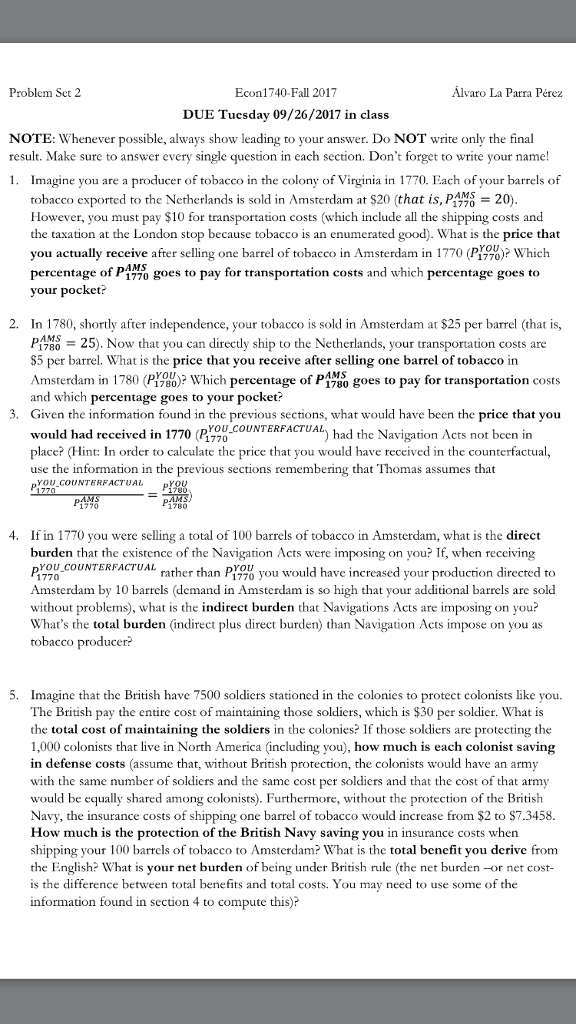
Problem Set 2 Econ1740-Fall 2017 varo La Parra Perez DUE Tuesday 09/26/2017 in class NOTE: Whenever possible, always show leading to your answer. Do NOT Write only the final result. Make sure to answer every single question in each section. Don't forget to write your name! Imagine you are a producer of tobacco in the colony of Virginia in 1770. Each of your barrels of tobacco ex sported to the Netherlands is sold in Amsterdam at $20 (that is, P1770 AMS 20 However, you must pay $10 for transportation costs (which include all the shipping costs and the taxation at the London stop because tobacco is an enumerated good). What is the price that YOU you actually receive after selling one barrel of tobacco in Amsterdam in 1770 (? Which percentage of P, 170 goes to pay for transportation costs and which percentage goes to your pocket? 1770 AMS You 2. In 1780, shortly after independence, your tobacco is sold in Amsterdam at $25 per barrel (that is, AMS 780 25). Now that you can directly ship to the Netherlands, your transportation costs are $5 per barrel. What is the price that you receive after selling one barrel of tobacco in AMS Amsterdam in 1780 ( 17 80, ? Which percentage of P130 goes to pay for transportation costs nd which percentage goes to your pocket? 3. Given the information found in the previous sections, what would have been the price that you YOU COUNTERFACTUAL would had received in 1770 (P 1770 ) had the Navigation Acts not been in olace? (HintIn order to calculate the price that you would have received in the counterfactual use the information in the previous sections emembering that "Thomas assumes that YOU COUNTERF ACTUAL Pxy 1980 4. If in 1770 you were selling a total of 100 barrels of tobacco in Amsterdam, what is the direct burden that the existence of the Navigation Acts were imposing you? If, when receiving YOU COUNTERFACTUAL rather than P. YOU 9% ou would have increased your production directed to 1770 Amsterdam by 10 barrels demand in Amsterdam is so high that your additional barrels are sold without problems), what is the indirect burden that Navigations Acts are imposing on y What's the total burden (indirect plus direct burden) than Navigation Acts impose on you as tobacco producer? Imagine that the British have 7500 soldiers stationed in the colonies to protect colonists like you. The British pay the entire cost of maintaining those soldiers, which is $30 per soldier. What is the total cost of maintaining the soldiers in the colonies? If those soldiers are protecting the 1,000 colonists that live in North America (including you, how much is each colonist saving in defense costs (assume that, without British protection, the colonists would have an army with the same number of soldiers and the same cost per soldiers and that the cost of that army would be equally shared among colonists). Furthermore, without the p protection of the British Navy, the insurance costs of shipping one barrel of tobacco would increase from $2 to $7.3458. How much is the protection of the British Navy saving you in insurance costs when shipping your 10 barrels of tobacco to Amsterdam? What is the total benefit you derive from the English? What is your net burden of being under British rule (the net burden or net cost is the difference between total benefits and total costs. You may need to use some of the information found in section 4 to compute this)? Problem Set 2 Econ1740-Fall 2017 varo La Parra Perez DUE Tuesday 09/26/2017 in class NOTE: Whenever possible, always show leading to your answer. Do NOT Write only the final result. Make sure to answer every single question in each section. Don't forget to write your name! Imagine you are a producer of tobacco in the colony of Virginia in 1770. Each of your barrels of tobacco ex sported to the Netherlands is sold in Amsterdam at $20 (that is, P1770 AMS 20 However, you must pay $10 for transportation costs (which include all the shipping costs and the taxation at the London stop because tobacco is an enumerated good). What is the price that YOU you actually receive after selling one barrel of tobacco in Amsterdam in 1770 (? Which percentage of P, 170 goes to pay for transportation costs and which percentage goes to your pocket? 1770 AMS You 2. In 1780, shortly after independence, your tobacco is sold in Amsterdam at $25 per barrel (that is, AMS 780 25). Now that you can directly ship to the Netherlands, your transportation costs are $5 per barrel. What is the price that you receive after selling one barrel of tobacco in AMS Amsterdam in 1780 ( 17 80, ? Which percentage of P130 goes to pay for transportation costs nd which percentage goes to your pocket? 3. Given the information found in the previous sections, what would have been the price that you YOU COUNTERFACTUAL would had received in 1770 (P 1770 ) had the Navigation Acts not been in olace? (HintIn order to calculate the price that you would have received in the counterfactual use the information in the previous sections emembering that "Thomas assumes that YOU COUNTERF ACTUAL Pxy 1980 4. If in 1770 you were selling a total of 100 barrels of tobacco in Amsterdam, what is the direct burden that the existence of the Navigation Acts were imposing you? If, when receiving YOU COUNTERFACTUAL rather than P. YOU 9% ou would have increased your production directed to 1770 Amsterdam by 10 barrels demand in Amsterdam is so high that your additional barrels are sold without problems), what is the indirect burden that Navigations Acts are imposing on y What's the total burden (indirect plus direct burden) than Navigation Acts impose on you as tobacco producer? Imagine that the British have 7500 soldiers stationed in the colonies to protect colonists like you. The British pay the entire cost of maintaining those soldiers, which is $30 per soldier. What is the total cost of maintaining the soldiers in the colonies? If those soldiers are protecting the 1,000 colonists that live in North America (including you, how much is each colonist saving in defense costs (assume that, without British protection, the colonists would have an army with the same number of soldiers and the same cost per soldiers and that the cost of that army would be equally shared among colonists). Furthermore, without the p protection of the British Navy, the insurance costs of shipping one barrel of tobacco would increase from $2 to $7.3458. How much is the protection of the British Navy saving you in insurance costs when shipping your 10 barrels of tobacco to Amsterdam? What is the total benefit you derive from the English? What is your net burden of being under British rule (the net burden or net cost is the difference between total benefits and total costs. You may need to use some of the information found in section 4 to compute this)
Step by Step Solution
There are 3 Steps involved in it

Get step-by-step solutions from verified subject matter experts
 Study Help