







Question: I need answers for this lab please. E53: Resistivity Introduction: Electrical resistivity is an intrinsic property of a material and measure how strong it opposes
I need answers for this lab please.
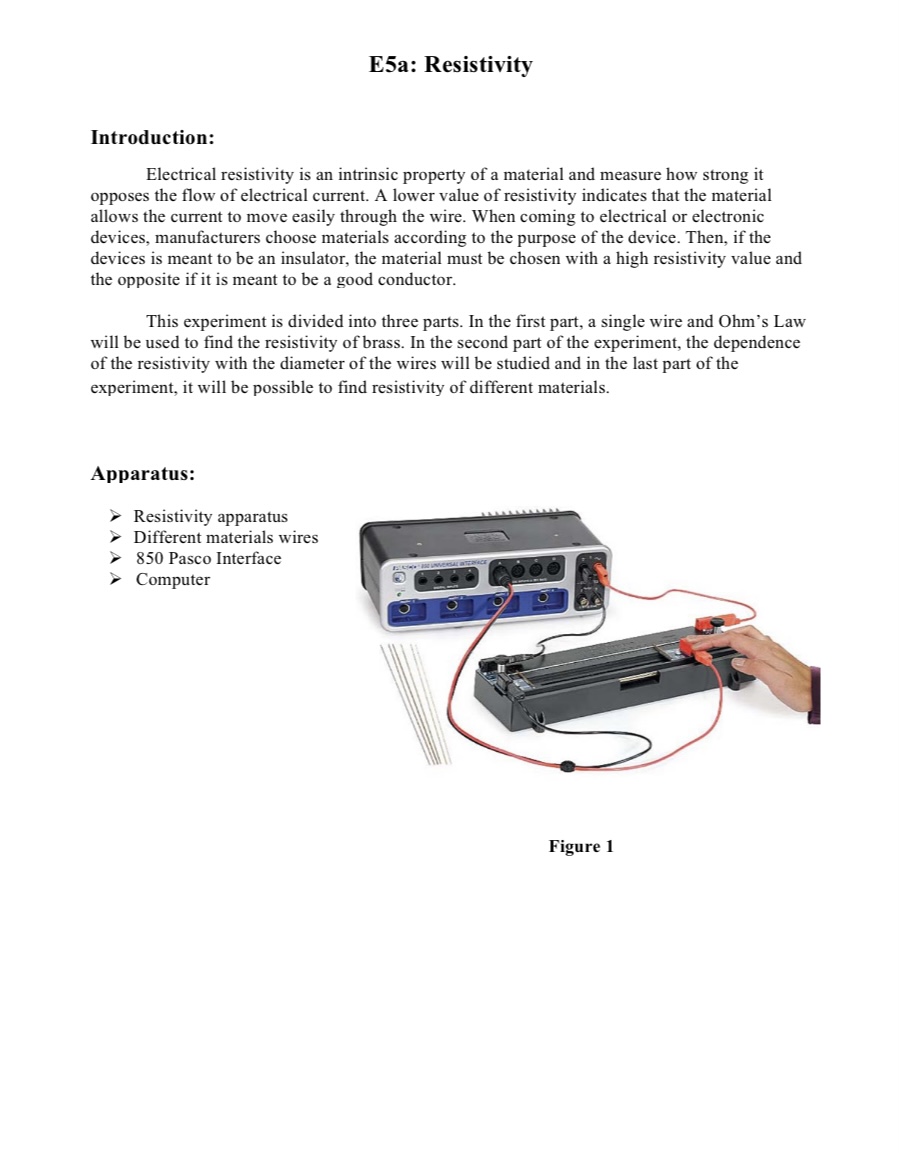
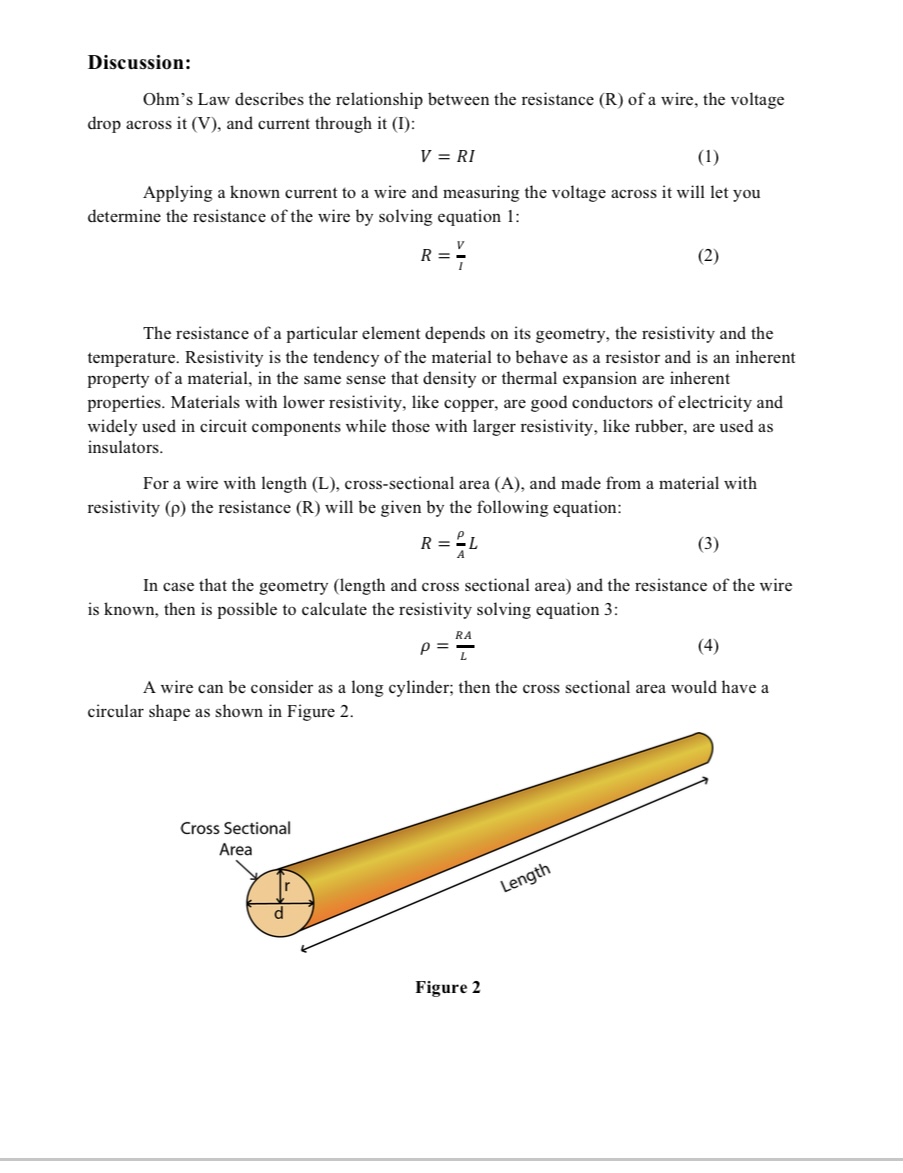
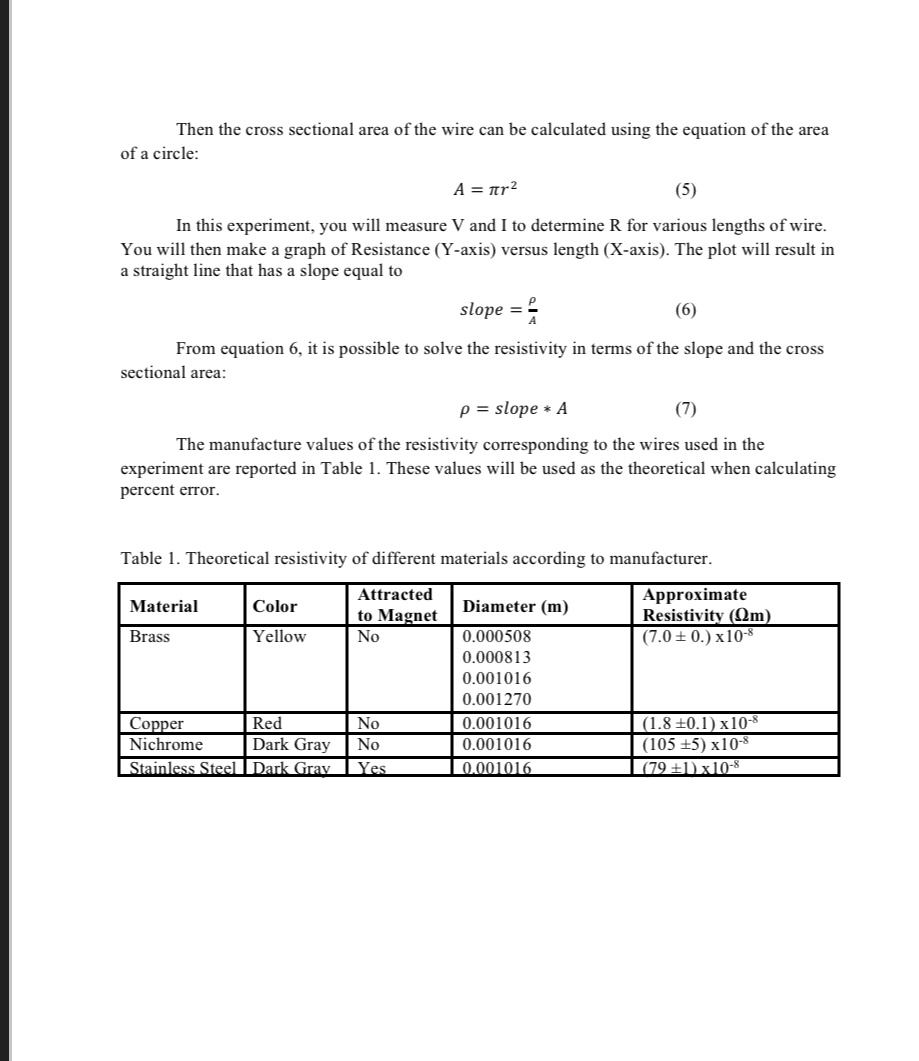
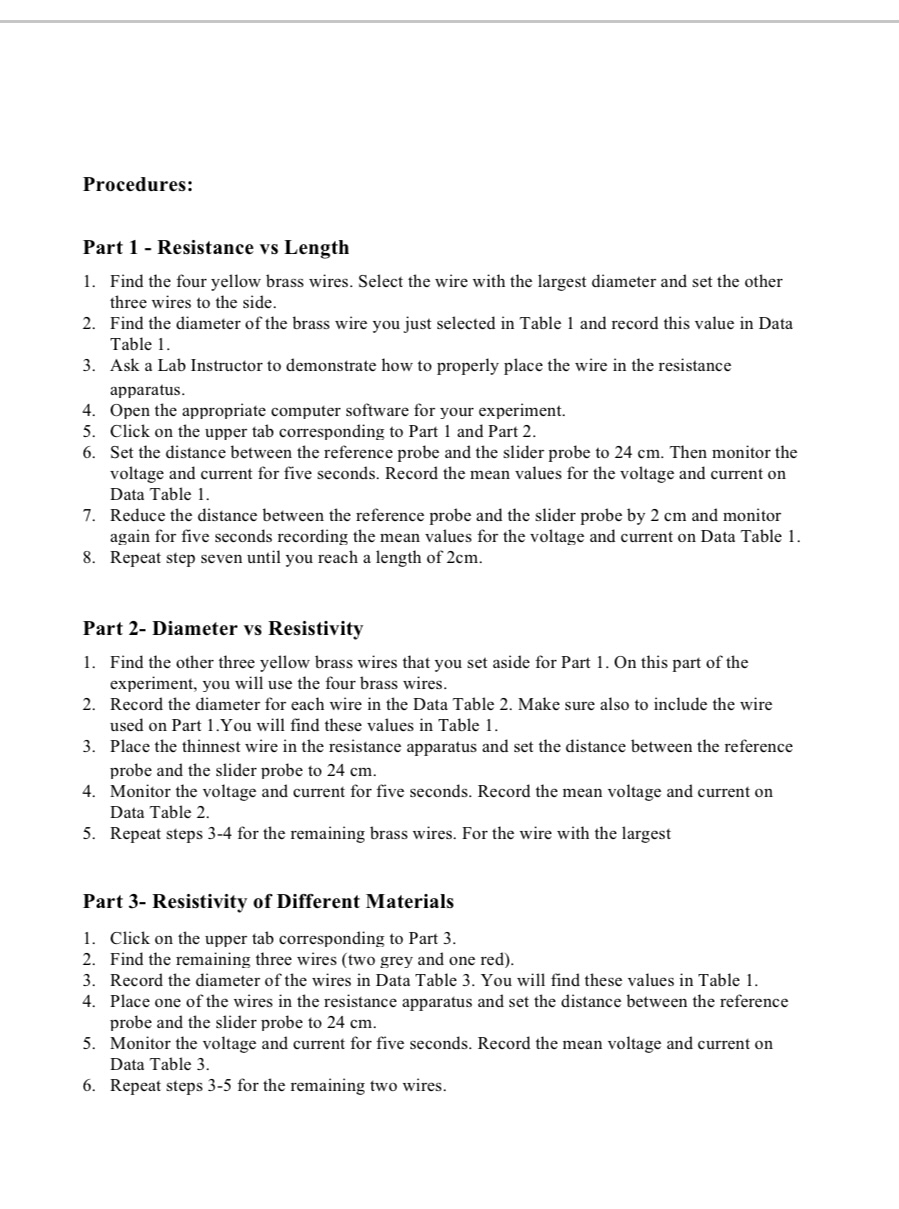
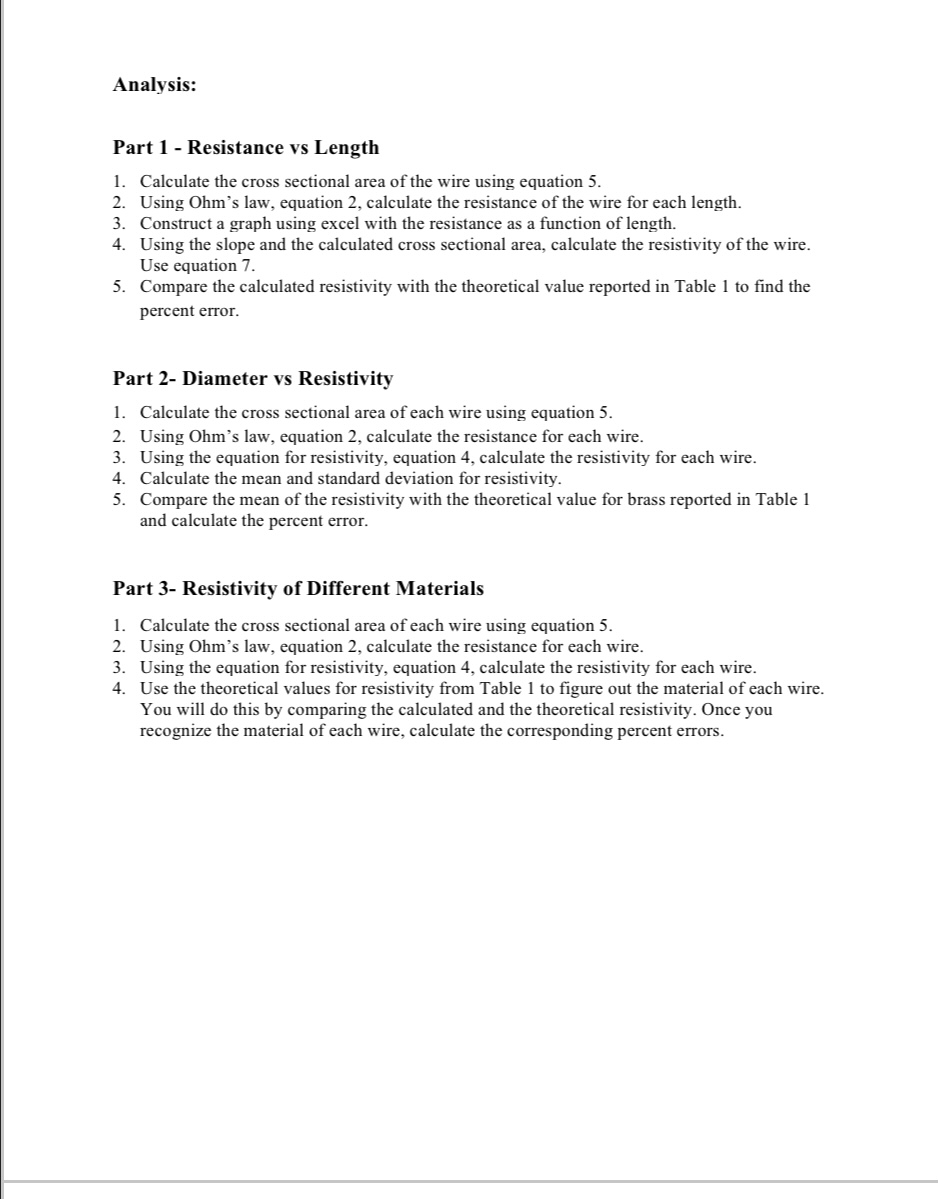
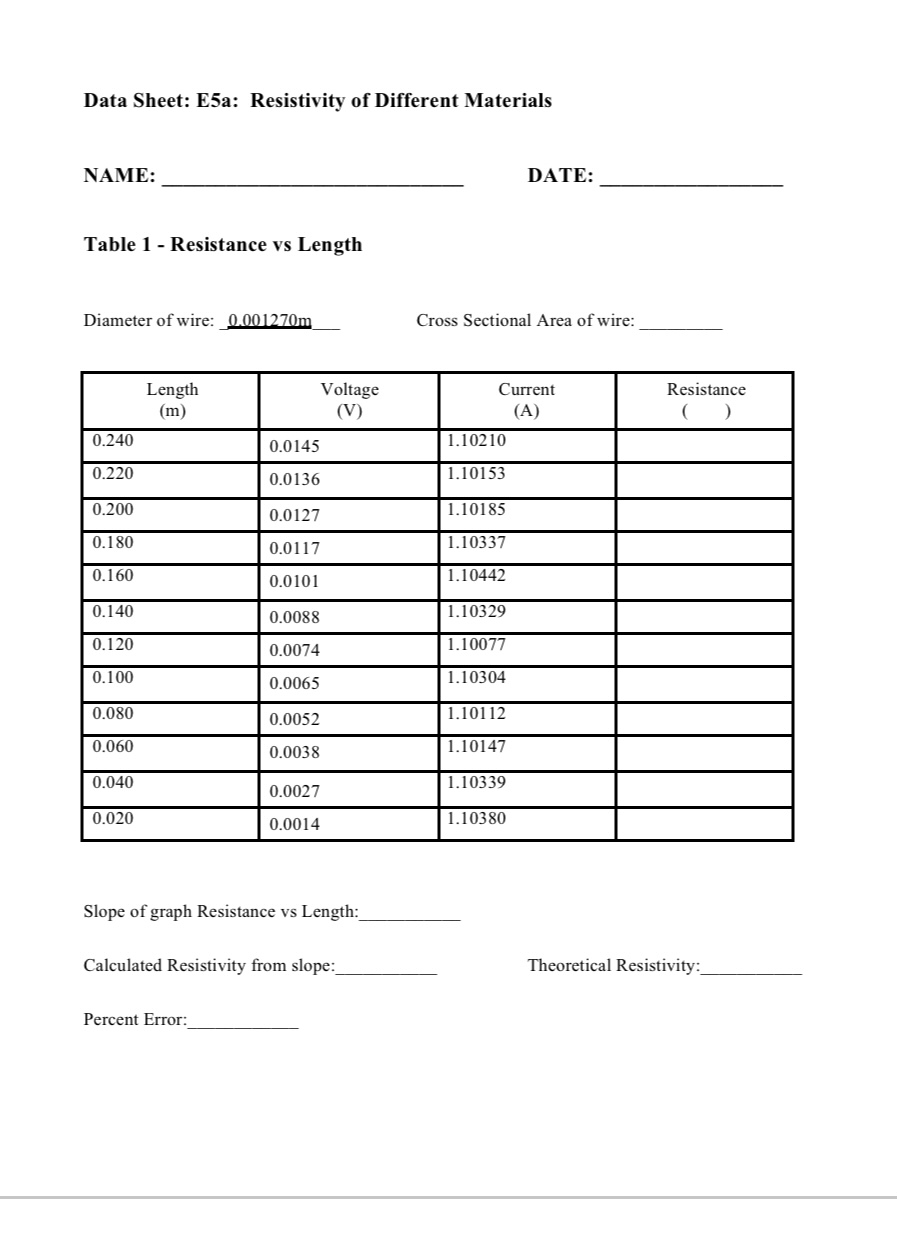
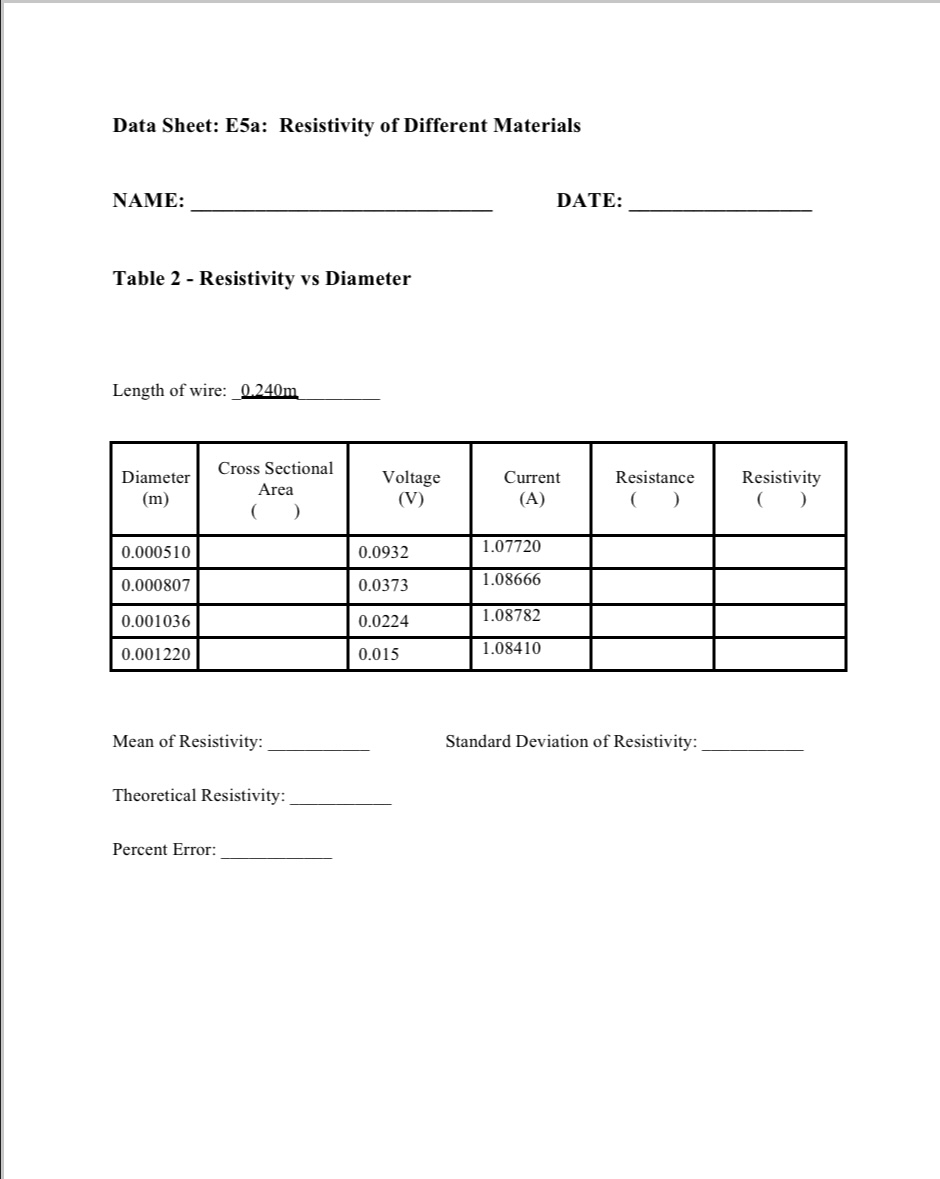
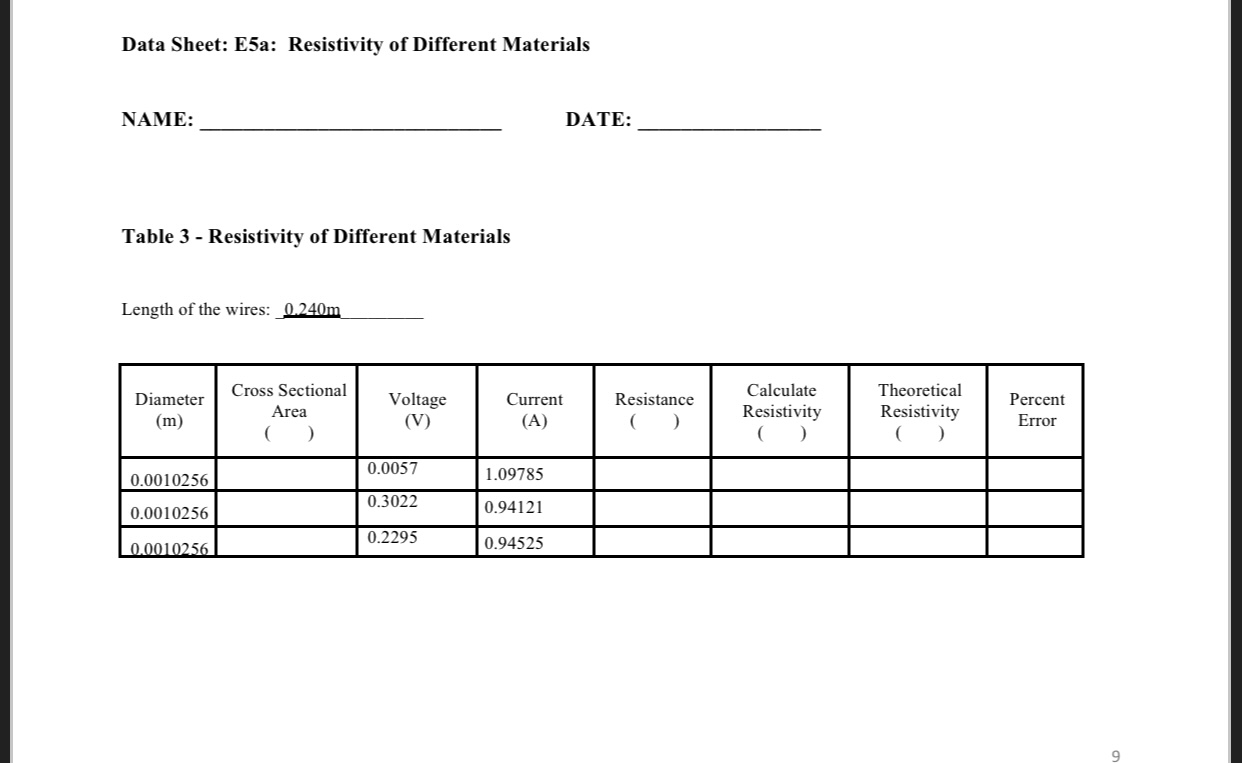
E53: Resistivity Introduction: Electrical resistivity is an intrinsic property of a material and measure how strong it opposes the ow of electrical current. A lower value of resistivity indicates that the material allows the current to move easily through the wire. When coming to electrical or electronic devices, manufacturers choose materials according to the purpose of the device. Then, if the devices is meant to be an insulator, the material must be chosen with a high resistivity value and the opposite if it is meant to he a good conductor. This experiment is divided into three parts. In the rst part, a single wire and Dhrn's Law will he used to nd the resistivity of brass. In the second part of the experiment, the dependence of the resistivity with the diameter of the wires will he studied and in the last part of the experiment, it will be possible to nd resistivity of different materials. Apparatus: 5* Resistivity apparatus Fr Different materials wires 3' 850 Pasco Interface 5* Computer Figure l Discussion: Olnn's Law describes the relationship between the resistance (R) of a wire, the voltage drop across it (V), and current through it (I): v = m (1) Applying a known current to a wire and measuring the voltage across it will let you determine the msistance of the wire by solving equation 1: 'Iv' R: T (2) The resistance of a particular element depends on its geometry, the resistivity and the temperature. Resistivity is the tendency of the material to behave as a resistor and is an inherent property of a material, in the same sense that density or thermal expansion are inherent properties. Materials with lower msistivity, like copper, are good conductors of electricity and widely used in circuit components while those with larger resistivity, like rubber, are used as insulators. For a wire with length (L), cross-sectional area (A), and made from a material with resistivity (p) the resistance (R) will be given by the following equation: R: 21. (3) in case that the geometry (length and cross sectional area) and the resistance of the wire is known, then is possible to calculate the resistivity solving equation 3: in p = r (4) A wire can he consider as a long cylinder; then the cross sectional area would have a circular shape as shown in Figure 2. Figure 2 Then the cross sectional area of the wire can be calculated using the equation of the area of a circle: A = m"! (5) In this experiment, you will measure V and I to determine R for various lengths of wire. You will then make a graph of Resistance (YaJris) versus length (Xaxis). The plot will result in a straight line that has a slope equal to slope = E (6] From equation 6, it is possible to solve the resistivity in terms of the slope and the cross sectional area: p = slope 1: A (T) The manufacture values of the resistivity corresponding to the wires used in the experiment are reported in Table 1. These values will be used as the theoretical when calculating percent error. Table 1. Theoretical resistivity of different materials according to manufacturer. _ Attracted , APPmma' Material cal\" to Ma_ .et RESiSHVi 9'" Brass Yellow No 0.000508 (7.0 i 0.) 11:10\"3 0.000313 0.001016 0.001270 0.001016 1.3 i0.1 x103 0001016 (105 i5)x10'3 - mm_ :|: . Procedures: Part 1 - Resistance vs Length 1. 2. 5"!\"- P' Find the four yellow brass wires. Select the wire with the largest diameter and set the other three wires to the side. Find the diameter of the brass wire you just selected in Table l and reeord this value in Data Table 1. Ask a Lab Instructor to demonstrate how to properly place the wire in the resistance apparatus. Open the appropriate computer software for your experiment. Click on the upper tab eorresponding to Part 1 and Part 2. Set the distance between the reference probe and the slider probe to 24 cm. Then monitor the voltage and current for five seconds. Record the mean values for the voltage and current on Data Table 1. Reduce the distance between the reference probe and the slider probe by 2 cm and monitor again for ve seconds recording the mean values for the voltage and current on Data Table 1. Repeat step seven until you reach a length of 2cm. Part 2- Diameter vs Resistivity l. 2. Find the other three yellow brass wires that you set aside for Part 1. On this part of the experiment, you will use the four brass wires. Record the diameter for each wire in the Data Table 2. Make sure also to include the wire used on Part LYou will nd these values in Table 1. Place the thinnest wire in the resistance apparatus and set the distanee between the reference probe and the slider probe to 24 cm. Monitor the voltage and current for five seeonds. Record the mean voltage and current on Data Table 2. Repeat steps 3-4 for the remaining brass wires. For the wire with the largest Part 3- Resistivity of Different Materials 9544.\"? 5" Click on the upper tab corresponding to Part 3. Find the remaining three wires (two grey and one red). Record the diameter of the wires in Data Table 3. You will nd these values in Table 1. Place one of the wires in the resistance apparatus and set the distance between the reference probe and the slider probe to 24 cm. Monitor the voltage and current for five seeonds. Reeord the mean voltage and current on Data Table 3. Repeat steps 3-5 for the remaining two wires. Analysis: Part 1 - Resistance vs Length 1. Calculate the cross sectional area of the wire using equation 5. 2. Using Ohm's law, equation 2, calculate the resistance of the wire for each length. 3. Construct a graph using excel with the resistance as a function of length. 4. Using the slope and the calculated cross sectional area, calculate the resistivity of the wire. Use equation 7. 5. Compare the calculated resistivity with the theoretical value reported in Table 1 to find the percent error. Part 2- Diameter vs Resistivity 1. Calculate the cross sectional area of each wire using equation 5. 2. Using Ohm's law, equation 2, calculate the resistance for each wire. 3. Using the equation for resistivity, equation 4, calculate the resistivity for each wire. 4. Calculate the mean and standard deviation for resistivity. 5. Compare the mean of the resistivity with the theoretical value for brass reported in Table 1 and calculate the percent error. Part 3- Resistivity of Different Materials 1. Calculate the cross sectional area of each wire using equation 5. 2. Using Ohm's law, equation 2, calculate the resistance for each wire. 3. Using the equation for resistivity, equation 4, calculate the resistivity for each wire. 4. Use the theoretical values for resistivity from Table 1 to figure out the material of each wire. You will do this by comparing the calculated and the theoretical resistivity. Once you recognize the material of each wire, calculate the corresponding percent errors.Data Sheet: E5a: Resistivity of Different Materials NAME: DATE: Table 1 - Resistance vs Length Diameter of wire: _0.001270m Cross Sectional Area of wire: Length Voltage Current Resistance (m) (V) (A) ") 0.240 0.0145 1.10210 0.220 0.0136 1.10153 0.200 0.0127 1.10185 0.180 0.0117 1.10337 0.160 0.0101 1.10442 0.140 0.0088 1.10329 0.120 0.0074 1.10077 0.100 0.0065 1.10304 0.080 0.0052 1.10112 0.060 0.0038 1.10147 0.040 0.0027 1.10339 0.020 0.0014 1.10380 Slope of graph Resistance vs Length: Calculated Resistivity from slope: Theoretical Resistivity: Percent Error:Data Sheet: E5a: Resistivity of Different Materials NAME: DATE: Table 2 - Resistivity vs Diameter Length of wire: _0.240m Diameter Cross Sectional Voltage Current Resistance Resistivity Area (m) (V) (A) 0.000510 0.0932 1.07720 0.000807 0.0373 1.08666 0.001036 0.0224 1.08782 0.001220 0.015 1.08410 Mean of Resistivity: Standard Deviation of Resistivity: Theoretical Resistivity: Percent Error:Data Sheet: E5a: Resistivity of Different Materials NAME: DATE: Table 3 - Resistivity of Different Materials Length of the wires: _0.240m Cross Sectional Voltage Current Resistance Calculate Theoretical Diameter Percent Area Resistivity Resistivity (m) (V) (A) Error 0.0057 0.0010256 1.09785 0.3022 0.0010256 0.94121 0.2295 0.0010256 0.94525
Step by Step Solution
There are 3 Steps involved in it

Get step-by-step solutions from verified subject matter experts
 Study Help