







Question: I need code please Problem 3: Vector3D - Inheritance of MyVector Recall, that we considered class MyVector on one of the lectures (you can find
I need code please
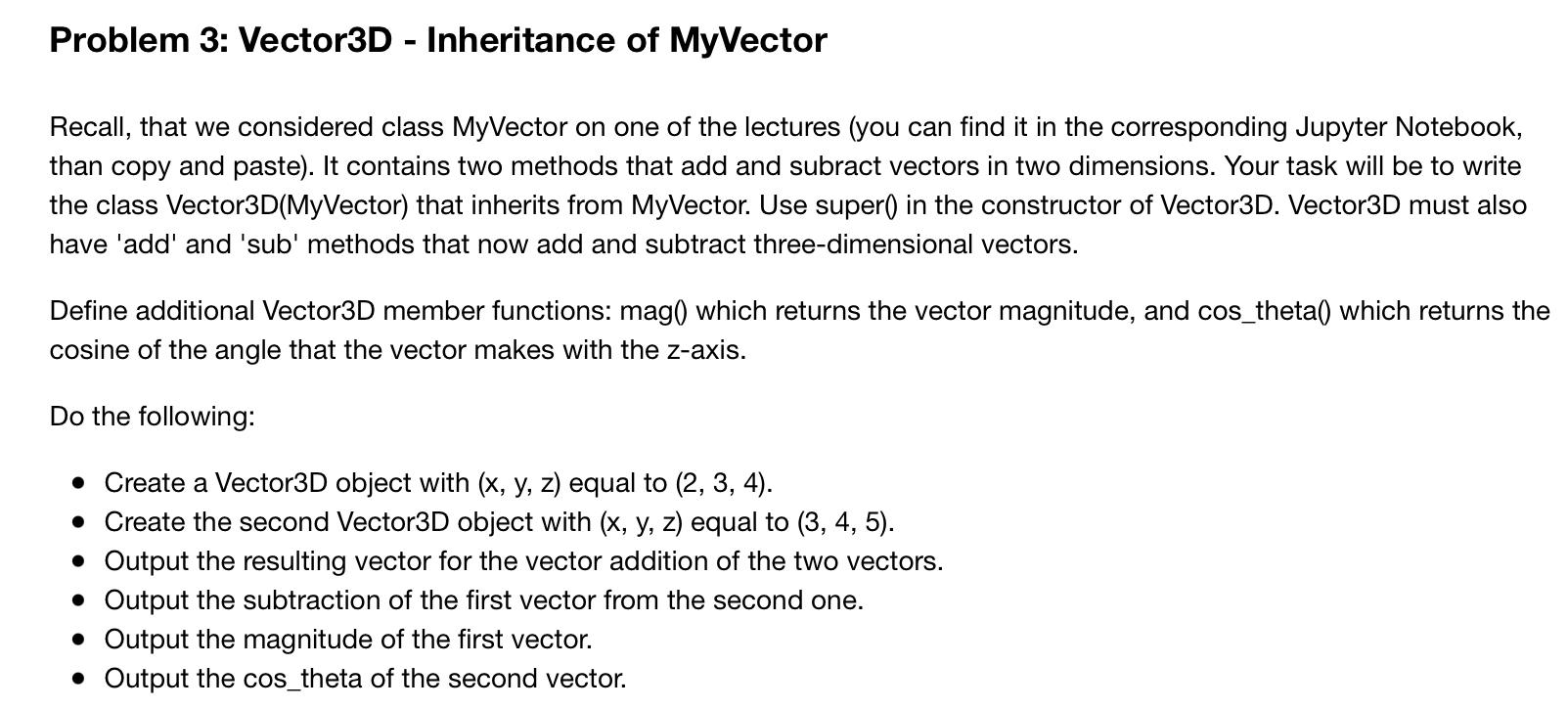
Problem 3: Vector3D - Inheritance of MyVector Recall, that we considered class MyVector on one of the lectures (you can find it in the corresponding Jupyter Notebook, than copy and paste). It contains two methods that add and subract vectors in two dimensions. Your task will be to write the class Vector3D( MyVector) that inherits from MyVector. Use super() in the constructor of Vector3D. Vector3D must also have 'add' and 'sub' methods that now add and subtract three-dimensional vectors. Define additional Vector3D member functions: mag() which returns the vector magnitude, and cos_theta) which returns the cosine of the angle that the vector makes with the z-axis. Do the following: Create a Vector3D object with (x, y, z) equal to (2, 3, 4). Create the second Vector3D object with (x, y, z) equal to (3, 4, 5). Output the resulting vector for the vector addition of the two vectors. Output the subtraction of the first vector from the second one. Output the magnitude of the first vector. Output the cos_theta of the second vector. Problem 3: Vector3D - Inheritance of MyVector Recall, that we considered class MyVector on one of the lectures (you can find it in the corresponding Jupyter Notebook, than copy and paste). It contains two methods that add and subract vectors in two dimensions. Your task will be to write the class Vector3D( MyVector) that inherits from MyVector. Use super() in the constructor of Vector3D. Vector3D must also have 'add' and 'sub' methods that now add and subtract three-dimensional vectors. Define additional Vector3D member functions: mag() which returns the vector magnitude, and cos_theta) which returns the cosine of the angle that the vector makes with the z-axis. Do the following: Create a Vector3D object with (x, y, z) equal to (2, 3, 4). Create the second Vector3D object with (x, y, z) equal to (3, 4, 5). Output the resulting vector for the vector addition of the two vectors. Output the subtraction of the first vector from the second one. Output the magnitude of the first vector. Output the cos_theta of the second vector
Step by Step Solution
There are 3 Steps involved in it

Get step-by-step solutions from verified subject matter experts
 Study Help