







Question: I need five strong and long discussion question based on reading? for sale, or shall write or print, or cause to be written or printed,
I need five strong and long discussion question based on reading? 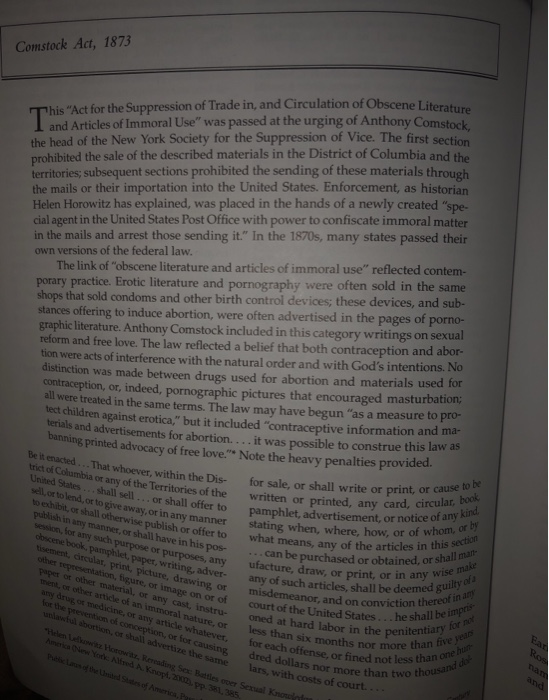
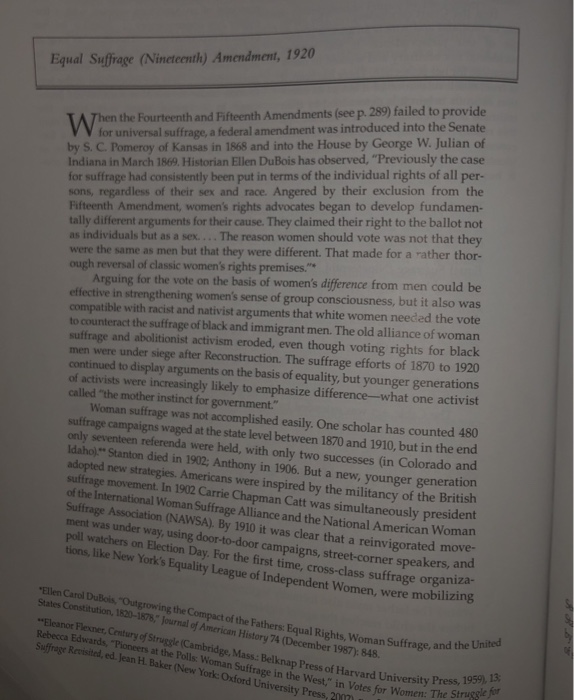
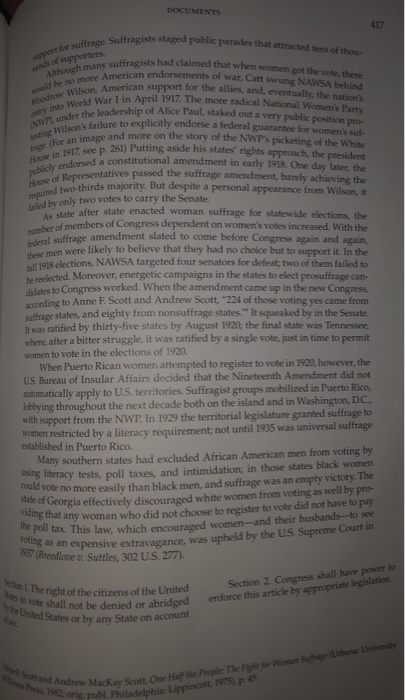
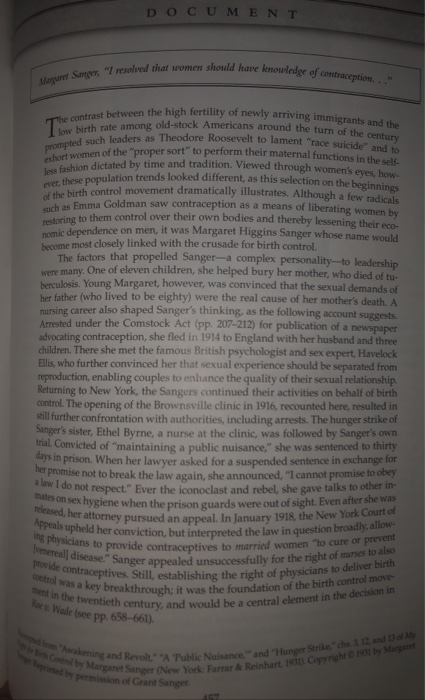
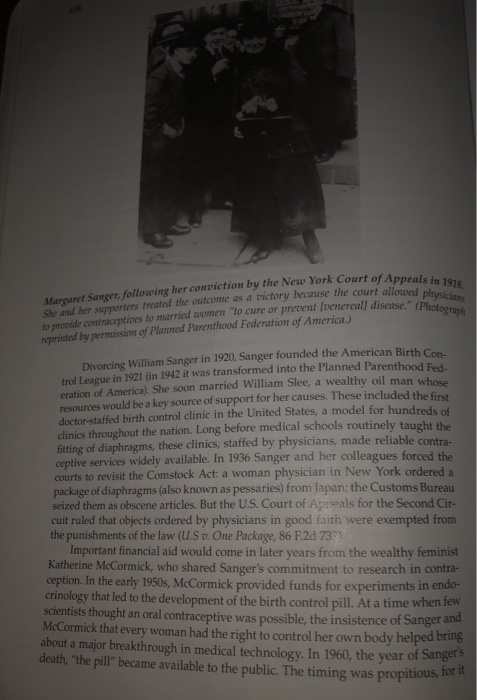
for sale, or shall write or print, or cause to be written or printed, any card, circular book what means, any of the articles in this section .. can be purchased or obtained, or shall man ufacture, draw, or print, or in any wise make any of such articles, shall be deemed guilty of misdemeanor, and on conviction thereof in an court of the United States... he shall be imon oned at hard labor in the penitentiary for less than six months no more than five pe dred dollars no more than two thousand for each offense, or fined not less than one Comstock Act, 1873 stating when, where, how, or of whom, or by his "Act for the Suppression of Trade in, and Circulation of Obscene Literature , the head of the New York Society for the Suppression of Vice. The first section prohibited the sale of the described materials in the District of Columbia and the territories, subsequent sections prohibited the sending of these materials through the mails or their importation into the United States. Enforcement, as historian Helen Horowitz has explained, was placed in the hands of a newly created "spe- cial agent in the United States Post Office with power to confiscate immoral matter in the mails and arrest those sending it." In the 1870s, many states passed their own versions of the federal law. The link of "obscene literature and articles of immoral use" reflected contem- porary practice. Erotic literature and pornography were often sold in the same shops that sold condoms and other birth control devices; these devices, and sub- stances offering to induce abortion, were often advertised in the pages of porno- graphic literature. Anthony Comstock included in this category writings on sexual reform and free love. The law reflected a belief that both contraception and abor- tion were acts of interference with the natural order and with God's intentions. No distinction was made between drugs used for abortion and materials used for contraception, or, indeed, pornographic pictures that encouraged masturbation; all were treated in the same terms. The law may have begun "as a measure to pro- tect children against erotica," but it included contraceptive information and ma- pamphlet, advertisement, terials and advertisements for abortion.... it was possible to construe this law as banning printed advocacy of free love."* Note the heavy penalties provided. Be it enacted... That whoever, within the Dis- trict of Columbia or any of the Territories of the United States... shall sell ... or shall offer to sell, or to lend, or to give away, or in any manner to exhibit, or shall otherwise publish or offer to publish in any manner, or shall have in his pos- Session for any such purpose or purposes, any obscene book, pamphlet, paper, writing, adver- tisement, circular, print, picture, drawing or other representation, figure, or image on or of paper or other material, or any cast, instru- or notice of any kind ment, otthet article of an immoral nature, or my drug of medicine, or any article whatever for the prevention of conception, or for causing webol bortion of shall advertize the same Helen Low Howy, Rereading Se Battles toer Sexual Know America York Knop200.). pp. 31,385 Eat Ree lars, with costs of court... "Ellen Carol DuBois. "Outgrowing the Compact of the Fathers: Equal Rights, Woman Suffrage, and the United Rebecca Edwards "Pioneers at the Polls: Woman Suffrage in the West," in Votes for Women: The Struggle Eleanor Flexer. Century of Struggle (Cambridge, Mass. Belknap Press of Harvard University Press, 1959), 13 Equal Suffrage (Nineteenth) Amendment, 1920 W Then the Fourteenth and Fifteenth Amendments (see p. 289) failed to provide for universal suffrage, a federal amendment was introduced into the Senate by S. C. Pomeroy of Kansas in 1868 and into the House by George W. Julian of Indiana in March 1869. Historian Ellen DuBois has observed, "Previously the case for suffrage had consistently been put in terms of the individual rights of all per- sons, regardless of their sex and race. Angered by their exclusion from the Fifteenth Amendment, women's rights advocates began to develop fundamen- tally different arguments for their cause. They claimed their right to the ballot not as individuals but as a sex.... The reason women should vote was not that they were the same as men but that they were different. That made for a rather thor- ough reversal of classic women's rights premises."** Arguing for the vote on the basis of women's difference from men could be effective in strengthening women's sense of group consciousness, but it also was compatible with racist and nativist arguments that white women needed the vote to counteract the suffrage of black and immigrant men. The old alliance of woman suffrage and abolitionist activism eroded, even though voting rights for black men were under siege after Reconstruction. The suffrage efforts of 1870 to 1920 continued to display arguments on the basis of equality, but younger generations of activists were increasingly likely to emphasize difference-what one activist called the mother instinct for government." Woman suffrage was not accomplished easily. One scholar has counted 480 suffrage campaigns waged at the state level between 1870 and 1910, but in the end only seventeen referenda were held, with only two successes in Colorado and Idaho)."* Stanton died in 1902; Anthony in 1906. But a new, younger generation adopted new strategies. Americans were inspired by the militancy of the British suffrage movement. In 1902 Carrie Chapman Catt was simultaneously president of the International Woman Suffrage Alliance and the National American Woman Suffrage Association (NAWSA). By 1910 it was clear that a reinvigorated move ment was under way, using door-to-door campaigns, street-corner speakers, and poll watchers on Election Day. For the first time, cross-class suffrage organiza- tions, like New York's Equality League of Independent Women, were mobilizing States Constitution, 1820-1878," Journal of American History 74 (December 1987): 848. Suffrage Revisited, ed. Jean H. Baker (New York: Oxford University Press, 2007 part for suffrage. Suffragists staged public parades that attracted tens of thou Although many suffragists had claimed that when women got the vote, there Nodrow Wilson, American support for the allies, and eventually, the nation's w be no more American endorsements of war, Cattswung NAWSA behind NIF under the leadership of Alice Paul, staked out a very public position pro- try into World War I in April 1917. The more radical National Women's Party Desting Wilson's failure to explicitly endorse a federal guarantee for women's suf- for an image and more on the story of the NWT's picketing of the White publicly endorsed a constitutional amendment in early 1918. One day later, the House in 1917, see p. 261) Putting aside his states' rights approach, the president House of Representatives passed the suffrage amendment, barely achieving the mined two-thirds majority. But despite a personal appearance from Wilson, it as to vote shall not be denied or abridged The right of the citizens of the United Stand Andrew Mackay Scott One Half the Philie The For Sirhane Liversity 1962 ore publ Philadelphia Lippincott, 1955 failed by only two votes to carry the Senate. the United States or by any State on account DOCUMENTS 417 sands of supporters As state after state enacted woman suffrage for statewide elections, the number of members of Congress dependent on women's votes increased. With the federal suffrage amendment slated to come before Congress again and again, these men were likely to believe that they had no choice but to support it. In the till 1918 elections, NAWSA targeted four senators for defeat; two of them failed to be reelected. Moreover, energetic campaigns in the states to elect prosuffrage can- didates to Congress worked. When the amendment came up in the new Congress, according to Anne F. Scott and Andrew Scott,"224 of those voting yes came from suffrage states, and eighty from nonsuffrage states."* It squeaked by in the Senate. It was ratified by thirty-five states by August 1920; the final state was Tennessee where, after a bitter struggle, it was ratified by a single vote, just in time to permit women to vote in the elections of 1920. When Puerto Rican women attempted to register to vote in 1920, however, the US Bureau of Insular Affairs decided that the Nineteenth Amendment did not automatically apply to U.S. territories. Suffragist groups mobilized in Puerto Rico Lobbying throughout the next decade both on the island and in Washington, DC, with support from the NWP. In 1929 the territorial legislature granted suffrage to women restricted by a literacy requirement; not until 1935 was universal suffrage established in Puerto Rico Many southern states had excluded African American men from voting by using literacy tests, poll taxes, and intimidation; in those states black women could vote no more easily than black men, and suffrage was an empty victory. The viding that any woman who did not choose to register to vote did not have to pay the poll tax. This law, which encouraged women and their husbandsto see 1989 as an expensive extravagance, was upheld by the US Supreme Court in 1937 (Breedlove u. Suttles, 302 U.S. 277). Section 2 Congress shall have power to enforce this article by appropriate legislation permission of Grant Sanger a Sam, "I resolved that women should have knowledge of contraception The contrast between the high fertility of newly arriving immigrants and the prompted such leaders as Theodore Roosevelt to Lament "race suicide and to exhort women of the proper sort to perform their maternal functions in the self- Jess fashion dictated by time and tradition. Viewed through women's eyes, how ever, these population trends looked different, as this selection on the beginnings of the birth control movement dramatically illustrates. Although a few radicals released, her attorney pursued an appeal. In January 1918, the New York Court of Appeals upheld her conviction, but interpreted the law in question broadly, allow ng physicians to provide contraceptives to married women to cure or prevent nereal] disease." Sanger appealed unsuccessfully for the right of me to also provide contraceptives. Still, establishing the right of physicians to deliver birth control was a key breakthrough; it was the foundation of the birth control move ment in the twentieth century, and would be a central element in the decision in Rou. Wade (see PP. 658-661). Cby Margaret Sanger New York Farrar & Reinhart. 1901 Copyright Awakening and Revolt. A Public Nuance and Hunger Strike chander DOCUMENT och as Emma Goldman saw contraception as a means of liberating women by restoring to them control over their own bodies and thereby lessening their eco nomic dependence on men, it was Margaret Higgins Sanger whose name would become most closely linked with the crusade for birth control. The factors that propelled Sanger-a complex personality--to leadership were many. One of eleven children, she helped bury her mother, who died of tu- berculosis. Young Margaret, however, was convinced that the sexual demands of her father (who lived to be eighty) were the real cause of her mother's death. A nursing career also shaped Sanger's thinking, as the following account suggests. Arrested under the Comstock Act (pp. 207-212) for publication of a newspaper advocating contraception, she fled in 1914 to England with her husband and three children. There she met the famous British psychologist and sex expert, Havelock Ellis, who further convinced her that sexual experience should be separated from reproduction, enabling couples to enhance the quality of their sexual relationship. Returning to New York, the Sangers continued their activities on behalf of birth control. The opening of the Brownsville clinic in 1916, recounted here, resulted in still further confrontation with authorities, including arrests. The hunger strike of Sanger's sister, Ethel Byrne, a nurse at the clinic, was followed by Sanger's own trial. Convicted of "maintaining a public nuisance," she was sentenced to thirty days in prison. When her lawyer asked for a suspended sentence in exchange for her promise not to break the law again, she announced, "I cannot promise to obey alaw I do not respect." Ever the iconoclast and rebel, she gave talks to other in- Margaret Sanger, following her conviction by the New York Court of Appeals in 1918 She and her supporters frated the outcome as a victory because the court alloted physicians to provide contracts to married women to cure or prevent (veneral disease. (Photographe reprinted by permission of Planned Parenthood Federation of America.) Divorcing William Sanger in 1920, Sanger founded the American Birth Con trol League in 1921 (in 1942 it was transformed into the Planned Parenthood Fed. eration of America). She soon married William Slee, a wealthy oil man whose resources would be a key source of support for her causes. These included the first doctor-staffed birth control clinic in the United States, a model for hundreds of clinics throughout the nation. Long before medical schools routinely taught the fitting of diaphragms, these clinics, staffed by physicians, made reliable contra- ceptive services widely available. In 1936 Sanger and her colleagues forced the courts to revisit the Comstock Act: a woman physician in New York ordered a package of diaphragms (also known as pessaries) from Japan; the Customs Bureau seized them as obscene articles. But the U.S. Court of Appeals for the Second Cir- cuit ruled that objects ordered by physicians in good faith were exempted from the punishments of the law (US v. One Package, 86 F.2d 73 Important financial aid would come in later years from the wealthy feminist Katherine McCormick, who shared Sanger's commitment to research in contra- ception. In the early 1950s, McCormick provided funds for experiments in endo- crinology that led to the development of the birth control pill. At a time when few scientists thought an oral contraceptive was possible, the insistence of Sanger and McCormick that every woman had the right to control her own body helped bring about a major breakthrough in medical technology. In 1960, the year of Sangers death, "the pill" became available to the public. The timing was propitious, for it
Step by Step Solution
There are 3 Steps involved in it
1 Expert Approved Answer
Step: 1 Unlock

Question Has Been Solved by an Expert!
Get step-by-step solutions from verified subject matter experts
Step: 2 Unlock
Step: 3 Unlock
 Study Help