







Question: I need full answer with explaining clearly and solving the bonus (15 (+5) points) Vigenre cipher security strength. (a) Given that we somehow know that
I need full answer with explaining clearly and solving the bonus
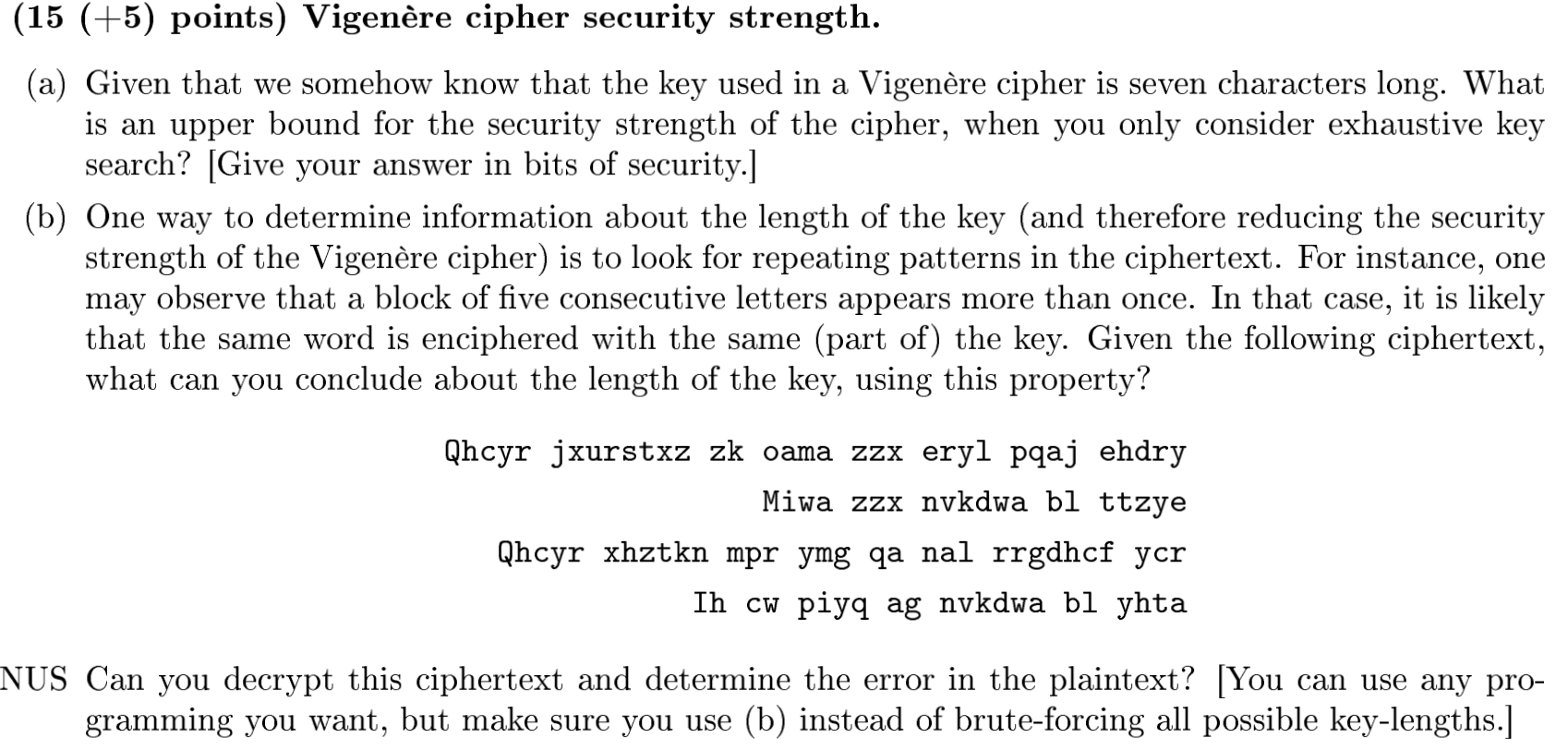
(15 (+5) points) Vigenre cipher security strength. (a) Given that we somehow know that the key used in a Vigenre cipher is seven characters long. What is an upper bound for the security strength of the cipher, when you only consider exhaustive key search? [Give your answer in bits of security.] (b) One way to determine information about the length of the key (and therefore reducing the security strength of the Vigenre cipher) is to look for repeating patterns in the ciphertext. For instance, one may observe that a block of five consecutive letters appears more than once. In that case, it is likely that the same word is enciphered with the same (part of) the key. Given the following ciphertext, what can you conclude about the length of the key, using this property? Qhcyr jxurstxz zk oama zzx eryl pqaj ehdry Miwa zzx nvkdwa bl ttzye Qhcyr xhztkn mpr ymg qa nal rrgdhcf ycr Ih cw piyq ag nvkdwa bl yhta NUS Can you decrypt this ciphertext and determine the error in the plaintext? [You can use any pro- gramming you want, but make sure you use (b) instead of brute-forcing all possible key-lengths.] (15 (+5) points) Vigenre cipher security strength. (a) Given that we somehow know that the key used in a Vigenre cipher is seven characters long. What is an upper bound for the security strength of the cipher, when you only consider exhaustive key search? [Give your answer in bits of security.] (b) One way to determine information about the length of the key (and therefore reducing the security strength of the Vigenre cipher) is to look for repeating patterns in the ciphertext. For instance, one may observe that a block of five consecutive letters appears more than once. In that case, it is likely that the same word is enciphered with the same (part of) the key. Given the following ciphertext, what can you conclude about the length of the key, using this property? Qhcyr jxurstxz zk oama zzx eryl pqaj ehdry Miwa zzx nvkdwa bl ttzye Qhcyr xhztkn mpr ymg qa nal rrgdhcf ycr Ih cw piyq ag nvkdwa bl yhta NUS Can you decrypt this ciphertext and determine the error in the plaintext? [You can use any pro- gramming you want, but make sure you use (b) instead of brute-forcing all possible key-lengths.]
Step by Step Solution
There are 3 Steps involved in it

Get step-by-step solutions from verified subject matter experts
 Study Help