







Question: i need handwritten solution 5. Consider the following two graphs: G1 Vi = {a, b, c, d, e, f, g} E1 = {{a, b}, {a,
i need handwritten solution
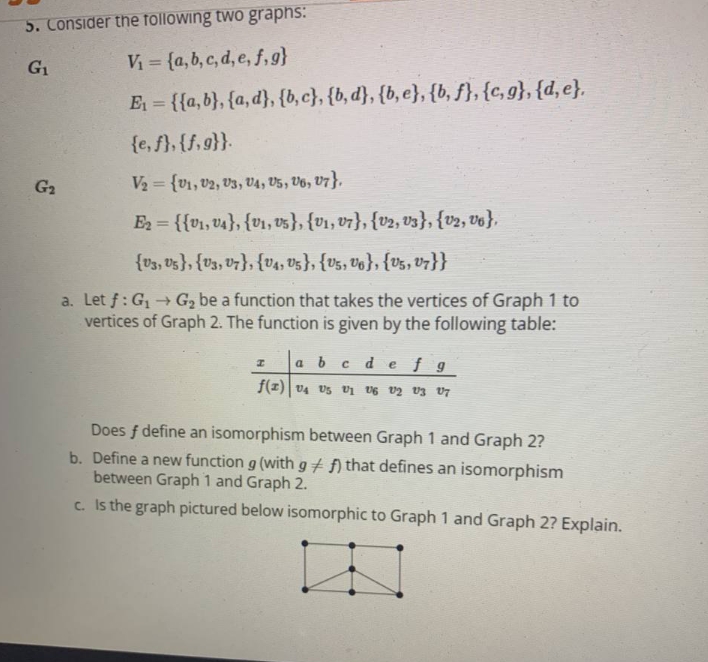
5. Consider the following two graphs: G1 Vi = {a, b, c, d, e, f, g} E1 = {{a, b}, {a, d), {b, c}, {b, d}, {b, e}, {b, f}, {c, g), {d, e}. {e, f], {f, 9}}. G2 V2 = {v1, U2, U3, U4, US, 16, 07}. E2 = { {v1, v4}, {v1, us), {v1, 07}, {v2, Us}, {v2, ve}. {v3, US), {v3, U7), (UA, US), (Us, US), [Us, U7}} a. Let f : G1 -+ G2 be a function that takes the vertices of Graph 1 to vertices of Graph 2. The function is given by the following table: I abcdefg f(2) UA US U1 06 12 UJ U7 Does f define an isomorphism between Graph 1 and Graph 2? b. Define a new function g (with g # f) that defines an isomorphism between Graph 1 and Graph 2. c. Is the graph pictured below isomorphic to Graph 1 and Graph 2? Explain
Step by Step Solution
There are 3 Steps involved in it

Get step-by-step solutions from verified subject matter experts
 Study Help