







Question: i need help asap a b and c 1. Read the following situation prudently and answer the questions that follow: [30] The developing and developed
i need help asap 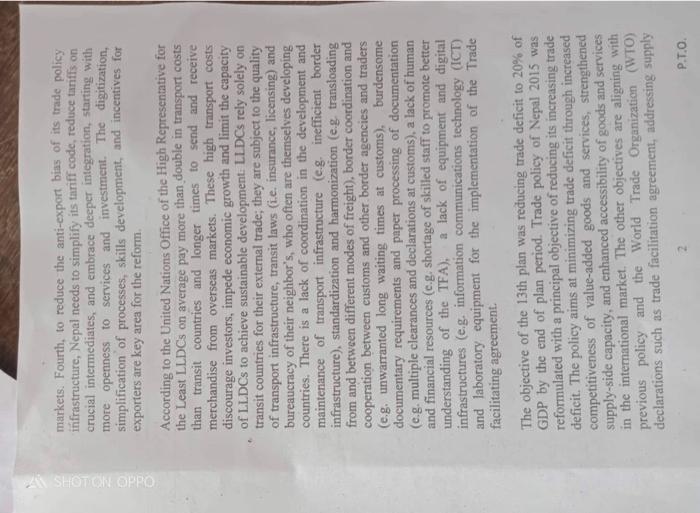
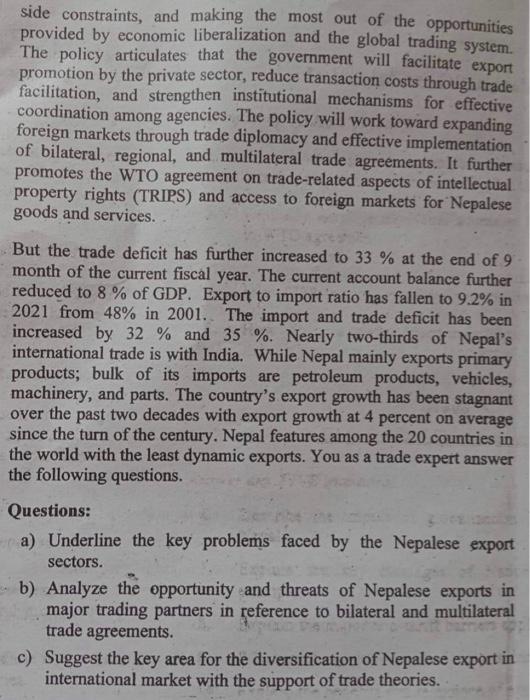
1. Read the following situation prudently and answer the questions that follow: [30] The developing and developed countries are focusing on export-led growth. Exports only bring foreign currency into the economy to finance well-needed imports, but also spur the creation of good jobs in higher value-added activities. Indeed, export orientation tends to drive productivity gains through increased scale and exposure to sophisticated global clients. The World Bank released the report has concluded that export potential of the Nepal, is 12 times higher than existing export to worth an estimated $9.2 billion, which represents an opportunity to create around 220,000 new jobs. The export potential is equivalent to current trade deficit of Nepal. The exports could help increase Nepal's economic resilience, and accelerate recovery from the devastating shock that the Covid-19 pandemic has posed for the private sector. The future dynamic export further leads additional export opportunities. Research highlighted that key obstacles are for expanding the exports are exporters size are small, and struggle with increasing their shipments once they enter a new market, rather than with the fixed cost associated with entering. This is essentially due to severe supply-side constraints that affect their trade and production costs. Second, Nepalese firms underutilize existing trade agreements and granted trade preferences provided by multilateral and bilateral agreements. Third, diversification opportunities lie in fast-growing economies in East Asia and the Pacific. Efforts regarding connectivity, trade facilitation and export intelligence could help firms get to those A SHOT ON OPPO markets. Fourth, to reduce the anti-export bias of its trade policy infrastructure, Nepal needs to simplify its tariff code, reduce tariffs on crucial intermediates, and embrace deeper integration, starting with more openness to services and investment. The digitization, simplification of processes, skills development, and incentives for exporters are key area for the reform. According to the United Nations Office of the High Representative for the Least LLDCs on average pay more than double in transport costs than transit countries and longer times to send and receive merchandise from overseas markets. These high transport costs discourage investors, impede economic growth and limit the capacity of LLDCs to achieve sustainable development: LLDCs rely solely on transit countries for their external trade; they are subject to the quality of transport infrastructure, transit laws (i.e. insurance, licensing) and bureaucracy of their neighbor's, who often are themselves developing countries. There is a lack of coordination in the development and maintenance of transport infrastructure (e.g. inefficient border infrastructure), standardization and harmonization (e.g. transloading from and between different modes of freight), border coordination and cooperation between customs and other border agencies and traders (e.g. unwarranted long waiting times at customs), burdensome documentary requirements and paper processing of documentation (e.g. multiple clearances and declarations at customs), a lack of human and financial resources (e.g. shortage of skilled staff to promote better understanding of the TFA), a lack of equipment and digital infrastructures (e.g. information communications technology (ICT) and laboratory equipment for the implementation of the Trade facilitating agreement. The objective of the 13th plan was reducing trade deficit to 20% of GDP by the end of plan period. Trade policy of Nepal 2015 was reformulated with a principal objective of reducing its increasing trade deficit. The policy aims at minimizing trade deficit through increased competitiveness of value-added goods and services, strengthened supply-side capacity, and enhanced accessibility of goods and services in the international market. The other objectives are aligning with previous policy and the World Trade Organization (WTO) declarations such as trade facilitation agreement, addressing supply 2 P.T.O. side constraints, and making the most out of the opportunities provided by economic liberalization and the global trading system. The policy articulates that the government will facilitate export promotion by the private sector, reduce transaction costs through trade facilitation, and strengthen institutional mechanisms for effective coordination among agencies. The policy will work toward expanding foreign markets through trade diplomacy and effective implementation of bilateral, regional, and multilateral trade agreements. It further promotes the WTO agreement on trade-related aspects of intellectual property rights (TRIPS) and access to foreign markets for Nepalese goods and services. But the trade deficit has further increased to 33 % at the end of 9 month of the current fiscal year. The current account balance further reduced to 8% of GDP. Export to import ratio has fallen to 9.2% in 2021 from 48% in 2001. The import and trade deficit has been increased by 32 % and 35 %. Nearly two-thirds of Nepal's international trade is with India. While Nepal mainly exports primary products; bulk of its imports are petroleum products, vehicles, machinery, and parts. The country's export growth has been stagnant over the past two decades with export growth at 4 percent on average since the turn of the century. Nepal features among the 20 countries in the world with the least dynamic exports. You as a trade expert answer the following questions. Questions: a) Underline the key problems faced by the Nepalese export sectors. b) Analyze the opportunity and threats of Nepalese exports in major trading partners in reference to bilateral and multilateral trade agreements. c) Suggest the key area for the diversification of Nepalese export in international market with the support of trade theories a b and c 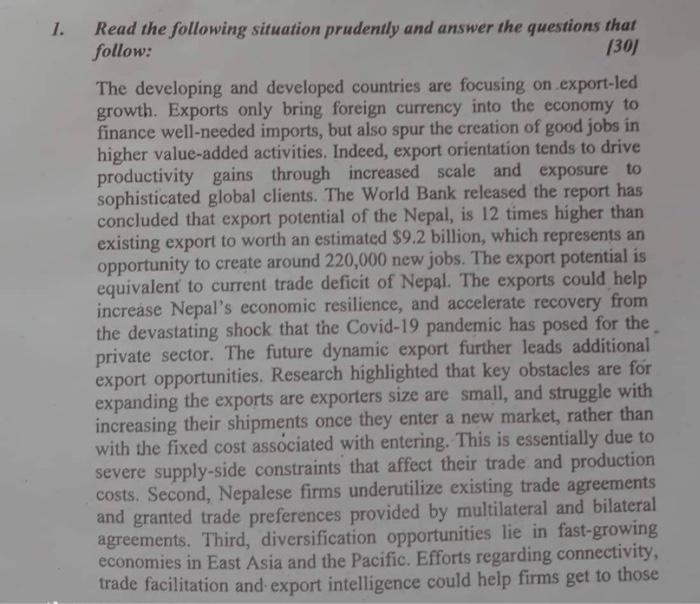
Step by Step Solution
There are 3 Steps involved in it
1 Expert Approved Answer
Step: 1 Unlock

Question Has Been Solved by an Expert!
Get step-by-step solutions from verified subject matter experts
Step: 2 Unlock
Step: 3 Unlock
 Study Help