







Question: I need help coding the following program in r For each integer number n from 1 to 10, use 1000 simulations of S_n to estimate
I need help coding the following program in r
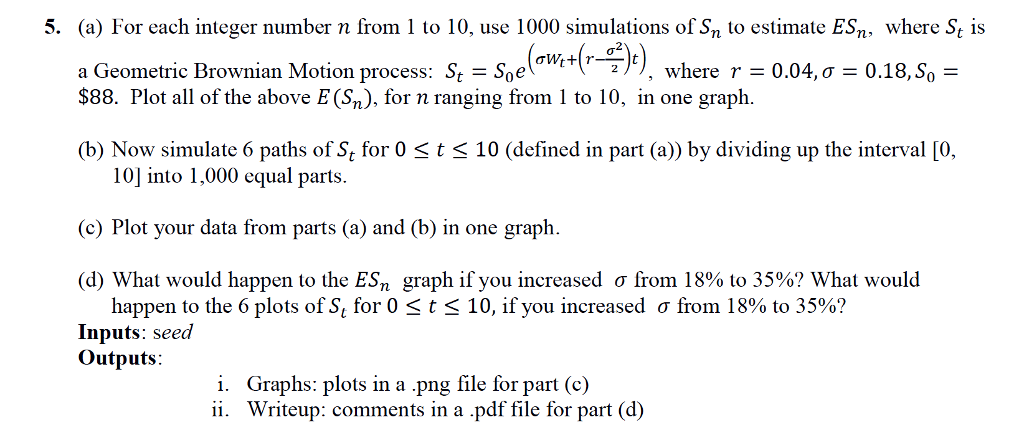
For each integer number n from 1 to 10, use 1000 simulations of S_n to estimate ES_n, where S_t is a Geometric Brownian Motion process: S_t = S_0 e(sigma W_t + (r sigma^2/2)t), where r = 0.04, sigma = 0.18, S_0 = $88. Plot all of the above E (S_n), for n ranging from 1 to 10, in one graph. (b) Now simulate 6 paths of S_t for 0 lessthanorequalto t lessthanorequalto 10 (defined in part (a)) by dividing up the interval [0, 10] into 1,000 equal parts. (c) Plot your data from parts (a) and (b) in one graph. (d) What would happen to the ES_n graph if you increased sigma from 18% to 35%? What would happen to the 6 plots of S_t for 0 lessthanorequalto t lessthanorequalto 10, if you increased sigma from 18% to 35%? Inputs: seed Outputs: i. Graphs: plots in a .png file for part (c) ii. Writeup: comments in a .pdf tile for part (d) For each integer number n from 1 to 10, use 1000 simulations of S_n to estimate ES_n, where S_t is a Geometric Brownian Motion process: S_t = S_0 e(sigma W_t + (r sigma^2/2)t), where r = 0.04, sigma = 0.18, S_0 = $88. Plot all of the above E (S_n), for n ranging from 1 to 10, in one graph. (b) Now simulate 6 paths of S_t for 0 lessthanorequalto t lessthanorequalto 10 (defined in part (a)) by dividing up the interval [0, 10] into 1,000 equal parts. (c) Plot your data from parts (a) and (b) in one graph. (d) What would happen to the ES_n graph if you increased sigma from 18% to 35%? What would happen to the 6 plots of S_t for 0 lessthanorequalto t lessthanorequalto 10, if you increased sigma from 18% to 35%? Inputs: seed Outputs: i. Graphs: plots in a .png file for part (c) ii. Writeup: comments in a .pdf tile for part (d)
Step by Step Solution
There are 3 Steps involved in it

Get step-by-step solutions from verified subject matter experts
 Study Help