Question: I need help composing a short answer question.that references the passage content, I also need the answer included. i have attached requirement sheet, please ask
I need help composing a short answer question.that references the passage content, I also need the answer included. i have attached requirement sheet, please ask question if you need
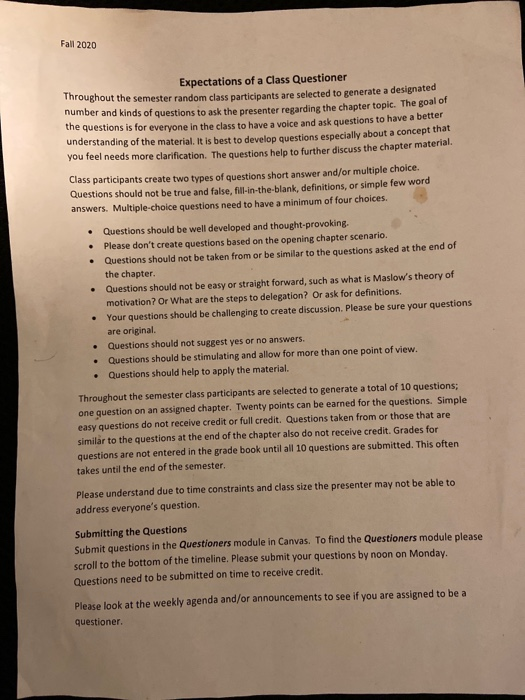
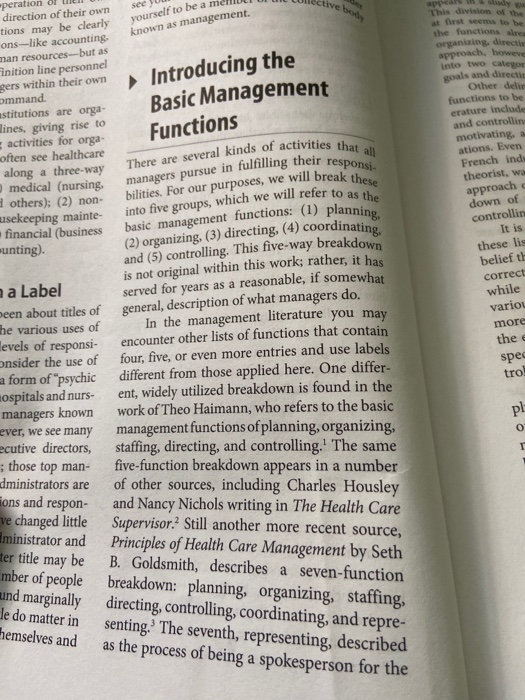
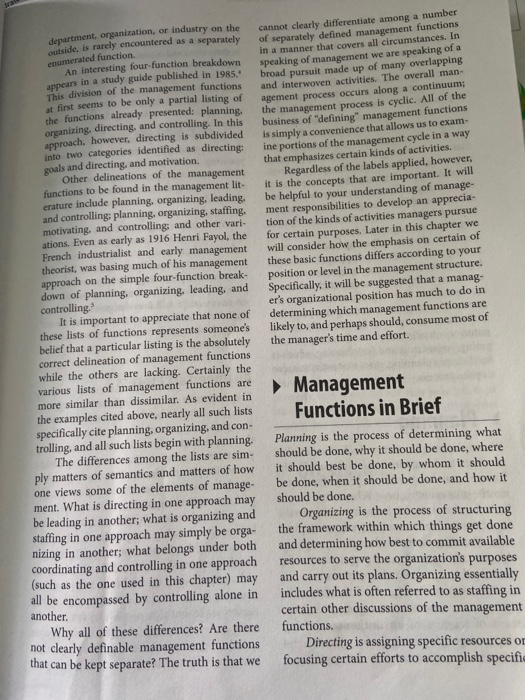
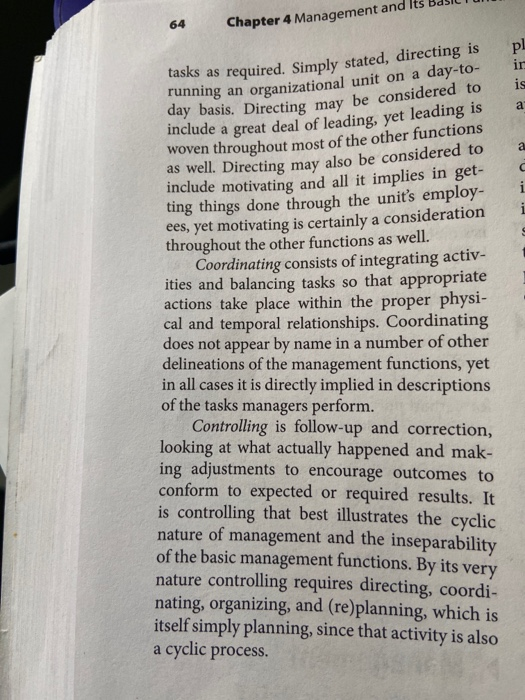
Fall 2020 . Expectations of a Class Questioner Throughout the semester random class participants are selected to generate a designated number and kinds of questions to ask the presenter regarding the chapter topic. The goal of the questions is for everyone in the class to have a voice and ask questions to have a better understanding of the material. It is best to develop questions especially about a concept that you feel needs more clarification. The questions help to further discuss the chapter material. Class participants create two types of questions short answer and/or multiple choice. Questions should not be true and false, fill-in-the-blank, definitions, or simple few word answers. Multiple-choice questions need to have a minimum of four choices. Questions should be well developed and thought-provoking. Please don't create questions based on the opening chapter scenario. Questions should not be taken from or be similar to the questions asked at the end of the chapter Questions should not be easy or straight forward, such as what is Maslow's theory of motivation? Or What are the steps to delegation? Or ask for definitions. Your questions should be challenging to create discussion. Please be sure your questions are original Questions should not suggest yes or no answers. Questions should be stimulating and allow for more than one point of view. Questions should help to apply the material. Throughout the semester class participants are selected to generate a total of 10 questions; one question on an assigned chapter Twenty points can be earned for the questions. Simple easy questions do not receive credit or full credit. Questions taken from or those that are similar to the questions at the end of the chapter also do not receive credit. Grades for questions are not entered in the grade book until all 10 questions are submitted. This often takes until the end of the semester. . Please understand due to time constraints and class size the presenter may not be able to address everyone's question. Submitting the Questions Submit questions in the Questioners module in Canvas. To find the Questioners module please scroll to the bottom of the timeline. Please submit your questions by noon on Monday. Questions need to be submitted on time to receive credit. Please look at the weekly agenda and/or announcements to see if you are assigned to be a questioner. ve body yourself to be a known as management. This division of the at ft seems to be the functions are organising, directe approach. howeve into two categor goals and directie Other delu functions to be Introducing the Functions There are several kinds of activities that all managers pursue in fulfilling their responsi- bilities. For our purposes, we will break these into five groups, which we will refer to as the basic management functions: (1) planning, operation of direction of their own tions may be clearly ons-like accounting man resources-but as inition line personnel gers within their own ommand. nstitutions are orga- Basic Management Hines, giving rise to activities for orga often see healthcare along a three-way medical (nursing others); (2) non- usekeeping mainte- financial (business wunting) (2) organizing, (3) directing, (4) coordinating and (5) controlling. This five-way breakdown is not original within this work; rather, it has a Label served for years as a reasonable, if somewhat do. been about titles of general, description of what managers the various uses of In the management literature you may levels of responsi- encounter other lists of functions that contain onsider the use of four, five, or even more entries and use labels a form of "psychic different from those applied here. One differ- hospitals and nurs ent, widely utilized breakdown is found in the managers known work of Theo Haimann, who refers to the basic ever, we see many management functions of planning, organizing, ecutive directors, staffing, directing, and controlling. The same those top man five-function breakdown appears in a number administrators are of other sources, including Charles Housley and Nancy Nichols writing in The Health Care ve changed little erature include and controlling motivating, ations. Even French inds theorist, wa approach down of controllin It is these lis belief th correct while variou more the e spec tro PL 0 1 Fons and respon- Supervisor. Still another more recent source, Iministrator and Principles of Health Care Management by Seth ater title may be B. Goldsmith, describes a seven-function mber of people breakdown: planning, organizing, staffing, and marginally directing, controlling, coordinating, and repre- le do matter in senting. The seventh, representing, described hemselves and as the process of being a spokesperson for the cannot clearly differentiate among a number of separately defined management functions in a manner that covers all circumstances. In speaking of management we are speaking of a broad pursuit made up of many overlapping and interwoven activities. The overall man- agement process occurs along a continuum; the management process is cyclic. All of the business of "defining" management functions is simply a convenience that allows us to exam- ine portions of the management cycle in a way that emphasizes certain kinds of activities. Regardless of the labels applied, however, it is the concepts that are important. It will be helpful to your understanding of manage- ment responsibilities to develop an apprecia- tion of the kinds of activities managers pursue for certain purposes. Later in this chapter we will consider how the emphasis on certain of these basic functions differs according to your position or level in the management structure. Specifically, it will be suggested that a manag- er's organizational position has much to do in determining which management functions are likely to and perhaps should consume most of the manager's time and effort. department, organization, or industry on the outside, is rarely encountered as a separately enumerated function. An interesting four-function breakdown appears in a study guide published in 1985. This division of the management functions at first seems to be only a partial listing of the functions already presented: planning. organizing directing, and controlling. In this approach, however, directing is subdivided into two categories identified as directing: goals and directing, and motivation. Other delineations of the management functions to be found in the management lit- erature include planning, organizing, leading, and controlling planning, organizing, staffing, motivating, and controlling, and other vari- ations. Even as early as 1916 Henri Fayol, the French industrialist and early management theorist, was basing much of his management approach on the simple four-function break- down of planning, organizing, leading, and controlling. It is important to appreciate that none of these lists of functions represents someone's belief that a particular listing is the absolutely correct delineation of management functions while the others are lacking. Certainly the various lists of management functions are more similar than dissimilar. As evident in the examples cited above, nearly all such lists specifically cite planning, organizing and con- trolling, and all such lists begin with planning. The differences among the lists are sim- ply matters of semantics and matters of how one views some of the elements of manage ment. What is directing in one approach may be leading in another; what is organizing and staffing in one approach may simply be orga- nizing in another; what belongs under both coordinating and controlling in one approach (such as the one used in this chapter) may all be encompassed by controlling alone in another Why all of these differences? Are there not clearly definable management functions that can be kept separate? The truth is that we Management Functions in Brief Planning is the process of determining what should be done, why it should be done, where it should best be done, by whom it should be done, when it should be done, and how it should be done. Organizing is the process of structuring the framework within which things get done and determining how best to commit available resources to serve the organization's purposes and carry out its plans. Organizing essentially includes what is often referred to as staffing in certain other discussions of the management functions. Directing is assigning specific resources on focusing certain efforts to accomplish specific 64 Chapter 4 Management and its pl ir is a C i tasks as required. Simply stated, directing is running an organizational unit on a day-to- day basis. Directing may be considered to include a great deal of leading, yet leading is woven throughout most of the other functions as well . Directing may also be considered to include motivating and all it implies in get- ting things done through the unit's employ- ees, yet motivating is certainly a consideration throughout the other functions as well. Coordinating consists of integrating activ- ities and balancing tasks so that appropriate actions take place within the proper physi- cal and temporal relationships. Coordinating does not appear by name in a number of other delineations of the management functions, yet in all cases it is directly implied in descriptions of the tasks managers perform. Controlling is follow-up and correction, looking at what actually happened and mak- ing adjustments to encourage outcomes to conform to expected or required results. It is controlling that best illustrates the cyclic nature of management and the inseparability of the basic management functions. By its very nature controlling requires directing, coordi- nating, organizing, and (re)planning, which is itself simply planning, since that activity is also a cyclic process









 Study Help