







Question: I need help creating a reverse outline for this article Authors: Kim K.P. Johnson and Sharon Lennon Table of Contents What is the Social Psychology
I need help creating a reverse outline for this article
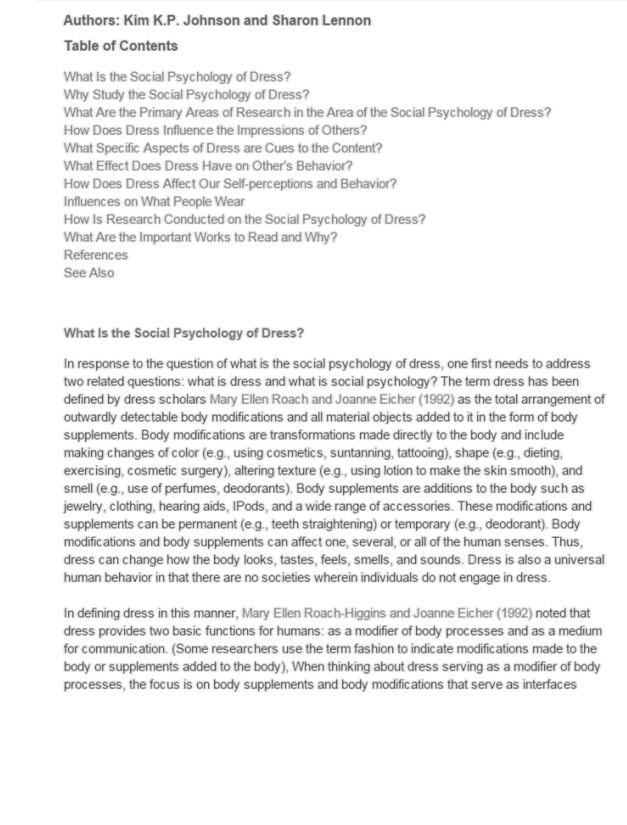
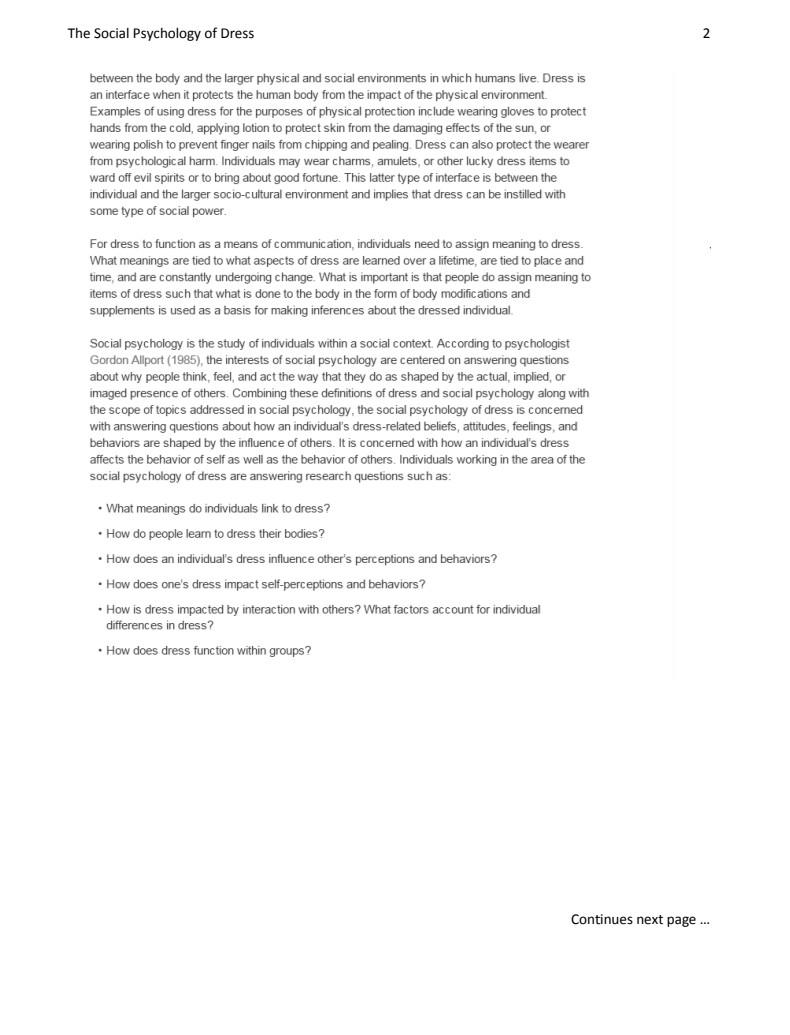
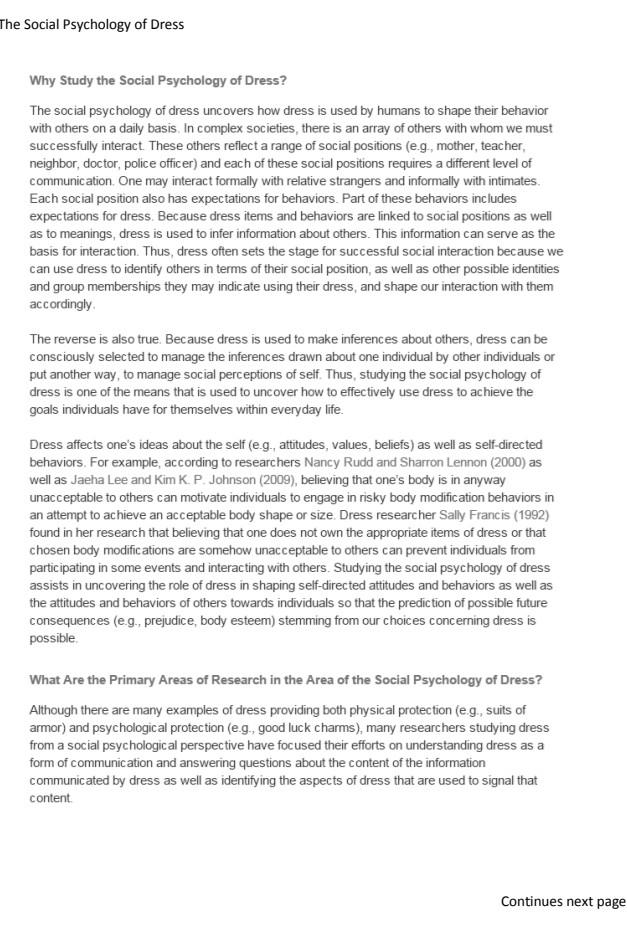
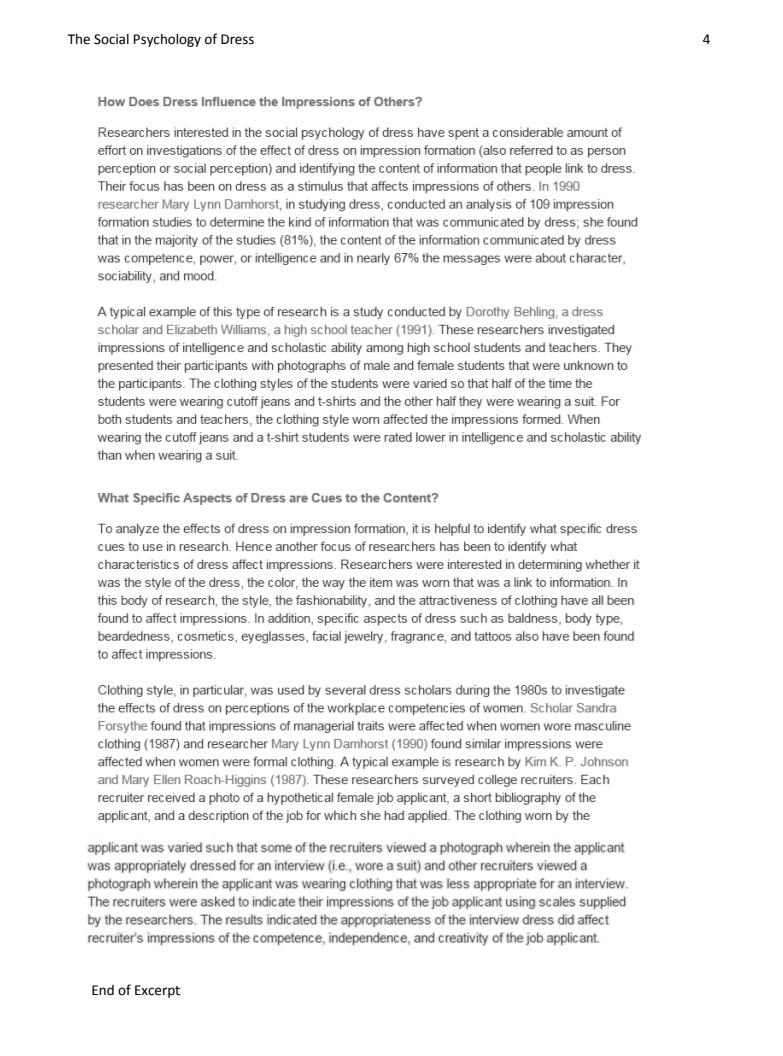
Authors: Kim K.P. Johnson and Sharon Lennon Table of Contents What is the Social Psychology of Dress? Why Study the Social Psychology of Dress? What Are the Primary Areas of Research in the Area of the Social Psychology of Dress? How Does Dress Influence the Impressions of Others? What Specific Aspects of Dress are Cues to the Content? What Effect Does Dress Have on Other's Behavior? How Does Dress Affect Our Self-perceptions and Behavior? Influences on What People Wear How is Research Conducted on the Social Psychology of Dress? What Are the Important Works to Read and Why? References See Also What Is the Social Psychology of Dress? In response to the question of what is the social psychology of dress, one first needs to address two related questions: what is dress and what is social psychology? The term dress has been defined by dress scholars Mary Ellen Roach and Joanne Eicher (1992) as the total arrangement of outwardly detectable body modifications and all material objects added to it in the form of body supplements. Body modifications are transformations made directly to the body and include making changes of color (eg, using cosmetics, suntanning, tattooing), shape (eg., dieting, exercising, cosmetic surgery), altering texture (e.g., using lotion to make the skin smooth), and smell (eg, use of perfumes, deodorants). Body supplements are additions to the body such as jewelry, clothing, hearing aids, IPods, and a wide range of accessories. These modifications and supplements can be permanent (e.g. teeth straightening) or temporary (eg, deodorant). Body modifications and body supplements can affect one, several, or all of the human senses. Thus, dress can change how the body looks, tastes, feels, smells, and sounds. Dress is also a universal human behavior in that there are no societies wherein individuals do not engage in dress. In defining dress in this manner, Mary Ellen Roach-Higgins and Joanne Eicher (1992) noted that dress provides two basic functions for humans: as a modifier of body processes and as a medium for communication (Some researchers use the term fashion to indicate modifications made to the body or supplements added to the body), When thinking about dress serving as a modifier of body processes, the focus is on body supplements and body modifications that serve as interfaces The Social Psychology of Dress 2 between the body and the larger physical and social environments in which humans live Dress is an interface when it protects the human body from the impact of the physical environment Examples of using dress for the purposes of physical protection include wearing gloves to protect hands from the cold, applying lotion to protect skin from the damaging effects of the sun, or wearing polish to prevent finger nails from chipping and pealing Dress can also protect the wearer from psychological harm. Individuals may wear charms, amulets, or other lucky dress items to ward off evil spirits or to bring about good fortune. This latter type of interface is between the individual and the larger socio-cultural environment and implies that dress can be instilled with some type of social power. For dress to function as a means of communication, individuals need to assign meaning to dress. What meanings are tied to what aspects of dress are learned over a lifetime, are tied to place and time, and are constantly undergoing change. What is important is that people do assign meaning to items of dress such that what is done to the body in the form of body modifications and supplements is used as a basis for making inferences about the dressed individual Social psychology is the study of individuals within a social context. According to psychologist Gordon Allport (1985), the interests of social psychology are centered on answering questions about why people think, feel, and act the way that they do as shaped by the actual, implied, or imaged presence of others. Combining these definitions of dress and social psychology along with the scope of topics addressed in social psychology, the social psychology of dress is concerned with answering questions about how an individual's dress-related beliefs, attitudes, feelings, and behaviors are shaped by the influence of others. It is concerned with how an individual's dress affects the behavior of self as well as the behavior of others. Individuals working in the area of the social psychology of dress are answering research questions such as: . What meanings do individuals link to dress? How do people learn to dress their bodies? How does an individual's dress influence other's perceptions and behaviors? How does one's dress impact self-perceptions and behaviors? How dress impacted by interaction with others? What factors account for individual differences in dress? How does dress function within groups? Continues next page... The Social Psychology of Dress Why Study the Social Psychology of Dress? The social psychology of dress uncovers how dress is used by humans to shape their behavior with others on a daily basis. In complex societies, there is an array of others with whom we must successfully interact These others reflect a range of social positions (e.g, mother, teacher, neighbor, doctor, police officer) and each of these social positions requires a different level of communication One may interact formally with relative strangers and informally with intimates. Each social position also has expectations for behaviors. Part of these behaviors includes expectations for dress. Because dress items and behaviors are linked to social positions as well as to meanings, dress is used to infer information about others. This information can serve as the basis for interaction. Thus, dress often sets the stage for successful social interaction because we can use dress to identify others in terms of their social position, as well as other possible identities and group memberships they may indicate using their dress, and shape our interaction with them accordingly The reverse is also true. Because dress is used to make inferences about others, dress can be consciously selected to manage the inferences drawn about one individual by other individuals or put another way, to manage social perceptions of self. Thus, studying the social psychology of dress is one of the means that is used to uncover how to effectively use dress to achieve the goals individuals have for themselves within everyday life. Dress affects one's ideas about the self (e.g., attitudes, values, beliefs) as well as self-directed behaviors. For example, according to researchers Nancy Rudd and Sharron Lennon (2000) as well as Jaeha Lee and Kim K P Johnson (2009), believing that one's body is in anyway unacceptable to others can motivate individuals to engage in risky body modification behaviors in an attempt to achieve an acceptable body shape or size Dress researcher Sally Francis (1992) found in her research that believing that one does not own the appropriate items of dress or that chosen body modifications are somehow unacceptable to others can prevent individuals from participating in some events and interacting with others. Studying the social psychology of dress assists in uncovering the role of dress in shaping self-directed attitudes and behaviors as well as the attitudes and behaviors of others towards individuals so that the prediction of possible future consequences (e.g., prejudice, body esteem) stemming from our choices concerning dress is possible What Are the Primary Areas of Research in the Area of the Social Psychology of Dress? Although there are many examples of dress providing both physical protection (eg, suits of armor) and psychological protection (e.g., good luck charms), many researchers studying dress from a social psychological perspective have focused their efforts on understanding dress as a form of communication and answering questions about the content of the information communicated by dress as well as identifying the aspects of dress that are used to signal that content Continues next page The Social Psychology of Dress 4 How Does Dress Influence the Impressions of Others? Researchers interested in the social psychology of dress have spent a considerable amount of effort on investigations of the effect of dress on impression formation (also referred to as person perception or social perception) and identifying the content of information that people link to dress. Their focus has been on dress as a stimulus that affects impressions of others. In 1990 researcher Mary Lynn Damhorst, in studying dress, conducted an analysis of 109 impression formation studies to determine the kind of information that was communicated by dress, she found that in the majority of the studies (81%), the content of the information communicated by dress was competence, power, or intelligence and in nearly 67% the messages were about character, sociability, and mood A typical example of this type of research is a study conducted by Dorothy Behling, a dress scholar and Elizabeth Williams, a high school teacher (1991). These researchers investigated impressions of intelligence and scholastic ability among high school students and teachers. They presented their participants with photographs of male and female students that were unknown to the participants. The clothing styles of the students were varied so that half of the time the students were wearing cutoff jeans and t-shirts and the other half they were wearing a suit. For both students and teachers, the clothing style worn affected the impressions formed. When wearing the cutoff jeans and a t-shirt students were rated lower in intelligence and scholastic ability than when wearing a suit What Specific Aspects of Dress are Cues to the Content? To analyze the effects of dress on impression formation, it is helpful to identify what specific dress cues to use in research. Hence another focus of researchers has been to identify what characteristics of dress affect impressions. Researchers were interested in determining whether it was the style of the dress, the color the way the item was worn that was a link to information. In this body of researchthe style, the fashionability, and the attractiveness of clothing have all been found to affect impressions. In addition, specific aspects of dress such as baldness, body type, beardedness, cosmetics, eyeglasses, facial jewelry, fragrance, and tattoos also have been found to affect impressions Clothing style, in particular, was used by several dress scholars during the 1980s to investigate the effects of dress on perceptions of the workplace competencies of women. Scholar Sandra Forsythe found that impressions of managerial traits were affected when women wore masculine clothing (1987) and researcher Mary Lynn Damhorst (1990) found similar impressions were affected when women were formal clothing. A typical example is research by Kim K P. Johnson and Mary Ellen Roach-Higgins (1987). These researchers surveyed college recruiters. Each recruiter received a photo of a hypothetical female job applicant, a short bibliography of the applicant and a description of the job for which she had applied. The clothing worn by the applicant was varied such that some of the recruiters viewed a photograph wherein the applicant was appropriately dressed for an interview (ie, wore a suit) and other recruiters viewed a photograph wherein the applicant was wearing clothing that was less appropriate for an interview. The recruiters were asked to indicate their impressions of the job applicant using scales supplied by the researchers. The results indicated the appropriateness of the interview dress did affect recruiter's impressions of the competence, independence, and creativity of the job applicant End of ExcerptStep by Step Solution
There are 3 Steps involved in it
1 Expert Approved Answer
Step: 1 Unlock

Question Has Been Solved by an Expert!
Get step-by-step solutions from verified subject matter experts
Step: 2 Unlock
Step: 3 Unlock
 Study Help