







Question: I need help except a b c d. Thank you so much. Exercise 8.4 Consider a consumer that orders his preferences according to the following
I need help except a b c d. Thank you so much.
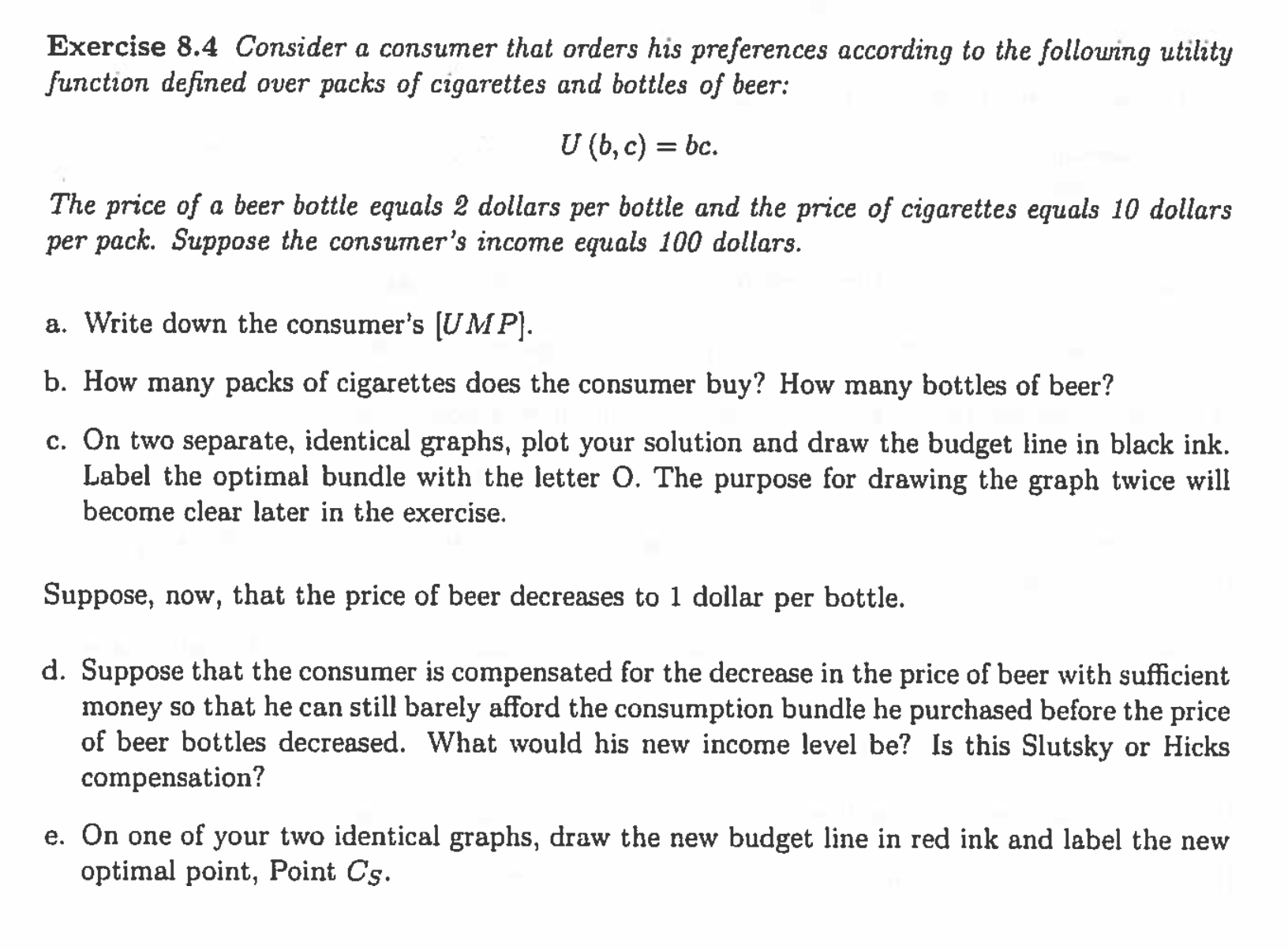
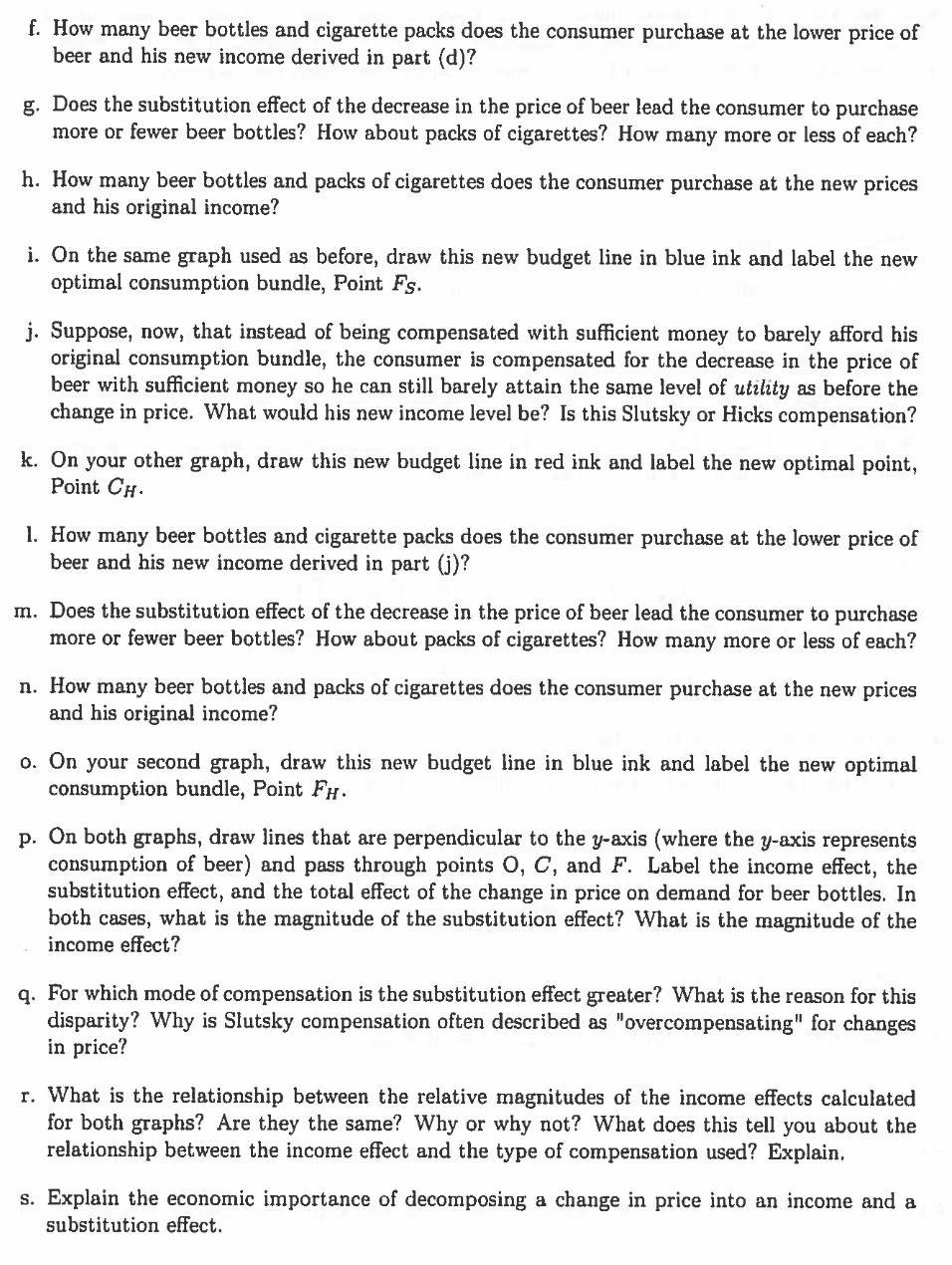
Exercise 8.4 Consider a consumer that orders his preferences according to the following utility function dened over packs of cigarettes and bottles of beer: U (b, c) = bc. The price of a beer bottle equals 2 dollars per bottle and the price of cigarettes equals 10 dollars per pack. Suppose the consumer's income equals 100 dollars. a. Write down the consumer's [UMP]. b. How many packs of cigarettes does the consumer buy? How many bottles of beer? c. On two separate, identical graphs. plot your solution and draw the budget line in black ink. Label the optimal bundle with the letter O. The purpose for drawing the graph twice will becorne clear later in the exercise. Suppose, now, that the price of beer decreases to 1 dollar per bottle. (1. Suppose that the consumer is compensated for the decrease in the price of beer with sufcient money so that he can still barely afford the consumption bundle he purchased before the price of beer bottles decreased. What would his new income level be? Is this Slutsky or Hicks compensation? e. On one of your two identical graphs, draw the new budget line in red ink and label the new optimal point, Point Cs. f. How many beer bottles and cigarette packs does the consumer purchase at the lower price of beer and his new income derived in part (d)? g. Does the substitution effect of the decrease in the price of beer lead the consumer to purchase more or fewer beer bottles? How about packs of cigarettes? How many more or less of each? h. How many beer bottles and packs of cigarettes does the consumer purchase at the new prices and his original income? i. On the some graph used as before, draw this new budget line in blue ink and label the new optimal consumption bundle, Point F3. j. Suppose, now, that instead of being compensated with sufcient money to barely afford his original consumption bundle, the consumer is compensated for the decrease in the price of beer with suihcient money so he can still barely attain the same level of utility as before the change in price. What would his new income level be? Is this Slutsky or Hicks compensatiou? k. On your other graph, draw this new budget line in red ink and label the new optimal point. Point 03. 1. How many beer bottles and cigarette packs does the consumer purchase at the lower price of beer and his new income derived in part (j)? m. Does the substitution effect of the decrease in the price of beer lead the consumer to purchase more or fewer beer bottles? How about packs of cigarettes? How many more or less of each? n. How many beer bottles and packs of cigarettes does the consumer purchase at the new prices and his original income? 0. On your second graph. draw this new budget line in blue ink and label the new optimal consumption bundle, Point PH. p. On both graphs. draw lines that are perpendicular to the y-axis (where the yaxis represents consumption of beer) and pass through points 0, C, and F. Label the income effect, the substitution effect, and the total effect of the change in price on demand for beer bottles. In both cases, what is the magnitude of the substitution effect? What is the magnitude of the income effect? q. For which mode of compensation is the substitution e'ect greater? What is the reason for this diSparity? Why is Slutsky compensation often described as "overcompensating" for changes in price? 1'. What is the relationship between the relative magnitudes of the income effects calculated for both graphs? Are they the same? Why or why not? What does this tell you about the relationship between the income effect and the type of compensation used? Explain. 5. Explain the economic importance of decomposing a change in price into an income and a substitution effect
Step by Step Solution
There are 3 Steps involved in it

Get step-by-step solutions from verified subject matter experts
 Study Help