







Question: i need help finding the solutions to table 7 and 8, i have included the equations and steps involved. Third Run Linear Kinematics Time (s)
i need help finding the solutions to table 7 and 8, i have included the equations and steps involved.
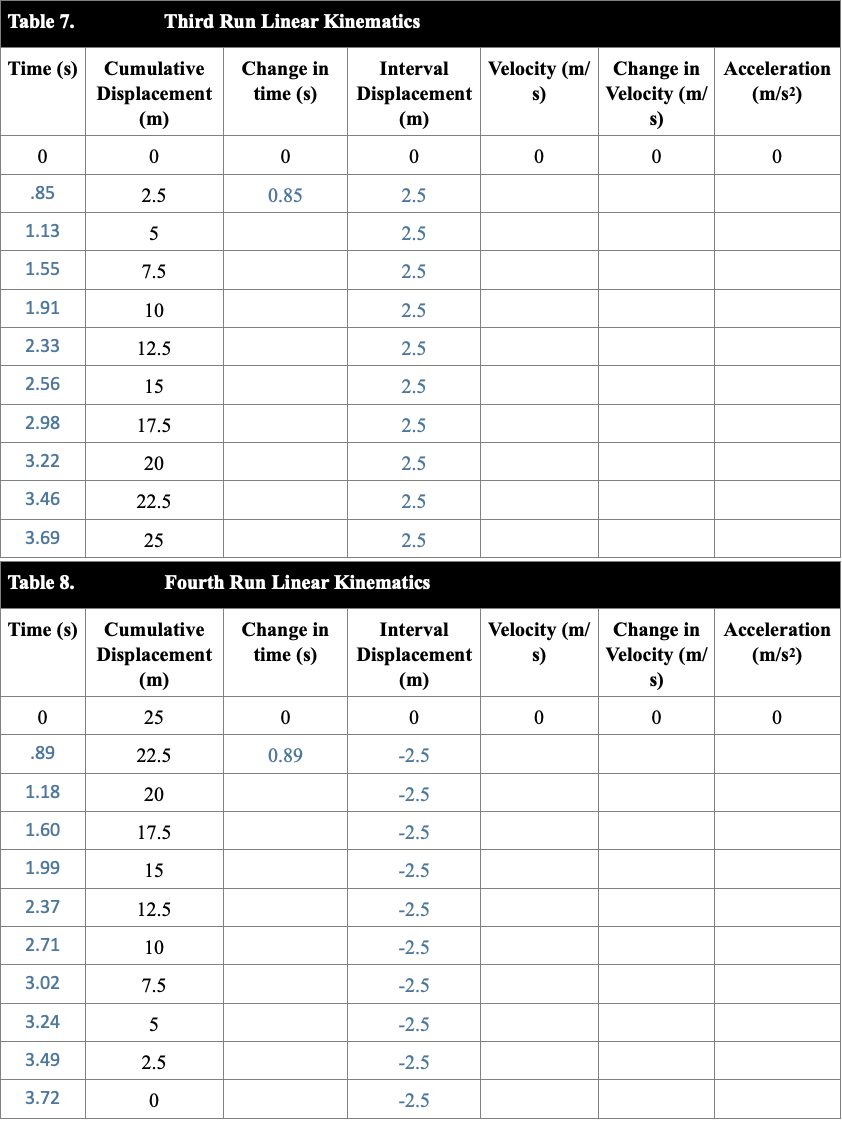
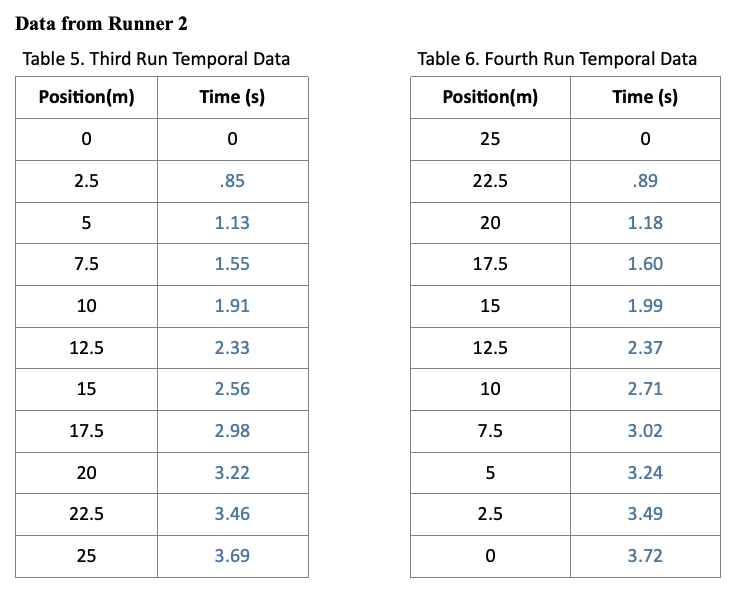
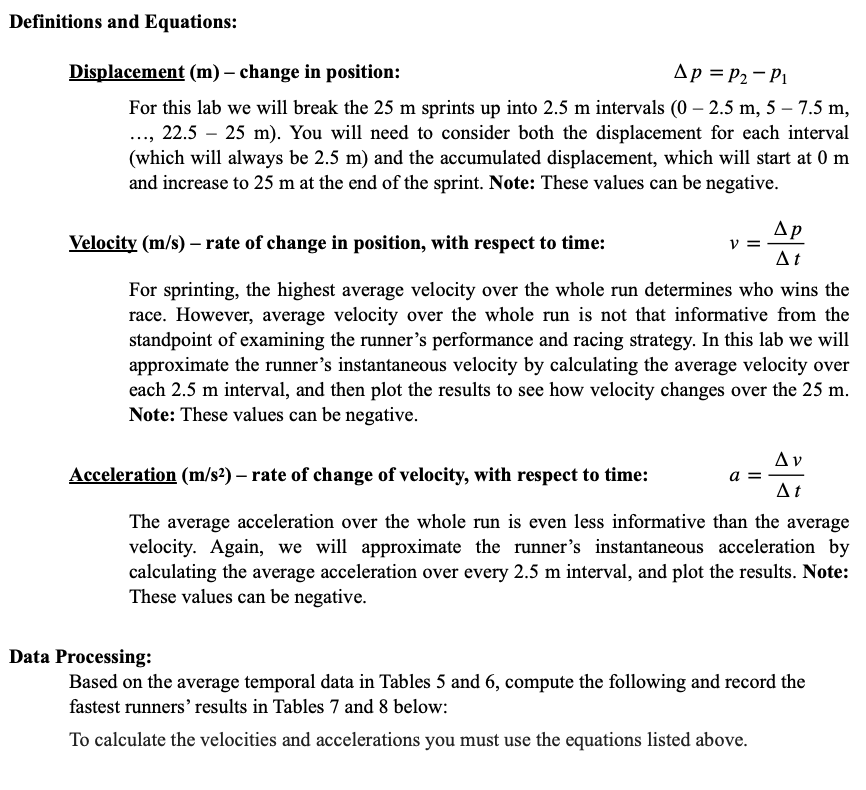
Third Run Linear Kinematics Time (s) Cumulative Change in Interval Velocity (to! Change in Acceleration Displacement time (3) Displacement 3) Velocity (ml (mfg?) (III) (III) S) 0 0 0 0 0 0 0 2.5 2.5 Fourth Run Linear Kinematics Time (s) Cumulative Change in Interval Velocity (to! Change in Acceleration Displacement time (1:) Displacement s) Velocity (ml (mfsz) (III) (III) II) 0 25 0 0 0 0 0 .89 22.5 0.89 -2.5 1.18 20 -2.5 1-50 17.5 -2.5 1.99 15 -2.5 2.37 12.5 -2.5 2.71 10 -2.5 3.02 7_ 5 -2.5 3.24 5 .25 3.49 2.5 -2.5 3.72 0 -2.5 Data from Runner 2 Table 5. Third Run Temporal Data Table 6. Fourth Run Temporal Data Position(m) Time (s) Position(m) Time (s) 0 0 25 0 2.5 .85 22.5 .89 5 1.13 20 1.18 7.5 1.55 17.5 1.60 10 1.91 15 1.99 12.5 2.33 12.5 2.37 15 2.56 10 2.71 17.5 2.98 7.5 3.02 20 3.22 5 3.24 22.5 3.46 2.5 3.49 25 3.69 0 3.72Denitions and Equations: Displagmgnt (m) change in position: A P = P2 P1 For this lab we will break the 25 m sprints up into 2.5 m intervals (0 2.5 m, 5 7.5 m, 22.5 25 m). You will need to consider both the displacement for each interval (which will always be 2.5 m) and the accumMated displacement, which will start at 0 m and increase to 25 m at the end of the sprint. Note: These values can be negative. Velocity; (mfs) rate of change in position, with respect to time: v = % For sprinting, the highest average velocity over the whole run determines who wins the race. However, average velocity over the whole run is not that informative from the standpoint of examining the runner's performance and racing strategy. In this lab we will approximate the runner's instantaneous velocity by calculating the average velocity over each 2.5 m interval, and then plot the results to see how velocity changes over the 25 m. Note: These values can be negative. A v Amleratlon (mfsz) rate of change of velocity, with respect to time: a = E The average acceleration over the whole run is even less informative than the average velocity. Again, we will approximate the runner's instantaneous acceleration by calculating the average acceleration over every 2.5 m interval, and plot the results. Note: These values can be negative. Data Processing: Based on the average temporal data in Tables 5 and 6, compute the following and record the fastest runners' results in Tables 7 and 8 below: To calculate the velocities and accelerations you must use the equations listed above
Step by Step Solution
There are 3 Steps involved in it

Get step-by-step solutions from verified subject matter experts
 Study Help