Question: I need help for these two problems please. Example 4.2. The blue whale and n whale are two similar species that inhabit the same areas.
I need help for these two problems please.
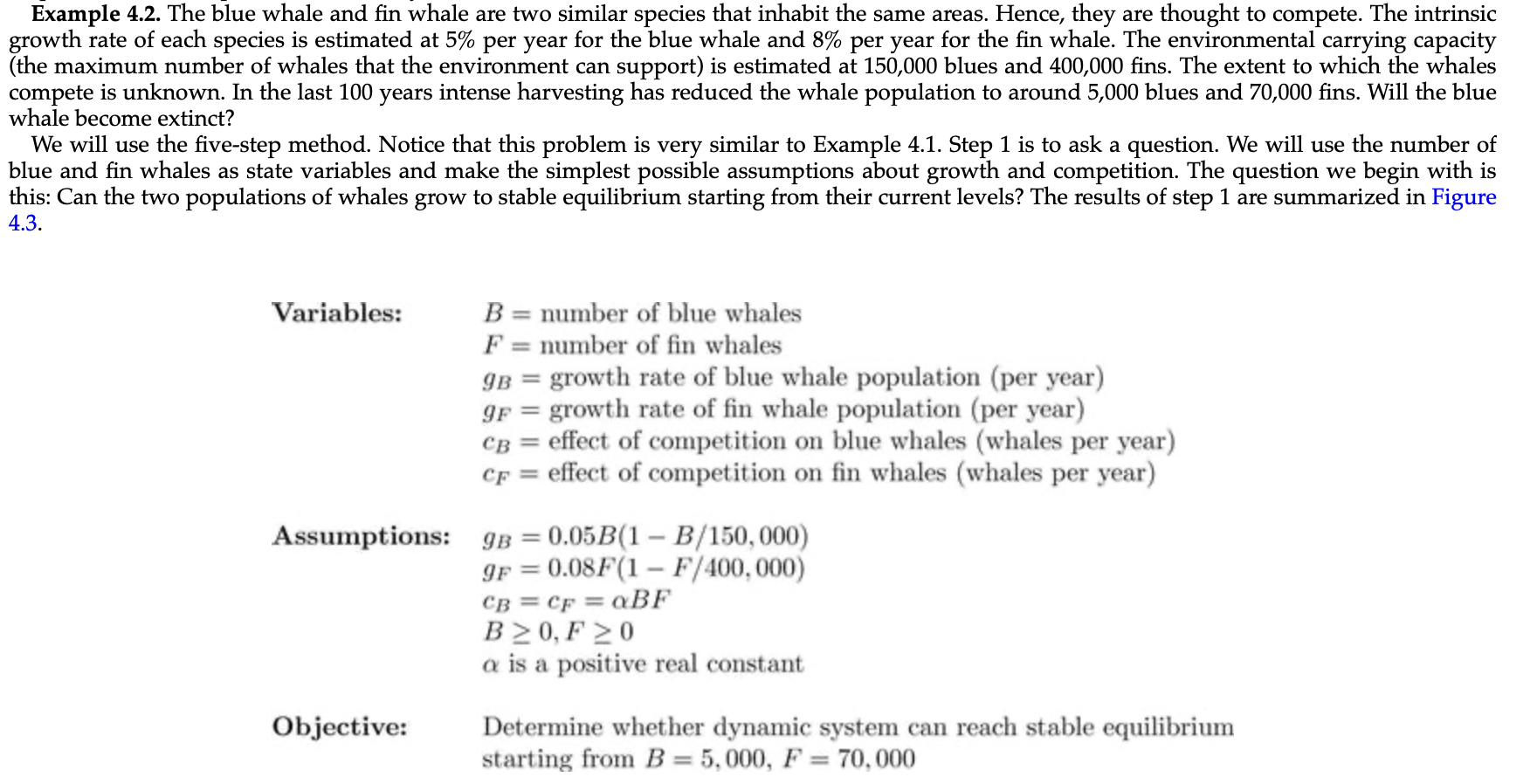
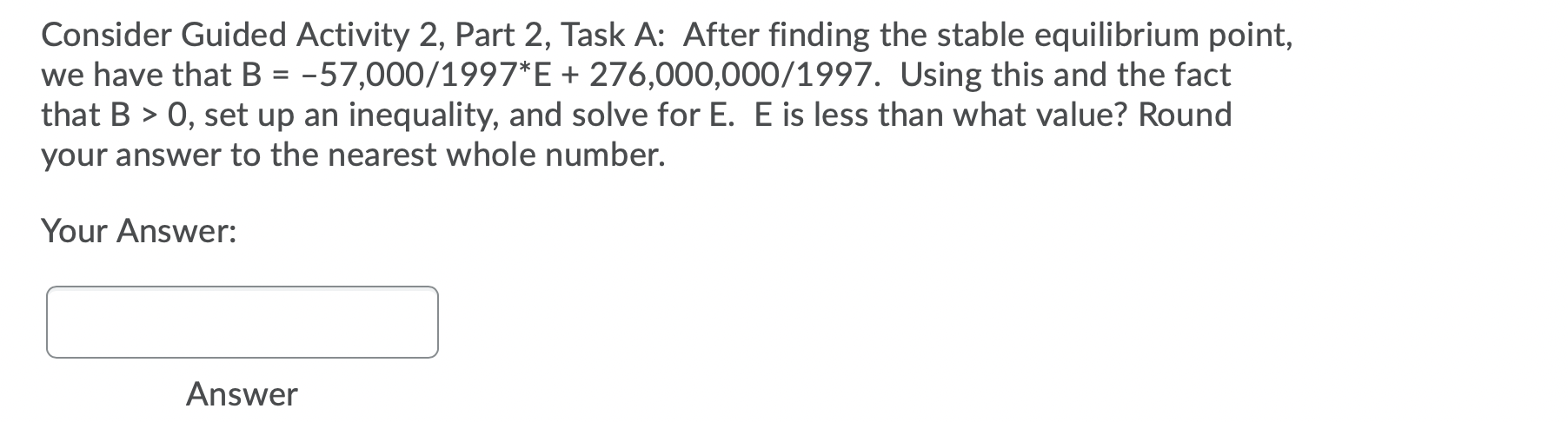
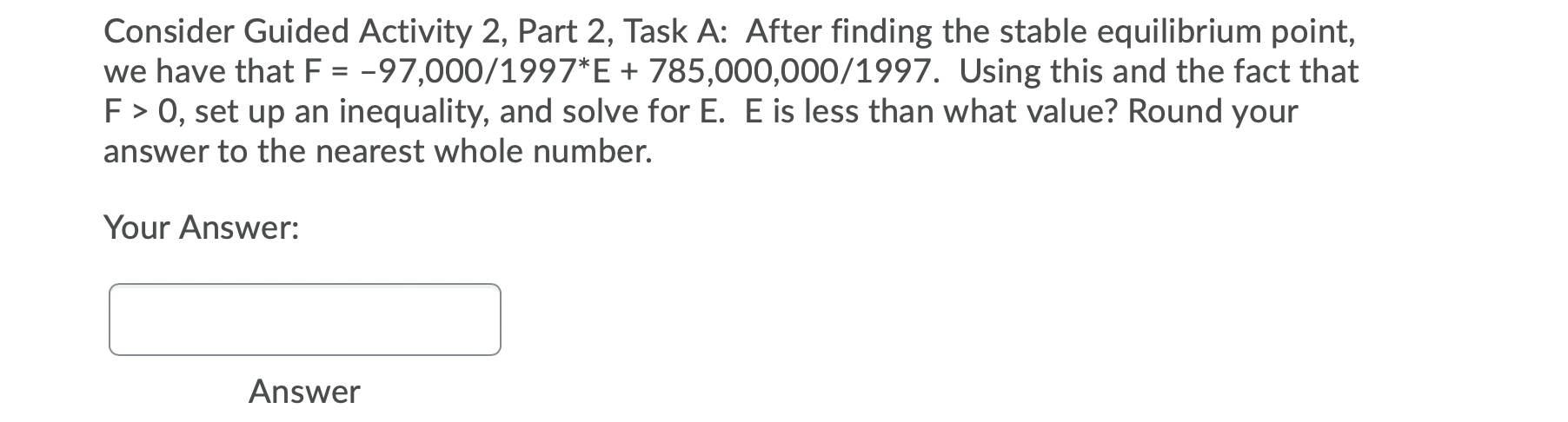
Example 4.2. The blue whale and n whale are two similar species that inhabit the same areas. Hence, they are thought to compete. The intrinsic growth rate of each species is estimated at 5% per year for the blue whale and 8% per year for the n whale. The environmental carrying capacity (the maximum number of whales that the environment can support) is estimated at 150,000 blues and 400,000 ns. The extent to which the whales compete is unknown. In the last 100 years intense harvesting has reduced the whale population to around 5,000 blues and 70,000 ns. Will the blue whale become extinct? We will use the ve-step method. Notice that this problem is very similar to Example 4.1. Step 1 is to ask a question. We will use the number of blue and n whales as state variables and make the simplest possible assumptions about growth and competition. The question we begin with is this: Can the two populations of whales grow to stable equilibrium starting from their current levels? The results of step 1 are summarized in Figure 4.3. Variables: B = number of blue whales F = number of n whales 9;; = growth rate of blue whale population (per year) gp = growth rate of n whale population (per year) 05 = effect of competition on blue whales (whales per year) c1: = effect of competition on n whales (whales per year) Assumptions: 9;; = 0.058(1 3/150. 000) g;- = 0081\"\" - 19/400. 000) ca = c;- = 03!" B 2 0. F 2 0 a is a positive real constant Objective: Determine whether dynamic system can reach stable equilibrium starting from B = 5.000. F = 70.000 6. Reconsider the whale problem of Example 4.2, and assume that a = 1078. In this problem we will investigate the effects of harvesting on the two whale populations. Assume that a level of effort E boat-days will result in the annual harvest of qEx, blue whales and qEx, fin whales, where the parameter q (catchability) is assumed to equal approximately 10-5. (a) Under what conditions can both species continue to coexist in the presence of harvesting? Use the five-step method, and model as a dynamical system in steady state. (b) Draw the vector field for this problem, assuming that the conditions identified in part (a) are satisfied. (c) Find the minimum level of effort required to reduce the fin whale population to its current level of around 70,000 whales. Assume that we started out with 150,000 blue whales and 400,000 fin whales before mankind began to harvest them. (d) Describe what would happen to the two populations if harvesting were allowed to continue at the level of effort identified in part (c). Draw the vector field in this case. This is the situation which led the IWC to call for an international ban on whaling.Consider Guided Activity 2, Part 2, Task A: After finding the stable equilibrium point, we have that B = 57,000/1997*E + 276,000,000/1997. Using this and the fact that B > 0, set up an inequality, and solve for E. E is less than what value? Round your answer to the nearest whole number. Your Answer: Q Answer Consider Guided Activity 2, Part 2, Task A: After finding the stable equilibrium point, we have that F = 97,000/1997*E + 785,000,000/1997. Using this and the fact that F > 0, set up an inequality, and solve for E. E is less than what value? Round your answer to the nearest whole number. Your
Step by Step Solution
There are 3 Steps involved in it
1 Expert Approved Answer
Step: 1 Unlock
Question Has Been Solved by an Expert!
Get step-by-step solutions from verified subject matter experts
Step: 2 Unlock
Step: 3 Unlock
Students Have Also Explored These Related Mathematics Questions!










 Study Help