



Question: I need help! In a randomized, placebo-controlled study, 1030 healthy women 45 years of age or older were randomly divided into two groups. The women
I need help!
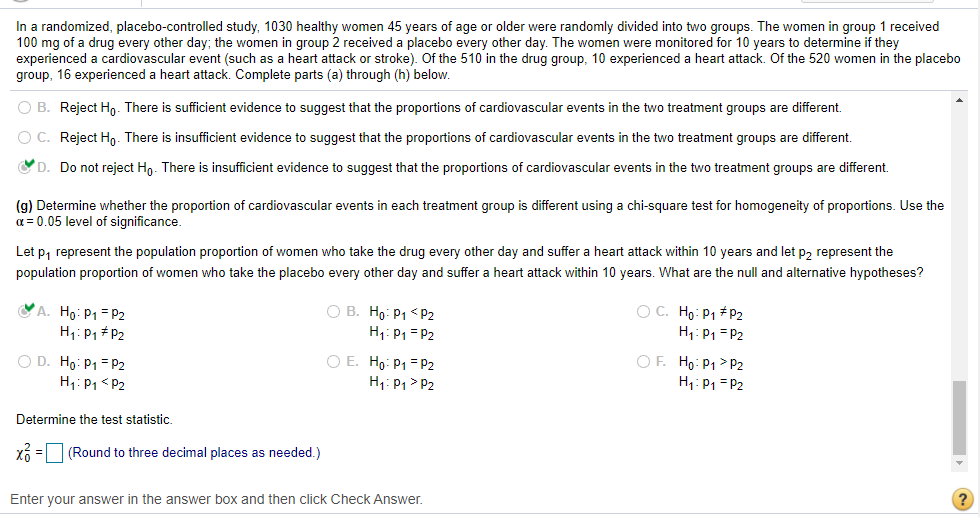
In a randomized, placebo-controlled study, 1030 healthy women 45 years of age or older were randomly divided into two groups. The women in group 1 received 100 mg of a drug every other day; the women in group 2 received a placebo every other day. The women were monitored for 10 years to determine if they experienced a cardiovascular event (such as a heart attack or stroke). Of the 510 in the drug group, 10 experienced a heart attack. Of the 520 women in the placebo group, 16 experienced a heart attack. Complete parts (a) through (h) below. O B. Reject Ho. There is sufficient evidence to suggest that the proportions of cardiovascular events in the two treatment groups are different. O C. Reject Ho. There is insufficient evidence to suggest that the proportions of cardiovascular events in the two treatment groups are different. CD. Do not reject Ho. There is insufficient evidence to suggest that the proportions of cardiovascular events in the two treatment groups are different. (g) Determine whether the proportion of cardiovascular events in each treatment group is different using a chi-square test for homogeneity of proportions. Use the a = 0.05 level of significance. Let p, represent the population proportion of women who take the drug every other day and suffer a heart attack within 10 years and let pz represent the population proportion of women who take the placebo every other day and suffer a heart attack within 10 years. What are the null and alternative hypotheses? A. Ho: P1 = P2 O B. Ho: P1 P2 Hy : P1 = P2 H1 : P1 > P2 H1 : P1 = P2 Determine the test statistic. x3 =(Round to three decimal places as needed.) Enter your answer in the answer box and then click Check
Step by Step Solution
There are 3 Steps involved in it

Get step-by-step solutions from verified subject matter experts