







Question: I need help in building this program ().pdf ta/Local plackages Microsoft MicrosoftEdge Bwekyb 3di bb we Temps tate Oownle do Min,%20Pr rentors anpa This does
I need help in building this program
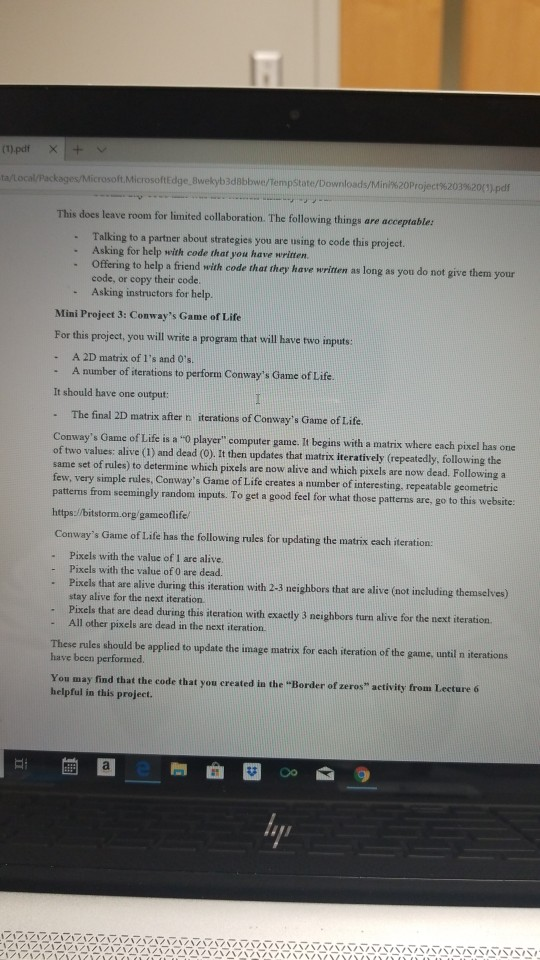
().pdf ta/Local plackages Microsoft MicrosoftEdge Bwekyb 3di bb we Temps tate Oownle do Min,%20Pr rentors anpa This does leave room for limited collaboration. The following things are acceptable: Talking to a partner about strategies you are using to code Asking for help with code that you have written Offering to help a friend with code that they have written as long as you do not give them your code, or copy their code this project - . - Asking instructors for help. Mini Project 3: Conway's Game of Life For this project, you will write a program that will have two inputs A 2D matrix of I's and O's. A number of iterations to perform Conway's Game of Life It should have one output: . The final 2D matrix after n iterations of Conway's Game of Life. Conway's Game of Life is a "O player" computer game. It begins with a matrix where each pixel has one of two values: alive (1) and dead (0). It then updates that matrix iteratively (repeatedly, following the same set of rules) to determine which pixels are few, very simple patterns now alive and which pixels are now dead. Following a e rules, Conway's Game of Life creates a number of interesting, repeatable geometrie from seemingly random inputs. To get a good feel for what those pattens are, go to this website: https:/bitstom.org/gameoflife Conway's Game of Life has the following rules for updating the matrix each iteration - Pixels with the value of I are alive. Pixels with the value of 0 are dead. Pixels that are alive during this iteration with 2-3 neighbors that are alive (not including th stay alive for the next iteration Pixels that are dead during this iteration with exactly 3 neighbors turn alive for the next iteration - All other pixels are dead in the next iteration. These rules should be applied to update the image matrix for each iteration of the game, until n iterations have been performed. You may find that the code that you created in the "Border of zeros" activity from Lecture 6 helpful in this project. 1/1/1/1/1/1/1/1/1/1/1 ().pdf ta/Local plackages Microsoft MicrosoftEdge Bwekyb 3di bb we Temps tate Oownle do Min,%20Pr rentors anpa This does leave room for limited collaboration. The following things are acceptable: Talking to a partner about strategies you are using to code Asking for help with code that you have written Offering to help a friend with code that they have written as long as you do not give them your code, or copy their code this project - . - Asking instructors for help. Mini Project 3: Conway's Game of Life For this project, you will write a program that will have two inputs A 2D matrix of I's and O's. A number of iterations to perform Conway's Game of Life It should have one output: . The final 2D matrix after n iterations of Conway's Game of Life. Conway's Game of Life is a "O player" computer game. It begins with a matrix where each pixel has one of two values: alive (1) and dead (0). It then updates that matrix iteratively (repeatedly, following the same set of rules) to determine which pixels are few, very simple patterns now alive and which pixels are now dead. Following a e rules, Conway's Game of Life creates a number of interesting, repeatable geometrie from seemingly random inputs. To get a good feel for what those pattens are, go to this website: https:/bitstom.org/gameoflife Conway's Game of Life has the following rules for updating the matrix each iteration - Pixels with the value of I are alive. Pixels with the value of 0 are dead. Pixels that are alive during this iteration with 2-3 neighbors that are alive (not including th stay alive for the next iteration Pixels that are dead during this iteration with exactly 3 neighbors turn alive for the next iteration - All other pixels are dead in the next iteration. These rules should be applied to update the image matrix for each iteration of the game, until n iterations have been performed. You may find that the code that you created in the "Border of zeros" activity from Lecture 6 helpful in this project. 1/1/1/1/1/1/1/1/1/1/1
Step by Step Solution
There are 3 Steps involved in it

Get step-by-step solutions from verified subject matter experts
 Study Help