







Question: I need help in creating a reference calculation and analysis so I can understand the process to calculate (using the time value of money) the
I need help in creating a reference calculation and analysis so I can understand the process to calculate (using the time value of money) the amount of money you will need to save to meet your own personal retirement goal.
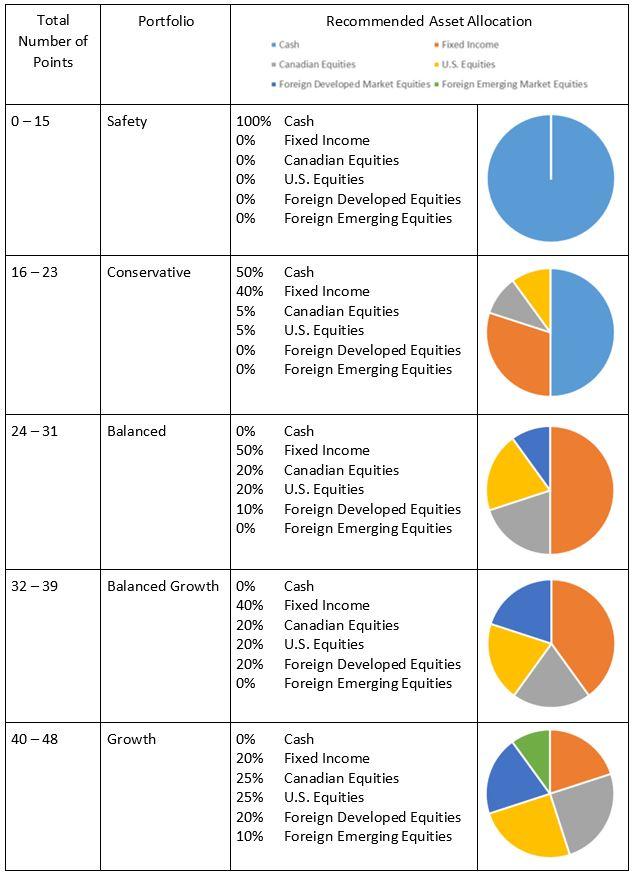
1. Visualize in your mind what your retirement will look like. Use your visualization to construct your financial planning-related retirement goal (in SMART format). 2. Use the RISK ASSESSMENT document that accompanies this assignment to determine what asset allocation you would use to invest your retirement funds. 3. Complete the calculations required to determine how much money you will need to save each month to meet your retirement goal. 4. Use the FP Canada PROJECTION ASSUMPTION GUIDELINES 2021 for rates of return. 5. Other Assumptions: Management fee of 1% for NRR No tax calculations are needed or accounted for (do not distinguish RRSP, TFSA, etc) Your current Assets are zero for the final calculation Use BALANCED GROWTH PROFILE WEIGHTINGS from the RISK ASSESSMENT QUESTIONNAIRE for NRR and RRR 6. 'Document this information in the space provided on the Time Value of Money Calculations Summary Sheet that accompanies this assignment. ONLY INCLUDE THE NUMBERS. YOU DO NOT NEED TO SHOW ANY OF YOUR CALCULATIONS.
RISK ASSESSMENT QUESTIONNAIRE
- Please choose how would you classify your familys overall financial situation?
- No savings and significant debt.
- No savings and some debt.
- No savings and little to no debt.
- Some savings and significant debt.
- Some savings and some debt.
- Some savings and little to no debt.
- Strong savings and significant.
- Strong savings and some debt.
- Strong savings and little to no debt.
- What is your current net worth? Liquid assets (available for emergencies) $ _________ + Invested assets (not earmarked for emergencies) $ _________ + Fixed assets (such as real estate property) $ _________ - Mortgage debt $ _________ - Consumer debt (such as credit cards, loans, lines of credit) $ _________ = Estimated Net Worth $ _________
- What is your gross monthly family income? $ _________
- How much is your cash surplus/deficit at the end of each month? $ _________
- What, if any, changes are you expecting to your cash flow during the next one to three years? ____________________
- Please choose how would you describe your understanding of investing?
- Limited: Im confused about how investments work.
- Average: I understand the difference between the expected risk and return relationship of different investments, including GICs, bonds, and stocks.
- Sophisticated: I understand how domestic and foreign capital markets work, including how different assets respond to changing economic variables.
- What net rate of return do you expect to earn on your investment portfolio? __________________
- Do you know how much risk you need to take in your investments to meet your goals?
- Yes, I need _______%.
- No, I do not know.
Willingness to Take on Risk (Please choose and calculate the total points)
- What is the primary purpose of your portfolio?
- Safety I do not want to risk losing any portion of my money. 0 points
- Inflation protection I want the value of my money to maintain pace with rising costs. 2 points
- Income I want to draw an income from my portfolio. 4 points
- Growth I want to grow my money. 6 points
- What type of portfolio would you like to own?
- One that mostly contains mostly term deposits, guaranteed investment certificates, principal-protected notes, and market-linked guaranteed investment certificates. 0 points
- One that contains mostly fixed income securities, such as bonds fixed income mutual funds, or fixed income exchange-traded funds. 2 points
- One that contains mostly equity mutual funds or exchange-traded funds. 4 points
- One that contains mostly stocks from individual companies. 6 points
- Which of the following portfolios are you most likely to invest in?
- Portfolio A: Worst return in one year = 0% Best return in one year = +3% 0 points
- Portfolio B: Worst return in one year = -6% Best return in one year = +8% 2 points
- Portfolio C: Worst return in one year = -15% Best return in one year = +12% 4 points
- Portfolio D: Worst return in one year = -25% Best return in one year = +15% 6 points
- Which of the following portfolios would you be likely to invest in over the long term?
- Portfolio A Does not fluctuate in value and earns a minimal rate of return on average. 0 points
- Portfolio B - Fluctuates in value by small amounts and has the potential to earn a low rate of return on average. 2 points
- Portfolio C Fluctuates in value by medium amounts and has the potential to earn a medium rate of return on average. 4 points
- Portfolio D Fluctuates in value by significant amounts and has the potential to earn a significant rate of return on average. 6 points
- How long would you be willing to wait for your investments to regain any lost value?
- Less than three months. 0 points
- Three to six months. 2 points
- Six months to one year. 4 points
- One to two years. 6 points
- For retirement investments only, which would you consider a bigger risk?
- Failing to retire when you plan.
- Running out of money during retirement.
Ability to Take on Risk (Please choose and calculate the total points)
- How long will you continue to remain invested before you will begin withdrawing a significant portion of your money from your investment portfolio?
- Less than three years 0 points
- Between three and five years 2 points
- Between 6 and 10 years 4 points
- Over 10 years 6 points
- After reaching your goal, over how many years do you plan to make withdrawals from your investment portfolio?
- Less than three years 0 points
- Between three and five years 2 points
- Between 6 and 10 years 4 points
- Over 10 years 6 points
- How long are you willing to postpone meeting your goal, if needed?
- Less than one year. 0 points
- One to three years. 2 points
- Three to five years. 4 points
- Over five years. 6 points
Total Point Calculation
Willingness to Take on Risk _____________ + Ability to Take on Risk _____________ = Total _____________
TIME VALUE OF MONEY CALCULATIONS SUMMARY SHEET
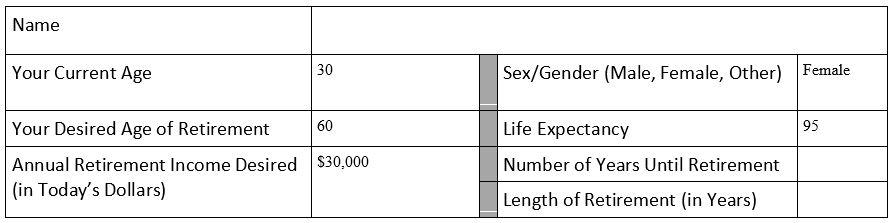
ASSUMPTIONS:
Zero current savings, no tax implications, 1% Management Fee Use BALANCED GROWTH % allocations mandate from Investor Profile to calculate NRR and RRR
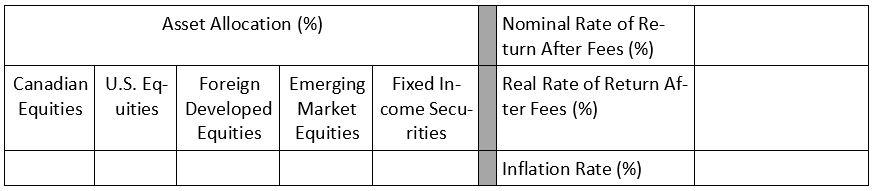
FINAL RESULTS
NRR = ______________ RRR = _______________
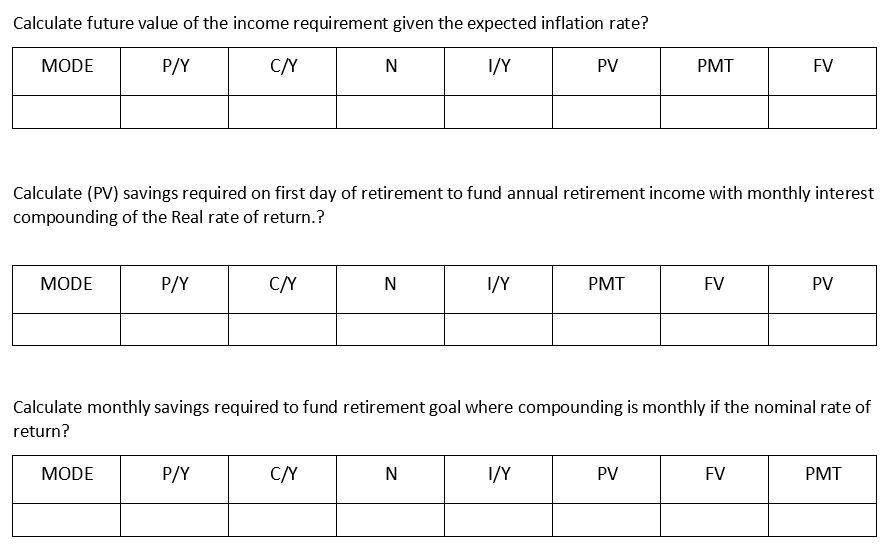
Portfolio Total Number of Points Recommended Asset Allocation Cash Fixed Income Canadian Equities U.S. Equities Foreign Developed Market Equities Foreign Emerging Market Equities 0-15 Safety 100% Cash 0% Fixed Income 0% Canadian Equities 0% U.S. Equities 0% Foreign Developed Equities 0% Foreign Emerging Equities 0 16-23 Conservative 50% 40% 5% 5% Cash Fixed Income Canadian Equities U.S. Equities Foreign Developed Equities Foreign Emerging Equities 0% 0% 24 - 31 Balanced 0% Cash 50% Fixed Income 20% Canadian Equities 20% U.S. Equities 10% Foreign Developed Equities 0% Foreign Emerging Equities 32-39 Balanced Growth 0% 40% 20% 20% 20% 0% Cash Fixed Income Canadian Equities U.S. Equities Foreign Developed Equities Foreign Emerging Equities 40-48 Growth 0% Cash 20% Fixed Income 25% Canadian Equities 25% U.S. Equities 20% Foreign Developed Equities 10% Foreign Emerging Equities Name Your Current Age 30 Sex/Gender (Male, Female, Other) Female Life Expectancy 95 Your Desired Age of Retirement 60 Annual Retirement Income Desired $30,000 (in Today's Dollars) Number of Years Until Retirement Length of Retirement (in Years) Asset Allocation (%) Nominal Rate of Re- turn After Fees (%) Real Rate of Return Af- ter Fees (%) Canadian U.S. Eq- Equities uities Foreign Emerging Fixed In- Developed Market come Secu- Equities Equities rities Inflation Rate (%) Calculate future value of the income requirement given the expected inflation rate? MODE P/Y CNY N 1/Y PV PMT FV Calculate (PV) savings required on first day of retirement to fund annual retirement income with monthly interest compounding of the Real rate of return.? MODE P/Y CAY N 1/ PMT FV PV Calculate monthly savings required to fund retirement goal where compounding is monthly if the nominal rate of return? MODE P/Y CNY N 1/Y PV FV PMT Portfolio Total Number of Points Recommended Asset Allocation Cash Fixed Income Canadian Equities U.S. Equities Foreign Developed Market Equities Foreign Emerging Market Equities 0-15 Safety 100% Cash 0% Fixed Income 0% Canadian Equities 0% U.S. Equities 0% Foreign Developed Equities 0% Foreign Emerging Equities 0 16-23 Conservative 50% 40% 5% 5% Cash Fixed Income Canadian Equities U.S. Equities Foreign Developed Equities Foreign Emerging Equities 0% 0% 24 - 31 Balanced 0% Cash 50% Fixed Income 20% Canadian Equities 20% U.S. Equities 10% Foreign Developed Equities 0% Foreign Emerging Equities 32-39 Balanced Growth 0% 40% 20% 20% 20% 0% Cash Fixed Income Canadian Equities U.S. Equities Foreign Developed Equities Foreign Emerging Equities 40-48 Growth 0% Cash 20% Fixed Income 25% Canadian Equities 25% U.S. Equities 20% Foreign Developed Equities 10% Foreign Emerging Equities Name Your Current Age 30 Sex/Gender (Male, Female, Other) Female Life Expectancy 95 Your Desired Age of Retirement 60 Annual Retirement Income Desired $30,000 (in Today's Dollars) Number of Years Until Retirement Length of Retirement (in Years) Asset Allocation (%) Nominal Rate of Re- turn After Fees (%) Real Rate of Return Af- ter Fees (%) Canadian U.S. Eq- Equities uities Foreign Emerging Fixed In- Developed Market come Secu- Equities Equities rities Inflation Rate (%) Calculate future value of the income requirement given the expected inflation rate? MODE P/Y CNY N 1/Y PV PMT FV Calculate (PV) savings required on first day of retirement to fund annual retirement income with monthly interest compounding of the Real rate of return.? MODE P/Y CAY N 1/ PMT FV PV Calculate monthly savings required to fund retirement goal where compounding is monthly if the nominal rate of return? MODE P/Y CNY N 1/Y PV FV PMT
Step by Step Solution
There are 3 Steps involved in it

Get step-by-step solutions from verified subject matter experts
 Study Help