







Question: I need help in developing a draft for this question. I have included photos as the references relevant to the question below. It is for
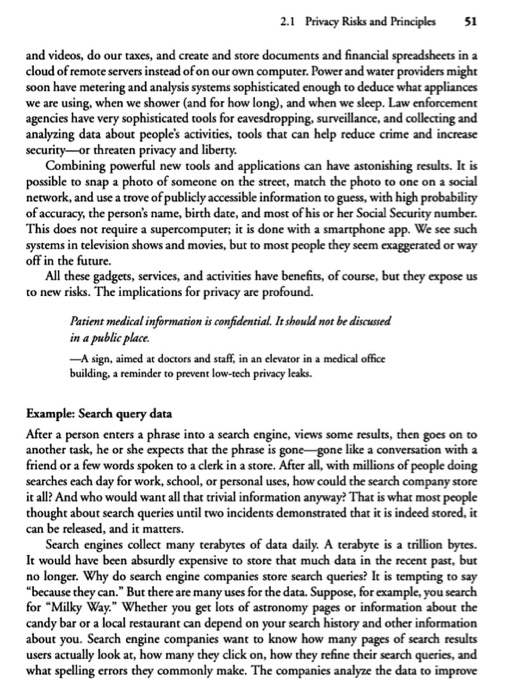
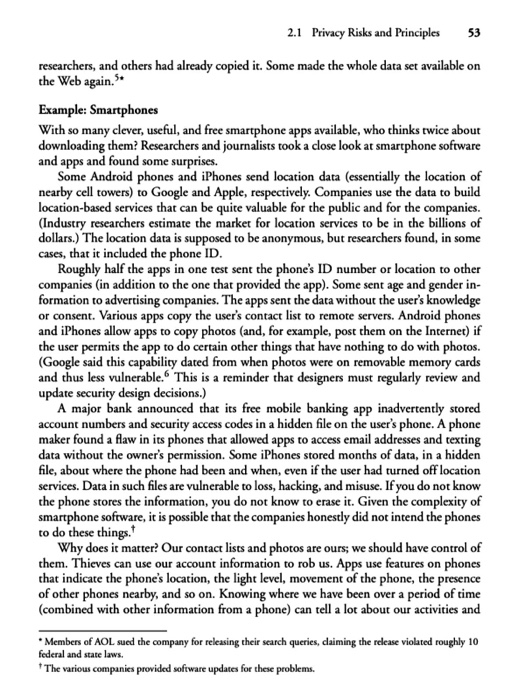
2.1 Privacy Risks and Principles 51 and videos, do our taxes, and create and store documents and financial spreadsheets in a cloud of remote servers instead of on our own computer. Power and water providers might soon have metering and analysis systems sophisticated enough to deduce what appliances we are using, when we shower (and for how long), and when we sleep. Law enforcement agencies have very sophisticated tools for eavesdropping, surveillance, and collecting and analyzing data about people's activities, tools that can help reduce crime and increase security-or threaten privacy and liberty. Combining powerful new tools and applications can have astonishing results. It is possible to snap a photo of someone on the street, match the photo to one on a social network, and use a trove of publicly accessible information to guess, with high probability of accuracy, the person's name, birth date, and most of his or her Social Security number. This does not require a supercomputer; it is done with a smartphone app. We see such systems in television shows and movies, but to most people they seem exaggerated or way off in the future. All these gadgets, services, and activities have benefits, of course, but they expose us to new risks. The implications for privacy are profound. Patient medical information is confidential. It should not be discussed in a public place. - A sign, aimed at doctors and staff, in an elevator in a medical office building, a reminder to prevent low-tech privacy leaks. Example: Search query data After a person enters a phrase into a search engine, views some results, then goes on to another task, he or she expects that the phrase is gone gone like a conversation with a friend or a few words spoken to a clerk in a store. After all, with millions of people doing searches each day for work, school, or personal uses, how could the search company store it all? And who would want all that trivial information anyway? That is what most people thought about search queries until two incidents demonstrated that it is indeed stored, it can be released, and it matters. Search engines collect many terabytes of data daily. A terabyte is a trillion bytes. It would have been absurdly expensive to store that much data in the recent past, but no longer. Why do search engine companies store search queries? It is tempting to say "because they can." But there are many uses for the data. Suppose, for example, you search for "Milky Way." Whether you get lots of astronomy pages or information about the candy bar or a local restaurant can depend on your search history and other information about you. Search engine companies want to know how many pages of search results users actually look at, how many they click on, how they refine their search queries, and what spelling errors they commonly make. The companies analyze the data to improve 2.1 Privacy Risks and Principles 53 researchers, and others had already copied it. Some made the whole data set available on the Web again." Example: Smartphones With so many clever, useful, and free smartphone apps available, who thinks twice about downloading them? Researchers and journalists took a close look at smartphone software and apps and found some surprises. Some Android phones and iPhones send location data (essentially the location of nearby cell towers) to Google and Apple, respectively. Companies use the data to build location-based services that can be quite valuable for the public and for the companies. (Industry researchers estimate the market for location services to be in the billions of dollars.) The location data is supposed to be anonymous, but researchers found, in some cases, that it included the phone ID. Roughly half the apps in one test sent the phone's ID number or location to other companies in addition to the one that provided the app). Some sent age and gender in- formation to advertising companies. The apps sent the data without the user's knowledge or consent. Various apps copy the user's contact list to remote servers. Android phones and iPhones allow apps to copy photos and, for example, post them on the Internet) if the user permits the app to do certain other things that have nothing to do with photos. (Google said this capability dated from when photos were on removable memory cards and thus less vulnerable. This is a reminder that designers must regularly review and update security design decisions.) A major bank announced that its free mobile banking app inadvertently stored account numbers and security access codes in a hidden file on the user's phone. A phone maker found a flaw in its phones that allowed apps to access email addresses and texting data without the owner's permission. Some iPhones stored months of data, in a hidden file, about where the phone had been and when, even if the user had turned off location services. Data in such files are vulnerable to loss, hacking, and misuse. If you do not know the phone stores the information, you do not know to erase it. Given the complexity of smartphone software, it is possible that the companies honestly did not intend the phones to do these things." Why does it matter? Our contact lists and photos are ours; we should have control of them. Thieves can use our account information to rob us. Apps use features on phones that indicate the phone's location, the light level, movement of the phone, the presence of other phones nearby, and so on. Knowing where we have been over a period of time (combined with other information from a phone) can tell a lot about our activities and * Members of AOL sued the company for releasing their search queries, daiming the release violated roughly 10 federal and state laws. 'The various companies provided software updates for these problems
Step by Step Solution
There are 3 Steps involved in it

Get step-by-step solutions from verified subject matter experts
 Study Help