







Question: I need help on question #2 please. Using the grammar defined in question #1. 1. Consider the following context-free grammar, where A V are the
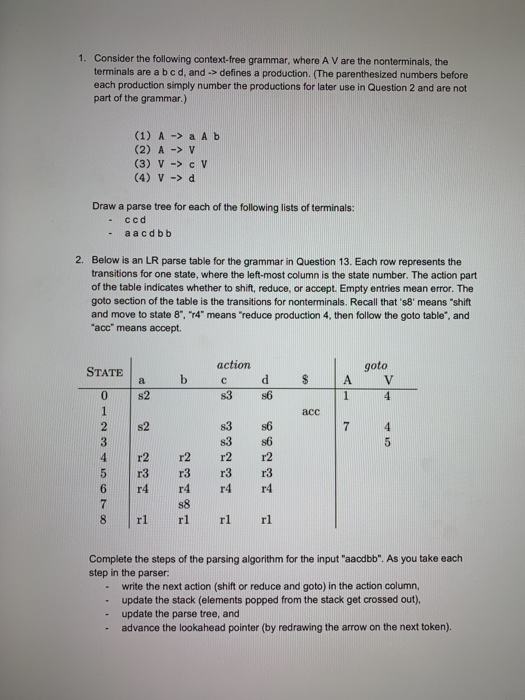
1. Consider the following context-free grammar, where A V are the nonterminals, the terminals are a b c d, and -> defines a production. (The parenthesized numbers before each production simply number the productions for later use in Question 2 and are not part of the grammar.) (1) A -> a A b (2) A-v (3) V -> c V (4) V> d Draw a parse tree for each of the following lists of terminals: -ccd - aacdbb 2. Below is an LR parse table for the grammar in Question 13. Each row represents the transitions for one state, where the left-most column is the state number. The action part of the table indicates whether to shift, reduce, or accept. Empty entries mean error. The goto section of the table is the transitions for nonterminals. Recall that 's8' means "shift and move to state 8", T4" means "reduce production 4, then follow the goto table", and "acc" means accept. action goto STATE 0 s2 4 2 s2 s3 s6 4 r2 r2 r2 r2 5 r3 r3 r3 r3 6 r4 r4 r4 r4 6 3 83 S6 acc 4 13 8 rl rl rl rl Complete the steps of the parsing algorithm for the input "aacdbb". As you take each step in the parser: - write the next action (shift or reduce and goto) in the action column, update the stack (elements popped from the stack get crossed out), update the parse tree, and advance the lookahead pointer (by redrawing the arrow on the next token)
Step by Step Solution
There are 3 Steps involved in it

Get step-by-step solutions from verified subject matter experts
 Study Help