







Question: I need help Overview As we are seeing, linear algebra comes up in a lot of applications. One of the prime applications for vectors and
I need help
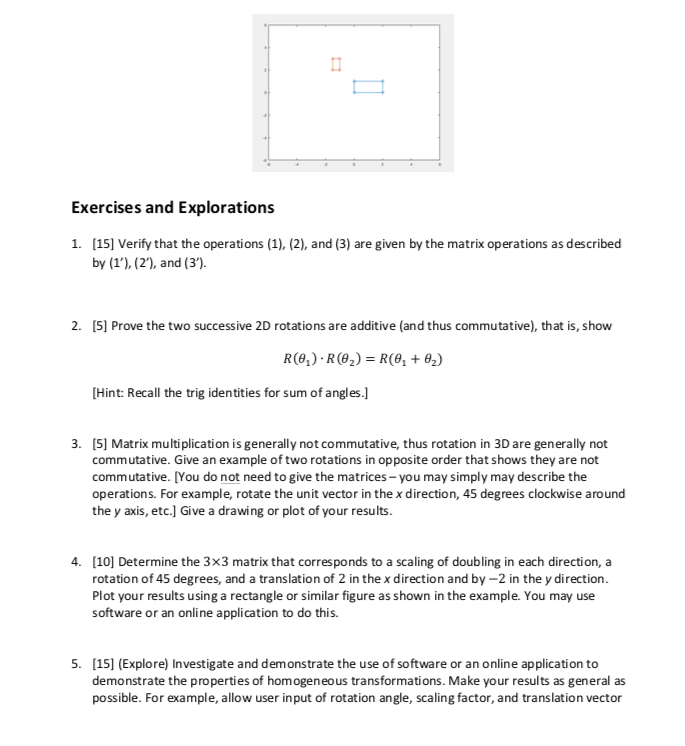
Overview As we are seeing, linear algebra comes up in a lot of applications. One of the prime applications for vectors and matrix transformations is the area of computer graphics and the related fields of computer vision, robotics, and image processing. If fact, one of the best reviews of linear algebra may be found in the appendix of the Computer Graphics textbook [4]. Basic operations in computer graphics include translations, rotations, and scaling. In this project, we'll investigate how these may be combined into a single matrix (multiplication) operation through the use of homogeneous coordinates. Background In computer graphics [4] (as well as in robotics [5]) object positions can be defined using vectors. Thus, changes in position (translations and rotations) can then be defined as matrix operations on these vectors. Likewise, scaling (resizing) the object can be also defined via matrix operations. These operations are represented as, P' = P +T (Translation) (1) P' = RP (Rotation) (2) P' = SP (Scaling) We see that the latter two of these operations are multiplications, while the first (translation) is a sum. Thus it is difficult to combine the three operations into a single matrix transformation. However, this combination may be achieved if the vectors are rewritten in homogeneous coordinates. In homogeneous coordinates, we add a third coordinate to a point (vector). Instead of being represented by a pair of numbers (x, y)', each point (vector) is represented as a triple (x, y, w). Thus a point in 20 will be represented by the set of points {(x, y, w)|w # 0) and we say point points are equal (equivalent) if and only if one is a multiple of the other. For example, (2,3,6) and (4,6,12) represent the point in 20. That is, each point has many different homogeneous coordinate representations. Also, at least one coordinate must be nonzero (that is, (0,0,0) is not allowed.) if the w coordinate is nonzero, we can divide through by it giving (-, 2, 1). That is, (*. *. In this project, we'll deal with two dimensional vectors for ease of visualization, but similar techniques apply to three dimensional vectors (for example, see [2].)Exercises and Explorations 1. [15] Verify that the operations (1), (2), and (3) are given by the matrix operations as described by (1'), (2'), and (3'). 2. [5] Prove the two successive 2D rotations are additive (and thus commutative), that is, show R(0,) . R(02) = R(0, + #2) [Hint: Recall the trig identities for sum of angles.] 3. [5] Matrix multiplication is generally not commutative, thus rotation in 3D are generally not commutative. Give an example of two rotations in opposite order that shows they are not commutative. [You do not need to give the matrices - you may simply may describe the operations. For example, rotate the unit vector in the x direction, 45 degrees clockwise around the y axis, etc.] Give a drawing or plot of your results. 4. [10] Determine the 3x3 matrix that corresponds to a scaling of doubling in each direction, a rotation of 45 degrees, and a translation of 2 in the x direction and by -2 in the y direction. Plot your results using a rectangle or similar figure as shown in the example. You may use software or an online application to do this. 5. [15] (Explore) Investigate and demonstrate the use of software or an online application to demonstrate the properties of homogeneous transformations. Make your results as general as possible. For example, allow user input of rotation angle, scaling factor, and translation vector
Step by Step Solution
There are 3 Steps involved in it

Get step-by-step solutions from verified subject matter experts
 Study Help