Question: I need help solving the question, I could not solve it Consider a population whose number we denote by P. Suppose that b is the

I need help solving the question, I could not solve it
I need help solving the question, I could notI need help solving the question, I could not
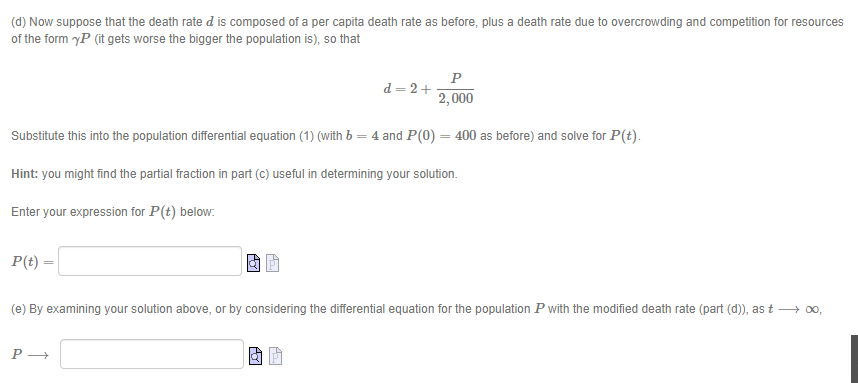
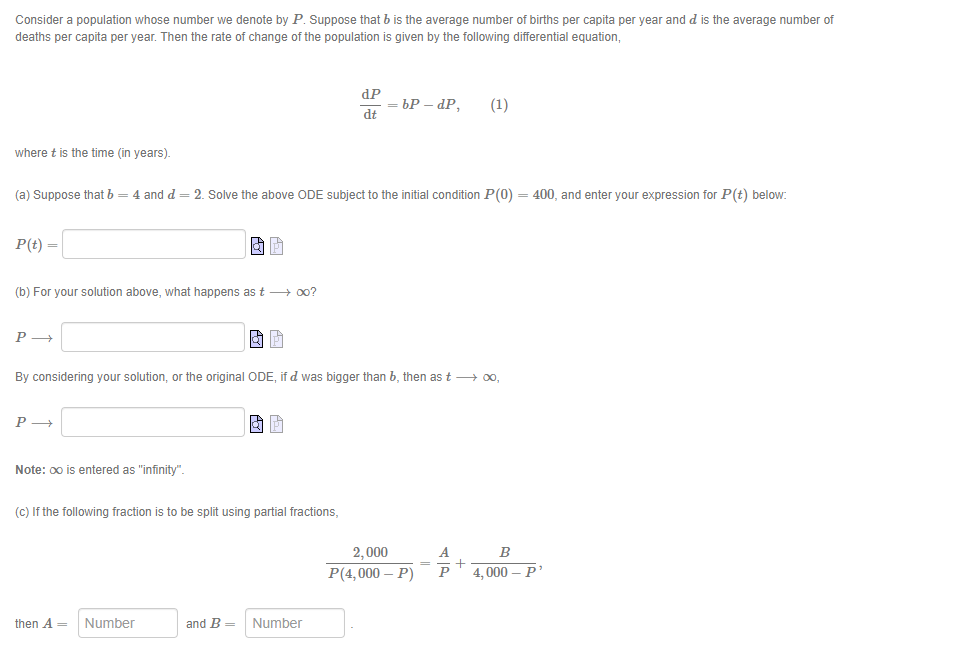
Consider a population whose number we denote by P. Suppose that b is the average number of births per capita per year and d is the average number of deaths per capita per year. Then the rate of change of the population is given by the following differential equation, dP dt = bP - dP, (1) where t is the time (in years). (a) Suppose that b = 4 and d = 2. Solve the above ODE subject to the initial condition P(0) = 400, and enter your expression for P(t) below: P(t) (b) For your solution above, what happens as t - oo? P By considering your solution, or the original ODE, if d was bigger than b, then as t -> co, P Note: oo is entered as "infinity". (c) If the following fraction is to be split using partial fractions, 2, 000 A B P(4, 000 - P) P + 4,000 - P then A = Number and B = Number(d) Now suppose that the death rate d is composed of a per capita death rate as before, plus a death rate due to overcrowding and competition for resources of the form yP (it gets worse the bigger the population is), so that P d = 2+ 2, 000 Substitute this into the population differential equation (1) (with b = 4 and P(0) = 400 as before) and solve for P(t). Hint: you might find the partial fraction in part (c) useful in determining your solution. Enter your expression for P(t) below: P(t) = (e) By examining your solution above, or by considering the differential equation for the population P with the modified death rate (part (d)), as t -> oo, P

Step by Step Solution

There are 3 Steps involved in it

1 Expert Approved Answer
Step: 1 Unlock blur-text-image

Question Has Been Solved by an Expert!

Get step-by-step solutions from verified subject matter experts

Step: 2 Unlock
Step: 3 Unlock

Students Have Also Explored These Related Mathematics Questions!