







Question: I need help solving this exercise step by step, please. [ 7 - 2 ] Terzaghi discussed the failure state shown in Fig. 7 .
I need help solving this exercise step by step, please.
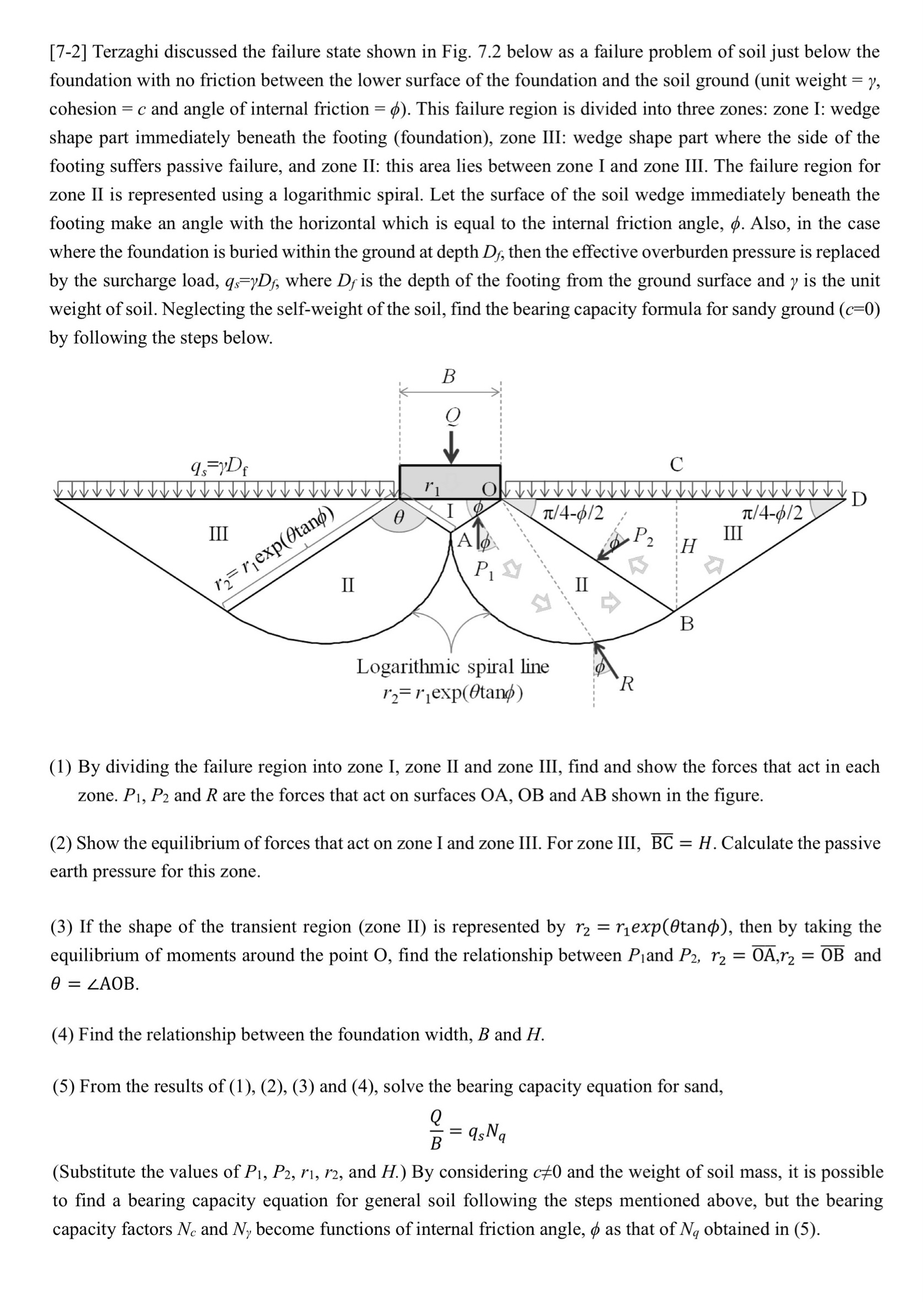
Terzaghi discussed the failure state shown in Fig. below as a failure problem of soil just below the foundation with no friction between the lower surface of the foundation and the soil ground unit weight cohesion and angle of internal friction This failure region is divided into three zones: zone I: wedge shape part immediately beneath the footing foundation zone III: wedge shape part where the side of the footing suffers passive failure, and zone II: this area lies between zone I and zone III. The failure region for zone II is represented using a logarithmic spiral. Let the surface of the soil wedge immediately beneath the footing make an angle with the horizontal which is equal to the internal friction angle, Also, in the case where the foundation is buried within the ground at depth then the effective overburden pressure is replaced by the surcharge load, where is the depth of the footing from the ground surface and is the unit weight of soil. Neglecting the selfweight of the soil, find the bearing capacity formula for sandy ground by following the steps below.
By dividing the failure region into zone I, zone II and zone III, find and show the forces that act in each zone. and are the forces that act on surfaces and AB shown in the figure.
Show the equilibrium of forces that act on zone I and zone III. For zone III, Calculate the passive earth pressure for this zone.
If the shape of the transient region zone II is represented by exp then by taking the equilibrium of moments around the point O find the relationship between and and
Find the relationship between the foundation width, and
From the results of and solve the bearing capacity equation for sand,
Substitute the values of and By considering and the weight of soil mass, it is possible to find a bearing capacity equation for general soil following the steps mentioned above, but the bearing capacity factors and become functions of internal friction angle, as that of obtained in
Step by Step Solution
There are 3 Steps involved in it
1 Expert Approved Answer
Step: 1 Unlock

Question Has Been Solved by an Expert!
Get step-by-step solutions from verified subject matter experts
Step: 2 Unlock
Step: 3 Unlock
 Study Help