



Question: I need help summarize pages 36,37, and 40 I need help summarizing and paraphrasing pages 36,37, and 40 please. ORICE COLLEGE INSTRUCTION MOUSSE M.S. IN
I need help summarize pages 36,37, and 40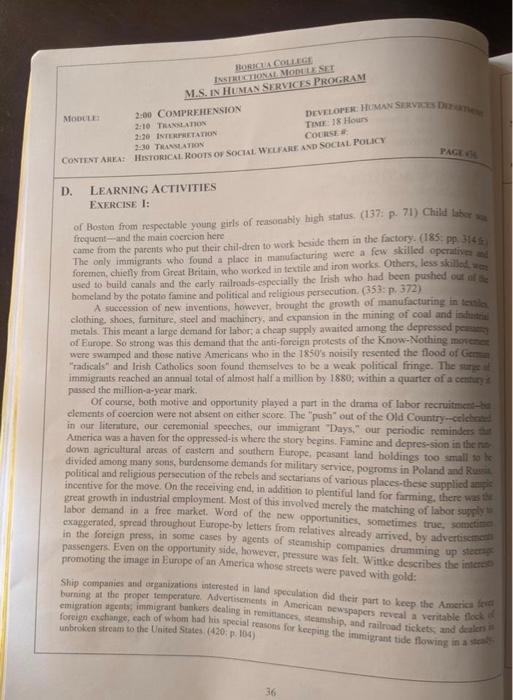
I need help summarizing and paraphrasing pages 36,37, and 40 please.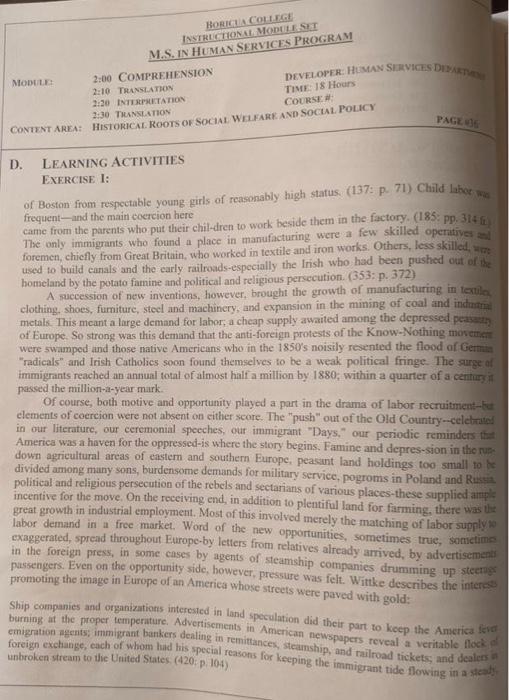
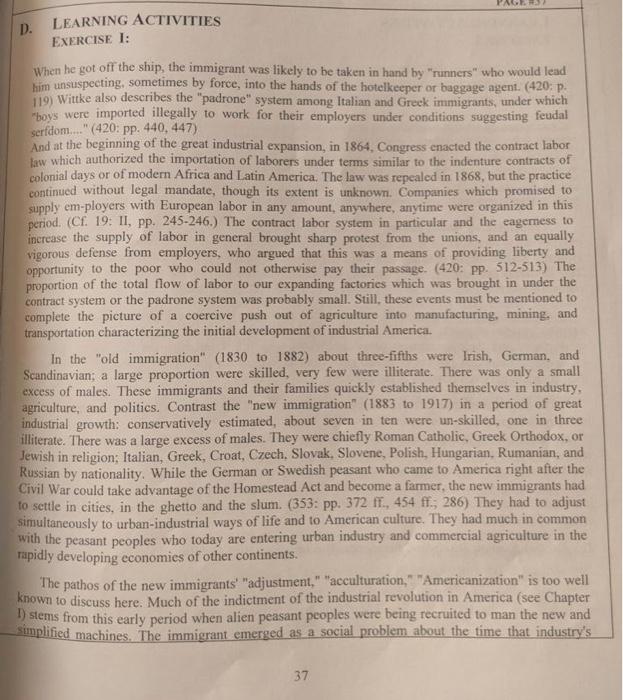
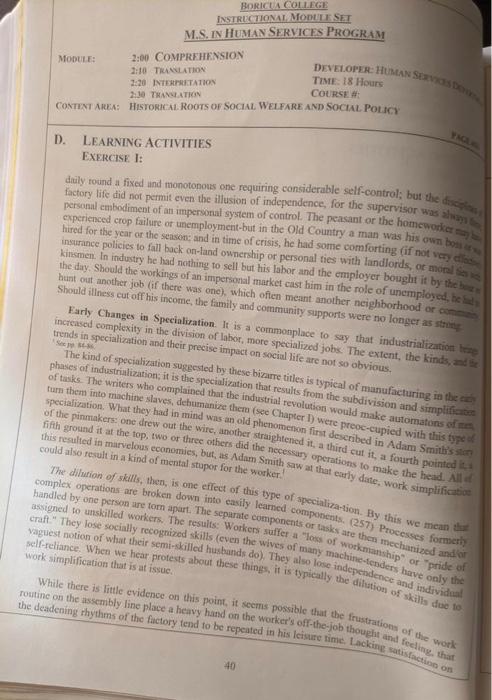
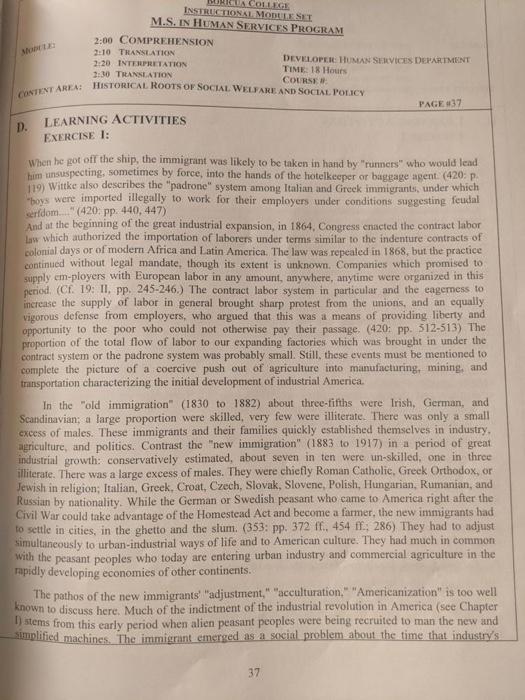
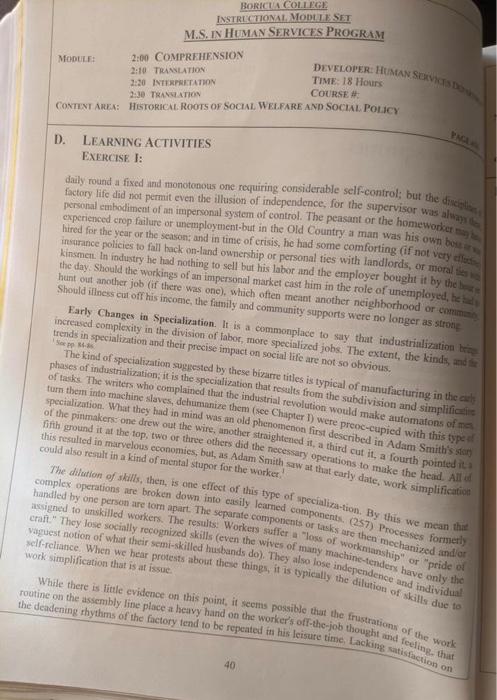
ORICE COLLEGE INSTRUCTION MOUSSE M.S. IN HUMAN SERVICES PROGRAM 2:00 COMPREHENSION 2:10. THANATION 2:30 INTERPRETATION TINE 18 Hours 3:30 TRANSLATION COURSE CONTENT AREA: HISTORICAL ROOTS OF SOCIAL WELFARE AND SOCIAL POLICY MODULE DEVELOPER HUMAN SERVISS PAGE D. LEARNING ACTIVITIES EXERCISE 1: of Boston from respectable young girls of reasonably high status (137: p. 71) Child laber frequent--and the main coercion here came from the parents who put their children to work beside them in the factory. (185pp3 The only immigrants who found a place in manufacturing were a few skilled operative foremen, chiefly from Great Britain, who worked in textile and iron works Others, less skilled used to build canals and the early railroads-especially the Irish who had been pushed out of homeland by the potato famine and political and religious persecution (3532p. 372) A succession of new inventions, however, brought the growth of manufacturing Intel clothing, shoes, furniture, steel and machinery, and expansion in the mining of coal and industria metals. This meant a large demand for labor, a cheap supply awaited among the depressed peas of Europe. So strong was this demand that the anti-foreign protests of the Know-Nothing more were swamped and those native Americans who in the 1850's noisily resented the flood of Ger "radicals" and Irish Catholics soon found themselves to be a weak political fringe. The sun immigrants reached an annual total of almost half a million by 1880; within a quarter of a century passed the million-a-year mark Of course, both motive and opportunity played a part in the drama of labor recruitment clements of coercion were not absent on either score. The "push" out of the Old Country-cleted in our literature, our ceremonial speeches, our immigrant "Days," our periodic reminders America was a haven for the oppressed-is where the story begins. Famine and depression in the down agricultural areas of caster and southern Europe. peasant land holdings too small to be divided among many sons, burdensome demands for military service, pogroms in Poland and Ruin political and religious persecution of the rebels and sectarians of various places-these supplied incentive for the move. On the receiving end, in addition to plentiful land for farming, there waste great growth in industrial employment. Most of this involved merely the matching of labor supply labor demand in a free market. Word of the new opportunities, sometimes true, someti exaggerated, spread throughout Europe-by letters from relatives already arrived, by advertisement in the forcign press, in some cases by agents of steamship companies drumming up stens passengers. Even on the opportunity side, however, pressure was felt. Winke describes the interese promoting the image in Europe of an America whose streets were paved with gold: Ship companies and weanizations interested in land speculation did their part to keep the America burning at the proper temperature, Advertisements in American newspapers reveal a veritable for emigration agents, immigrant bunkers dealing in remittances, steumship, and railroad tickets and deale unbroken stream to the United States (420p, 104) foreign exchange, each of whom had his special reasons for keeping the immigrantide flowing in a 36 D. ORIGLIA COLLEGE INSTRUCTION MODELE SET M.S. IN HUMAN SERVICES PROGRAM 2:00 COMPREHENSION 2:10 TRANSLATION 2:20. INTERPRETATION DEVELOPER HUMAN SERVICE DEPARTMENT TIME: 18 Hours 3:30 THANSLATION COURSE CONTENT AREA: HISTORICAL ROOTS OF SOCIAL WELFARE AND SOCIAL POLICY PAGE 37 LEARNING ACTIVITIES EXERCISE 1: When he got off the ship, the immigrant was likely to be taken in hand by "runners" who would lead him unsuspecting, sometimes by force, into the hands of the hotelkeeper or baggage agent (420p 119) Wittke also describes the "padrone" system among Italian and Greek immigrants, under which boys were imported illegally to work for their employers under conditions suggesting feudal serfdom. "(420 pp. 440, 447) And at the beginning of the great industrial expansion, in 1864, Congress enacted the contract labor law which authorized the importation of laborers under terms similar to the indenture contracts of colonial days or of modern Africa and Latin America. The law was repealed in 1868, but the practice continued without legal mandate, though its extent is unknown. Companies which promised to supply em-ployers with European labor in any amount, anywhere, anytime were organized in this period. (CF. 19: II, pp. 245-246.) The contract labor system in particular and the eagerness to increase the supply of labor in general brought sharp protest from the unions, and an equally vigorous defense from employers, who argued that this was a means of providing liberty and opportunity to the poor who could not otherwise pay their passage (420: pp. 512-513) The proportion of the total flow of labor to our expanding factories which was brought in under the contract system or the padrone system was probably small. Still, these events must be mentioned to complete the picture of a coercive push out of agriculture into manufacturing, mining, and transportation characterizing the initial development of industrial America In the "old immigration" (1830 to 1882) about three-fifths were Irish, German, and Scandinavian; a large proportion were skilled, very few were illiterate. There was only a small excess of males. These immigrants and their families quickly established themselves in industry, agriculture, and politics. Contrast the "new immigration" (1883 to 1917) in a period of great industrial growth: conservatively estimated, about seven in ten were un-skilled, one in three illiterate. There was a large excess of males. They were chiefly Roman Catholic, Greek Orthodox, or Jewish in religion, Italian, Greek, Croat, Czech, Slovak, Slovenc, Polish, Hungarian, Rumanian, and Russian by nationality. While the German or Swedish peasant who came to America right after the Civil War could take advantage of the Homestead Act and become a farmer, the new immigrants had to settle in cities, in the ghetto and the slum. (353: pp. 372 ff., 454 : 286) They had to adjust Simultaneously to urban-industrial ways of life and to American culture. They had much in common with the peasant peoples who today are entering urban industry and commercial agriculture in the Tapidly developing economies of other continents. The pathos of the new immigrants "adjustment," "acculturation." "Americanization" is too well known to discuss here. Much of the indictment of the industrial revolution in America (see Chapter 1) stems from this early period when alien peasant peoples were being recruited to man the new and Simplified machines. The immigrant emerged as a social problem about the time that industry's 37 BORICTA COLLEGE INSTRUCTIONAL MODULE SET M.S. IN HUMAN SERVICES PROGRAM MODULE 2:00 COMPREHENSION DEVELOPER: HUMAN SERVICES 2:10 TRANSLATION 2:20 INTERPRETATION TIME: 18 Hours 2:30 TRANSLATION COURSE# CONTENT AREA: HISTORICAL ROOTS OF SOCIAL WELFARE AND SOCIAL POLICY PNE D. LEARNING ACTIVITIES EXERCISE 1: daily round a fixed and monotonous one requiring considerable self-control; but the disci factory life did not permit even the illusion of independences for the supervisor was always personal embodiment of an impersonal system of control. The peasant or the homework. experienced crop failure or unemployment but in the Old Country a man was his own boss hired for the year or the season, and in time of crisis, he had some comforting (if not very close insurance policies to fall back on-land ownership or personal ties with landlords, of moral tits kinsmen. In industry he had nothing to sell but his labor and the employer bought it by the bed the day. Should the workings of an impersonal market cast him in the role of unemployed, head hunt out another job (if there was one), which often meant another neighborhood or comme Should illness cut off his income, the family and community supports were no longer as strong Early Changes in Specialization. It is a commonplace to say that industrialization bra increased complexity in the division of labor, more specialized jobs. The extent, the kinds, and the trends in specialization and their precise impact on social life are not so obvious. The kind of specialization sugaested by these bizarre titles is typical of manufacturing in the cel phases of industrialization, it is the specialization that results from the subdivision and simplificate of tasks. The writers who complained that the industrial revolution would make automatons of me turn them into machine slaves, dehumanize them (see Chapter 1) were preoc-cupied with this type specialization. What they had in mind was an old phenomenon first described in Adam Smith's sur of the pnmakers one drew out the wire, another straightened it, a third cut it, a fourth pointed it a Gitih ground it at the top, two or three others did the necessary operations to make the head. Alle this resulted in marvelous economics, but, as Adam Smith saw at that early date, work simplification could also result in a kind of mental stupor for the worker complex operations are broken down into easily learned components. 257) Processes formerly The chestion of skills, then, is one effect of this type of specialization. By this we mean that handled by one person retom apart. The soparate components of tasks are then mechanized and or craft." They lose socially recognired skills (even the wives of many machine-tenders have only the ned to unskilled workers. The results. Workers suffer a loss of workmanship" or "pride o self-reliance. When we hear protests about these things, it is typically the dilution of skills due to vaguest notion of what their semi-skilled husbands do). They also lose independence and individual work simplification that is at issue While there is little evidence on this point, it seems possible that the frustration of the work routine on the assembly line place a heavy hand on the worker's off-the-job thought and feeling that the deadening thythms of the factory tend to be repeated in his leisure time, Lacking satisfaction on 40 DEVELOPER: HUMAN SERVICES DEPARTY MODULE BORILA COLLEGE INSTRUCTIONAL MODELEST M.S. IN HUMAN SERVICES PROGRAM 2:00 COMPREHENSION 2:10 TRANSLATION 3:30 INTERPRETATION TIME: 18 Hours 2:30 TRANSLATION COURSE CONTENT AREA: HISTORICAL ROOTS OF SOCIAL WELFARE AND SOCIAL POLICY PAGLE D. LEARNING ACTIVITIES EXERCISE I: of Boston from respectable young girls of reasonably high status. (137: p. 71) Child labor frequent--and the main coercion here came from the parents who put their children to work beside them in the factory (185. pp. 314 fi The only immigrants who found a place in manufacturing were a few skilled operatives foremen, chiefly from Great Britain, who worked in textile and iron works. Others, less skilled, were used to build canals and the curly railroads-especially the Irish who had been pushed out of the homeland by the potato famine and political and religious persecution (353; p. 372) A succession of new inventions, however, brought the growth of manufacturing in textile clothing, shoes, furniture, steel and machinery, and expansion in the mining of coal and industrial metals. This meant a large demand for labor, a cheap supply awaited among the depressed peasant of Europe. So strong was this demand that the anti-foreign protests of the Know-Nothing movement were swamped and those native Americans who in the 1850's noisily resented the flood of Germi. "radicals" and Irish Catholics soon found themselves to be a weak political fringe. The surge immigrants reached an annual total of almost half a million by 1880, within a quarter of a century it passed the million-a-year mark. Of course, both motive and opportunity played a part in the drama of labor recruitment--but elements of coercion were not absent on either score. The "push" out of the Old Country--celebrated in our literature, our ceremonial speeches, our immigrant "Days." our periodic reminders that America was a haven for the oppressed-is where the story begins. Famine and depres-sion in the run down agricultural areas of eastern and southern Europe, peasant land holdings too small to be divided among many sons, burdensome demands for military service, pogroms in Poland and Russia political and religious persecution of the rebels and sectarians of various places these supplied ample incentive for the move. On the receiving end, in addition to plentiful land for farming, there was the great growth in industrial employment. Most of this involved merely the matching of labor supply labor demand in a free market. Word of the new opportunities, sometimes true, sometime exaggerated, spread throughout Europe-by letters from relatives already arrived, by advertisements in the foreign press, in some cases by agents of steamship companies drumming up stets pussengers. Even on the opportunity side, however, pressure was felt. Wittke describes the interese promoting the image in Europe of an America whose streets were paved with gold: emigration agents immigrant bankers dealing in remittances, Starship, and railroad tickets, and dealers Ship companies and organizations interested in land speculation did their part to keep the America live burning at the proper temperature Advertisements in American newspapers reveal a veritable flock foreign exchange, each of whold baza pecial seasons for keeping the immigrant tide flowing in a steel unbroken stream to the United States (420; p. 105) D. LEARNING ACTIVITIES EXERCISE I: When he got off the ship, the immigrant was likely to be taken in hand by "runners" who would lead him unsuspecting, sometimes by force, into the hands of the hotelkeeper or baggage agent. (420: P. 119) Wittke also describes the "padrone" system among Italian and Greek immigrants, under which "boys were imported illegally to work for their employers under conditions suggesting feudal serfdom...."(420: pp. 440, 447) And at the beginning of the great industrial expansion, in 1864, Congress enacted the contract labor law which authorized the importation of laborers under terms similar to the indenture contracts of colonial days or of modern Africa and Latin America. The law was repealed in 1868, but the practice continued without legal mandate, though its extent is unknown. Companies which promised to supply em-ployers with European labor in any amount, anywhere, anytime were organized in this period. (Cf. 19: II, pp. 245-246.) The contract labor system in particular and the eagerness to increase the supply of labor in general brought sharp protest from the unions, and an equally vigorous defense from employers, who argued that this was a means of providing liberty and opportunity to the poor who could not otherwise pay their passage. (420: pp. 512-513) The proportion of the total flow of labor to our expanding factories which was brought in under the contract system or the padrone system was probably small. Still, these events must be mentioned to complete the picture of a coercive push out of agriculture into manufacturing, mining, and transportation characterizing the initial development of industrial America. In the "old immigration" (1830 to 1882) about three-fifths were Irish, German, and Scandinavian: a large proportion were skilled, very few were illiterate. There was only a small excess of males. These immigrants and their families quickly established themselves in industry, agriculture, and politics. Contrast the "new immigration" (1883 to 1917) in a period of great industrial growth: conservatively estimated, about seven in ten were un-skilled, one in three illiterate. There was a large excess of males. They were chiefly Roman Catholic, Greek Orthodox, or Jewish in religion; Italian, Greek, Croat, Czech, Slovak, Slovene, Polish, Hungarian, Rumanian, and Russian by nationality. While the German or Swedish peasant who came to America right after the Civil War could take advantage of the Homestead Act and become a farmer, the new immigrants had to settle in cities, in the ghetto and the slum. (353: pp. 372 T., 454 ff., 286) They had to adjust simultaneously to urban-industrial ways of life and to American culture. They had much in common with the peasant peoples who today are entering urban industry and commercial agriculture in the rapidly developing economies of other continents. The pathos of the new immigrants adjustment," "acculturation," "Americanization" is too well known to discuss here. Much of the indictment of the industrial revolution in America (see Chapter stems from this early period when alien peasant peoples were being recruited to man the new and simplified machines. The immigrant emerged as a social problem about the time that industry's 37 BORICUA COLLEGE INSTRUCTIONAL MODULE SET M.S. IN HUMAN SERVICES PROGRAM MODULE: -2:00 COMPREHENSION DEVELOPER HUMAN SEN 23:10 TRANSLATION 1:20 INTERPRETATION TIME: 18 Hours 2.30 TRANSLATION COURSE CONTENT AREA: HISTORICAL ROOTS OF SOCIAL WELFARE AND SOCIAL POLICY D. LEARNING ACTIVITIES EXERCISE 1: duly round a fixed and monotonous one requiring considerable self-control; but the disc factory life did not permit even the illusion of independence, for the supervisor was alwa personal embodiment of an impersonal system of control. The peasant or the homeworkers experienced crop failure or unemployment-but in the Old Country a man was his own boala hired for the year or the season and in time of crisis, he had some comforting (if not very insurance policies to fall back on-land ownership or personal ties with landlords, or morale kinsmen. In industry he had nothing to sell but his labor and the employer bought it by the be the day. Should the workings of an impersonal market cast him in the role of unemployed, he bed hunt out another job (if there was one), which ofien meant another neighborhood or com Should illness cut off his income, the family and community supports were no longer as som Early Changes in Specialization. It is a commonplace to say that industrialization la increased complexity in the division of labor, more specialized jobs. The extent, the kinds, and trends in specialization and their precise impact on social life are not so obvious. The kind of specialization suggested by these bizarre titles is typical of manufacturing in the phases of industrialization, it is the specialization that results from the subdivision and simplificate of tasks. The writers who complained that the industrial revolution would make automatons of turn them into machine slaves, dehumanize them (see Chapter 1) were preoccupied with this type specialization. What they had in mind was an old phenomenon first described in Adam Smith's of the pinmakers one drew out the wire, another straightened it, a third cut it, a fourth pointed it fifth ground it at the top, two or three others did the necessary operations to make the head. All this resulted in marvelous economics, but, as Adam Smith saw at that early date, work simplification could also result in a kind of mental stupor for the worker Se The dilution of skills, then, is one effect of this type of specialization. By this we meant bandled by one person retom apart. The separate components or tasks are the mechanined and on assigned to unskilled workers. The results: Workers suffer a loss of workmanship or ride of vaquest motion of what their semi-skilled husbands do). They also lose independence and individual craft." They lose socially recognized skills (even the wives of many machine lenders have only the self-reliance. When we hear protests about these things, it is typically the dilution of skills due to work simplification that is at issue While there is little evidence on this point, it seems possible that the frustrations of the work routine on the assembly line place a heavy hand on the worker's off-the-job thought and feeling that the deadening rhythms of the factory tend to be repeated in his leisure time. Lacking satisfaction on 40 ORICE COLLEGE INSTRUCTION MOUSSE M.S. IN HUMAN SERVICES PROGRAM 2:00 COMPREHENSION 2:10. THANATION 2:30 INTERPRETATION TINE 18 Hours 3:30 TRANSLATION COURSE CONTENT AREA: HISTORICAL ROOTS OF SOCIAL WELFARE AND SOCIAL POLICY MODULE DEVELOPER HUMAN SERVISS PAGE D. LEARNING ACTIVITIES EXERCISE 1: of Boston from respectable young girls of reasonably high status (137: p. 71) Child laber frequent--and the main coercion here came from the parents who put their children to work beside them in the factory. (185pp3 The only immigrants who found a place in manufacturing were a few skilled operative foremen, chiefly from Great Britain, who worked in textile and iron works Others, less skilled used to build canals and the early railroads-especially the Irish who had been pushed out of homeland by the potato famine and political and religious persecution (3532p. 372) A succession of new inventions, however, brought the growth of manufacturing Intel clothing, shoes, furniture, steel and machinery, and expansion in the mining of coal and industria metals. This meant a large demand for labor, a cheap supply awaited among the depressed peas of Europe. So strong was this demand that the anti-foreign protests of the Know-Nothing more were swamped and those native Americans who in the 1850's noisily resented the flood of Ger "radicals" and Irish Catholics soon found themselves to be a weak political fringe. The sun immigrants reached an annual total of almost half a million by 1880; within a quarter of a century passed the million-a-year mark Of course, both motive and opportunity played a part in the drama of labor recruitment clements of coercion were not absent on either score. The "push" out of the Old Country-cleted in our literature, our ceremonial speeches, our immigrant "Days," our periodic reminders America was a haven for the oppressed-is where the story begins. Famine and depression in the down agricultural areas of caster and southern Europe. peasant land holdings too small to be divided among many sons, burdensome demands for military service, pogroms in Poland and Ruin political and religious persecution of the rebels and sectarians of various places-these supplied incentive for the move. On the receiving end, in addition to plentiful land for farming, there waste great growth in industrial employment. Most of this involved merely the matching of labor supply labor demand in a free market. Word of the new opportunities, sometimes true, someti exaggerated, spread throughout Europe-by letters from relatives already arrived, by advertisement in the forcign press, in some cases by agents of steamship companies drumming up stens passengers. Even on the opportunity side, however, pressure was felt. Winke describes the interese promoting the image in Europe of an America whose streets were paved with gold: Ship companies and weanizations interested in land speculation did their part to keep the America burning at the proper temperature, Advertisements in American newspapers reveal a veritable for emigration agents, immigrant bunkers dealing in remittances, steumship, and railroad tickets and deale unbroken stream to the United States (420p, 104) foreign exchange, each of whom had his special reasons for keeping the immigrantide flowing in a 36 D. ORIGLIA COLLEGE INSTRUCTION MODELE SET M.S. IN HUMAN SERVICES PROGRAM 2:00 COMPREHENSION 2:10 TRANSLATION 2:20. INTERPRETATION DEVELOPER HUMAN SERVICE DEPARTMENT TIME: 18 Hours 3:30 THANSLATION COURSE CONTENT AREA: HISTORICAL ROOTS OF SOCIAL WELFARE AND SOCIAL POLICY PAGE 37 LEARNING ACTIVITIES EXERCISE 1: When he got off the ship, the immigrant was likely to be taken in hand by "runners" who would lead him unsuspecting, sometimes by force, into the hands of the hotelkeeper or baggage agent (420p 119) Wittke also describes the "padrone" system among Italian and Greek immigrants, under which boys were imported illegally to work for their employers under conditions suggesting feudal serfdom. "(420 pp. 440, 447) And at the beginning of the great industrial expansion, in 1864, Congress enacted the contract labor law which authorized the importation of laborers under terms similar to the indenture contracts of colonial days or of modern Africa and Latin America. The law was repealed in 1868, but the practice continued without legal mandate, though its extent is unknown. Companies which promised to supply em-ployers with European labor in any amount, anywhere, anytime were organized in this period. (CF. 19: II, pp. 245-246.) The contract labor system in particular and the eagerness to increase the supply of labor in general brought sharp protest from the unions, and an equally vigorous defense from employers, who argued that this was a means of providing liberty and opportunity to the poor who could not otherwise pay their passage (420: pp. 512-513) The proportion of the total flow of labor to our expanding factories which was brought in under the contract system or the padrone system was probably small. Still, these events must be mentioned to complete the picture of a coercive push out of agriculture into manufacturing, mining, and transportation characterizing the initial development of industrial America In the "old immigration" (1830 to 1882) about three-fifths were Irish, German, and Scandinavian; a large proportion were skilled, very few were illiterate. There was only a small excess of males. These immigrants and their families quickly established themselves in industry, agriculture, and politics. Contrast the "new immigration" (1883 to 1917) in a period of great industrial growth: conservatively estimated, about seven in ten were un-skilled, one in three illiterate. There was a large excess of males. They were chiefly Roman Catholic, Greek Orthodox, or Jewish in religion, Italian, Greek, Croat, Czech, Slovak, Slovenc, Polish, Hungarian, Rumanian, and Russian by nationality. While the German or Swedish peasant who came to America right after the Civil War could take advantage of the Homestead Act and become a farmer, the new immigrants had to settle in cities, in the ghetto and the slum. (353: pp. 372 ff., 454 : 286) They had to adjust Simultaneously to urban-industrial ways of life and to American culture. They had much in common with the peasant peoples who today are entering urban industry and commercial agriculture in the Tapidly developing economies of other continents. The pathos of the new immigrants "adjustment," "acculturation." "Americanization" is too well known to discuss here. Much of the indictment of the industrial revolution in America (see Chapter 1) stems from this early period when alien peasant peoples were being recruited to man the new and Simplified machines. The immigrant emerged as a social problem about the time that industry's 37 BORICTA COLLEGE INSTRUCTIONAL MODULE SET M.S. IN HUMAN SERVICES PROGRAM MODULE 2:00 COMPREHENSION DEVELOPER: HUMAN SERVICES 2:10 TRANSLATION 2:20 INTERPRETATION TIME: 18 Hours 2:30 TRANSLATION COURSE# CONTENT AREA: HISTORICAL ROOTS OF SOCIAL WELFARE AND SOCIAL POLICY PNE D. LEARNING ACTIVITIES EXERCISE 1: daily round a fixed and monotonous one requiring considerable self-control; but the disci factory life did not permit even the illusion of independences for the supervisor was always personal embodiment of an impersonal system of control. The peasant or the homework. experienced crop failure or unemployment but in the Old Country a man was his own boss hired for the year or the season, and in time of crisis, he had some comforting (if not very close insurance policies to fall back on-land ownership or personal ties with landlords, of moral tits kinsmen. In industry he had nothing to sell but his labor and the employer bought it by the bed the day. Should the workings of an impersonal market cast him in the role of unemployed, head hunt out another job (if there was one), which often meant another neighborhood or comme Should illness cut off his income, the family and community supports were no longer as strong Early Changes in Specialization. It is a commonplace to say that industrialization bra increased complexity in the division of labor, more specialized jobs. The extent, the kinds, and the trends in specialization and their precise impact on social life are not so obvious. The kind of specialization sugaested by these bizarre titles is typical of manufacturing in the cel phases of industrialization, it is the specialization that results from the subdivision and simplificate of tasks. The writers who complained that the industrial revolution would make automatons of me turn them into machine slaves, dehumanize them (see Chapter 1) were preoc-cupied with this type specialization. What they had in mind was an old phenomenon first described in Adam Smith's sur of the pnmakers one drew out the wire, another straightened it, a third cut it, a fourth pointed it a Gitih ground it at the top, two or three others did the necessary operations to make the head. Alle this resulted in marvelous economics, but, as Adam Smith saw at that early date, work simplification could also result in a kind of mental stupor for the worker complex operations are broken down into easily learned components. 257) Processes formerly The chestion of skills, then, is one effect of this type of specialization. By this we mean that handled by one person retom apart. The soparate components of tasks are then mechanized and or craft." They lose socially recognired skills (even the wives of many machine-tenders have only the ned to unskilled workers. The results. Workers suffer a loss of workmanship" or "pride o self-reliance. When we hear protests about these things, it is typically the dilution of skills due to vaguest notion of what their semi-skilled husbands do). They also lose independence and individual work simplification that is at issue While there is little evidence on this point, it seems possible that the frustration of the work routine on the assembly line place a heavy hand on the worker's off-the-job thought and feeling that the deadening thythms of the factory tend to be repeated in his leisure time, Lacking satisfaction on 40 DEVELOPER: HUMAN SERVICES DEPARTY MODULE BORILA COLLEGE INSTRUCTIONAL MODELEST M.S. IN HUMAN SERVICES PROGRAM 2:00 COMPREHENSION 2:10 TRANSLATION 3:30 INTERPRETATION TIME: 18 Hours 2:30 TRANSLATION COURSE CONTENT AREA: HISTORICAL ROOTS OF SOCIAL WELFARE AND SOCIAL POLICY PAGLE D. LEARNING ACTIVITIES EXERCISE I: of Boston from respectable young girls of reasonably high status. (137: p. 71) Child labor frequent--and the main coercion here came from the parents who put their children to work beside them in the factory (185. pp. 314 fi The only immigrants who found a place in manufacturing were a few skilled operatives foremen, chiefly from Great Britain, who worked in textile and iron works. Others, less skilled, were used to build canals and the curly railroads-especially the Irish who had been pushed out of the homeland by the potato famine and political and religious persecution (353; p. 372) A succession of new inventions, however, brought the growth of manufacturing in textile clothing, shoes, furniture, steel and machinery, and expansion in the mining of coal and industrial metals. This meant a large demand for labor, a cheap supply awaited among the depressed peasant of Europe. So strong was this demand that the anti-foreign protests of the Know-Nothing movement were swamped and those native Americans who in the 1850's noisily resented the flood of Germi. "radicals" and Irish Catholics soon found themselves to be a weak political fringe. The surge immigrants reached an annual total of almost half a million by 1880, within a quarter of a century it passed the million-a-year mark. Of course, both motive and opportunity played a part in the drama of labor recruitment--but elements of coercion were not absent on either score. The "push" out of the Old Country--celebrated in our literature, our ceremonial speeches, our immigrant "Days." our periodic reminders that America was a haven for the oppressed-is where the story begins. Famine and depres-sion in the run down agricultural areas of eastern and southern Europe, peasant land holdings too small to be divided among many sons, burdensome demands for military service, pogroms in Poland and Russia political and religious persecution of the rebels and sectarians of various places these supplied ample incentive for the move. On the receiving end, in addition to plentiful land for farming, there was the great growth in industrial employment. Most of this involved merely the matching of labor supply labor demand in a free market. Word of the new opportunities, sometimes true, sometime exaggerated, spread throughout Europe-by letters from relatives already arrived, by advertisements in the foreign press, in some cases by agents of steamship companies drumming up stets pussengers. Even on the opportunity side, however, pressure was felt. Wittke describes the interese promoting the image in Europe of an America whose streets were paved with gold: emigration agents immigrant bankers dealing in remittances, Starship, and railroad tickets, and dealers Ship companies and organizations interested in land speculation did their part to keep the America live burning at the proper temperature Advertisements in American newspapers reveal a veritable flock foreign exchange, each of whold baza pecial seasons for keeping the immigrant tide flowing in a steel unbroken stream to the United States (420; p. 105) D. LEARNING ACTIVITIES EXERCISE I: When he got off the ship, the immigrant was likely to be taken in hand by "runners" who would lead him unsuspecting, sometimes by force, into the hands of the hotelkeeper or baggage agent. (420: P. 119) Wittke also describes the "padrone" system among Italian and Greek immigrants, under which "boys were imported illegally to work for their employers under conditions suggesting feudal serfdom...."(420: pp. 440, 447) And at the beginning of the great industrial expansion, in 1864, Congress enacted the contract labor law which authorized the importation of laborers under terms similar to the indenture contracts of colonial days or of modern Africa and Latin America. The law was repealed in 1868, but the practice continued without legal mandate, though its extent is unknown. Companies which promised to supply em-ployers with European labor in any amount, anywhere, anytime were organized in this period. (Cf. 19: II, pp. 245-246.) The contract labor system in particular and the eagerness to increase the supply of labor in general brought sharp protest from the unions, and an equally vigorous defense from employers, who argued that this was a means of providing liberty and opportunity to the poor who could not otherwise pay their passage. (420: pp. 512-513) The proportion of the total flow of labor to our expanding factories which was brought in under the contract system or the padrone system was probably small. Still, these events must be mentioned to complete the picture of a coercive push out of agriculture into manufacturing, mining, and transportation characterizing the initial development of industrial America. In the "old immigration" (1830 to 1882) about three-fifths were Irish, German, and Scandinavian: a large proportion were skilled, very few were illiterate. There was only a small excess of males. These immigrants and their families quickly established themselves in industry, agriculture, and politics. Contrast the "new immigration" (1883 to 1917) in a period of great industrial growth: conservatively estimated, about seven in ten were un-skilled, one in three illiterate. There was a large excess of males. They were chiefly Roman Catholic, Greek Orthodox, or Jewish in religion; Italian, Greek, Croat, Czech, Slovak, Slovene, Polish, Hungarian, Rumanian, and Russian by nationality. While the German or Swedish peasant who came to America right after the Civil War could take advantage of the Homestead Act and become a farmer, the new immigrants had to settle in cities, in the ghetto and the slum. (353: pp. 372 T., 454 ff., 286) They had to adjust simultaneously to urban-industrial ways of life and to American culture. They had much in common with the peasant peoples who today are entering urban industry and commercial agriculture in the rapidly developing economies of other continents. The pathos of the new immigrants adjustment," "acculturation," "Americanization" is too well known to discuss here. Much of the indictment of the industrial revolution in America (see Chapter stems from this early period when alien peasant peoples were being recruited to man the new and simplified machines. The immigrant emerged as a social problem about the time that industry's 37 BORICUA COLLEGE INSTRUCTIONAL MODULE SET M.S. IN HUMAN SERVICES PROGRAM MODULE: -2:00 COMPREHENSION DEVELOPER HUMAN SEN 23:10 TRANSLATION 1:20 INTERPRETATION TIME: 18 Hours 2.30 TRANSLATION COURSE CONTENT AREA: HISTORICAL ROOTS OF SOCIAL WELFARE AND SOCIAL POLICY D. LEARNING ACTIVITIES EXERCISE 1: duly round a fixed and monotonous one requiring considerable self-control; but the disc factory life did not permit even the illusion of independence, for the supervisor was alwa personal embodiment of an impersonal system of control. The peasant or the homeworkers experienced crop failure or unemployment-but in the Old Country a man was his own boala hired for the year or the season and in time of crisis, he had some comforting (if not very insurance policies to fall back on-land ownership or personal ties with landlords, or morale kinsmen. In industry he had nothing to sell but his labor and the employer bought it by the be the day. Should the workings of an impersonal market cast him in the role of unemployed, he bed hunt out another job (if there was one), which ofien meant another neighborhood or com Should illness cut off his income, the family and community supports were no longer as som Early Changes in Specialization. It is a commonplace to say that industrialization la increased complexity in the division of labor, more specialized jobs. The extent, the kinds, and trends in specialization and their precise impact on social life are not so obvious. The kind of specialization suggested by these bizarre titles is typical of manufacturing in the phases of industrialization, it is the specialization that results from the subdivision and simplificate of tasks. The writers who complained that the industrial revolution would make automatons of turn them into machine slaves, dehumanize them (see Chapter 1) were preoccupied with this type specialization. What they had in mind was an old phenomenon first described in Adam Smith's of the pinmakers one drew out the wire, another straightened it, a third cut it, a fourth pointed it fifth ground it at the top, two or three others did the necessary operations to make the head. All this resulted in marvelous economics, but, as Adam Smith saw at that early date, work simplification could also result in a kind of mental stupor for the worker Se The dilution of skills, then, is one effect of this type of specialization. By this we meant bandled by one person retom apart. The separate components or tasks are the mechanined and on assigned to unskilled workers. The results: Workers suffer a loss of workmanship or ride of vaquest motion of what their semi-skilled husbands do). They also lose independence and individual craft." They lose socially recognized skills (even the wives of many machine lenders have only the self-reliance. When we hear protests about these things, it is typically the dilution of skills due to work simplification that is at issue While there is little evidence on this point, it seems possible that the frustrations of the work routine on the assembly line place a heavy hand on the worker's off-the-job thought and feeling that the deadening rhythms of the factory tend to be repeated in his leisure time. Lacking satisfaction on 40 Step by Step Solution
There are 3 Steps involved in it
1 Expert Approved Answer
Step: 1 Unlock

Question Has Been Solved by an Expert!
Get step-by-step solutions from verified subject matter experts
Step: 2 Unlock
Step: 3 Unlock