







Question: I need help thank you ! been posting this 3 times and no one haa solved them can hold either seven 12 -ounce cans or

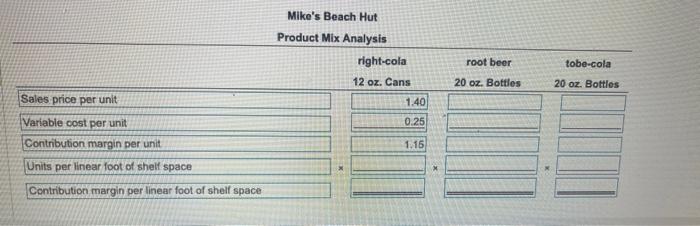
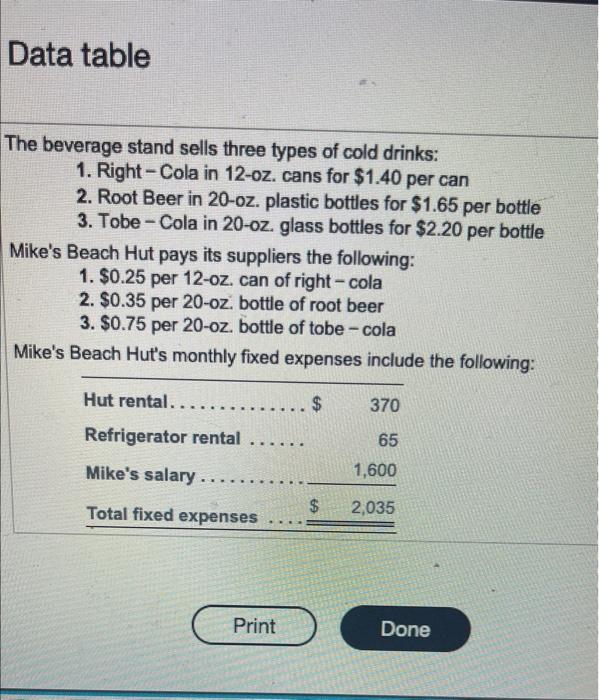
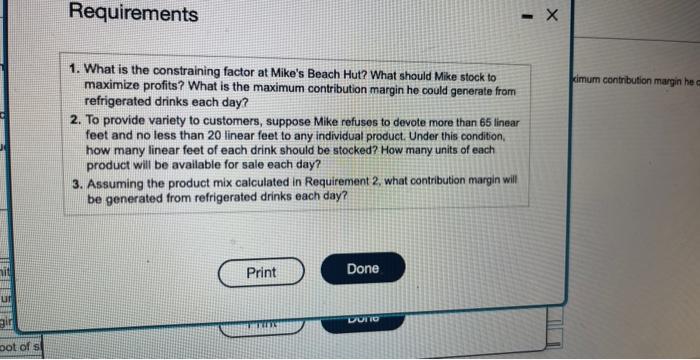
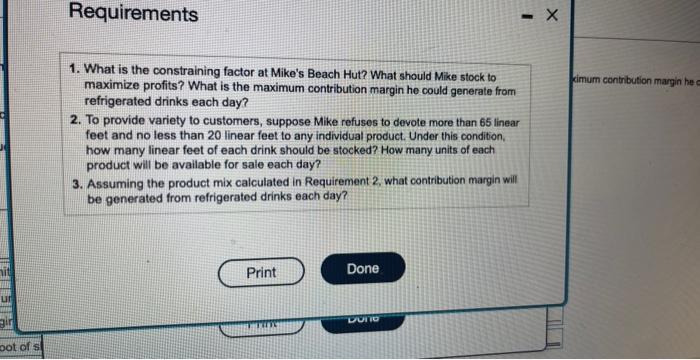
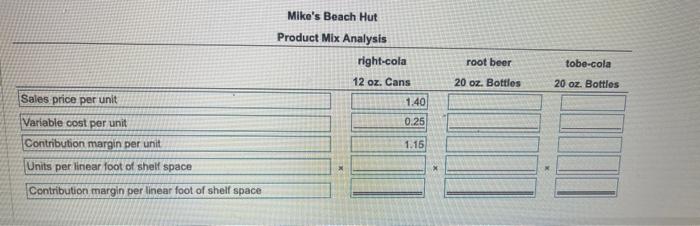
can hold either seven 12 -ounce cans or three 20-ounce plastic or glass botles. (Click the icon to view the informaton on the cold drinks.) The beverage stand can nell al drinks stocked in the display case each morning Read the requiresnents. Mike's Beach Hut Product Mix Analysis The beverage stand sells three types of cold drinks: 1. Right-Cola in 12-oz. cans for $1.40 per can 2. Root Beer in 20-oz. plastic bottles for $1.65 per bottle 3. Tobe-Cola in 20 -oz. glass bottles for $2.20 per bottle Mike's Beach Hut pays its suppliers the following: 1. $0.25 per 12-oz. can of right - cola 2. $0.35 per 20 -oz. bottle of root beer 3. $0.75 per 20 -oz. bottle of tobe-cola Mike's Beach Hut's monthly fixed expenses include the following: Requirements 1. What is the constraining factor at Mike's Beach Hut? What should Mike stock to maximize profits? What is the maximum contribution margin he could generate from refrigerated drinks each day? 2. To provide variety to customers, suppose Mike refuses to devote more than 65 linear feet and no less than 20 linear feet to any individual product. Under this condition, how many linear feet of each drink should be stocked? How many units of each product will be available for sale each day? 3. Assuming the product mix calculated in Requirement 2, what contribution margin will be generated from refrigerated drinks each day? The beverage stand sells three types of cold drinks: 1. Right-Cola in 12-oz. cans for $1.40 per can 2. Root Beer in 20-oz. plastic bottles for $1.65 per bottle 3. Tobe - Cola in 20 -oz. glass bottles for $2.20 per bottle Mike's Beach Hut pays its suppliers the following: 1. $0.25 per 12-oz. can of right - cola 2. $0.35 per 20 -oz. bottle of root beer 3. $0.75 per 20 -oz. bottle of tobe-cola Mike's Beach Hut's monthly fixed expenses include the following: Requirements 1. What is the constraining factor at Mike's Beach Hut? What should Mike stock to maximize profits? What is the maximum contribution margin he could generate from refrigerated drinks each day? 2. To provide variety to customers, suppose Mike refuses to devote more than 65 linear feet and no less than 20 linear feet to any individual product. Under this condition, how many linear feet of each drink should be stocked? How many units of each product will be available for sale each day? 3. Assuming the product mix calculated in Requirement 2 , what contribution margin will be generated from refrigerated drinks each day? Mike's Beach Hut Product Mix Analysis \begin{tabular}{l} Sales price per unit \\ \hline Variable cost per unit \\ \hline Contribution margin per unit \\ Units per linear foot of shelf space \\ \hline Contribution margin per linear foot of shelf space Cans \\ \hline \end{tabular} can hold either seven 12 -ounce cans or three 20-ounce plastic or glass botles. (Click the icon to view the informaton on the cold drinks.) The beverage stand can nell al drinks stocked in the display case each morning Read the requiresnents. Mike's Beach Hut Product Mix Analysis The beverage stand sells three types of cold drinks: 1. Right-Cola in 12-oz. cans for $1.40 per can 2. Root Beer in 20-oz. plastic bottles for $1.65 per bottle 3. Tobe-Cola in 20 -oz. glass bottles for $2.20 per bottle Mike's Beach Hut pays its suppliers the following: 1. $0.25 per 12-oz. can of right - cola 2. $0.35 per 20 -oz. bottle of root beer 3. $0.75 per 20 -oz. bottle of tobe-cola Mike's Beach Hut's monthly fixed expenses include the following: Requirements 1. What is the constraining factor at Mike's Beach Hut? What should Mike stock to maximize profits? What is the maximum contribution margin he could generate from refrigerated drinks each day? 2. To provide variety to customers, suppose Mike refuses to devote more than 65 linear feet and no less than 20 linear feet to any individual product. Under this condition, how many linear feet of each drink should be stocked? How many units of each product will be available for sale each day? 3. Assuming the product mix calculated in Requirement 2, what contribution margin will be generated from refrigerated drinks each day? The beverage stand sells three types of cold drinks: 1. Right-Cola in 12-oz. cans for $1.40 per can 2. Root Beer in 20-oz. plastic bottles for $1.65 per bottle 3. Tobe - Cola in 20 -oz. glass bottles for $2.20 per bottle Mike's Beach Hut pays its suppliers the following: 1. $0.25 per 12-oz. can of right - cola 2. $0.35 per 20 -oz. bottle of root beer 3. $0.75 per 20 -oz. bottle of tobe-cola Mike's Beach Hut's monthly fixed expenses include the following: Requirements 1. What is the constraining factor at Mike's Beach Hut? What should Mike stock to maximize profits? What is the maximum contribution margin he could generate from refrigerated drinks each day? 2. To provide variety to customers, suppose Mike refuses to devote more than 65 linear feet and no less than 20 linear feet to any individual product. Under this condition, how many linear feet of each drink should be stocked? How many units of each product will be available for sale each day? 3. Assuming the product mix calculated in Requirement 2 , what contribution margin will be generated from refrigerated drinks each day? Mike's Beach Hut Product Mix Analysis \begin{tabular}{l} Sales price per unit \\ \hline Variable cost per unit \\ \hline Contribution margin per unit \\ Units per linear foot of shelf space \\ \hline Contribution margin per linear foot of shelf space Cans \\ \hline \end{tabular}
Step by Step Solution
There are 3 Steps involved in it

Get step-by-step solutions from verified subject matter experts
 Study Help