


Question: I need help This exercise will show an application of spanning sets and linear independence to Chemistry. In industrial production or in theoretical Chemistry, you

I need help
I need help This exercise will show anI need help This exercise will show an
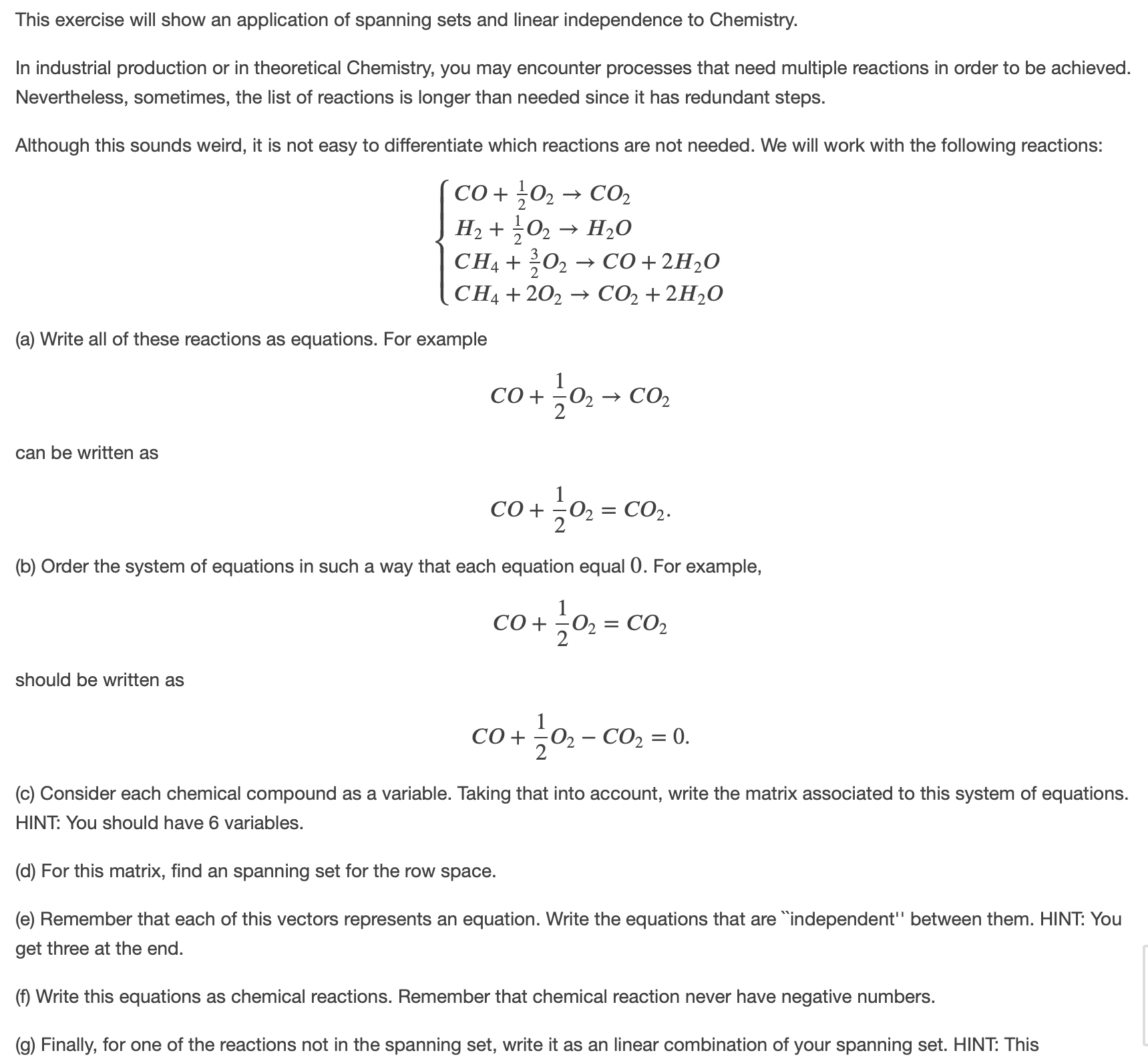
This exercise will show an application of spanning sets and linear independence to Chemistry. In industrial production or in theoretical Chemistry, you may encounter processes that need multiple reactions in order to be achieved. Nevertheless, sometimes, the list of reactions is longer than needed since it has redundant steps. Although this sounds weird, it is not easy to differentiate which reactions are not needed. We will work with the following reactions: co + %02 > (702 H2 + %02 > H20 CH4 + gag > 00 + 21120 CH4 + 202 > (:02 + 21120 (a) Write all of these reactions as equations. For example 1 CO+ 502 > C02 can be written as 1 C0+ 502 = C02. (b) Order the system of equations in such a way that each equation equal 0. For example, 1 00+ 502 = C02 should be written as 1 CO+ 502002 =0. (c) Consider each chemical compound as a variable. Taking that into account, write the matrix associated to this system of equations. HINT: You should have 6 variables. (d) For this matrix, find an spanning set for the row space. (e) Remember that each of this vectors represents an equation. Write the equations that are \"independent" between them. HINT: You get three at the end. (f) Write this equations as chemical reactions. Remember that chemical reaction never have negative numbers. (9) Finally, for one of the reactions not in the spanning set, write it as an linear combination of your spanning set. HINT: This computation is easier to do with the reactions as equations. (h) What do you think that this linear combination means chemically? If necessary, you can read more about this topic in section 4.10.3 of the book

Step by Step Solution

There are 3 Steps involved in it

1 Expert Approved Answer
Step: 1 Unlock blur-text-image

Question Has Been Solved by an Expert!

Get step-by-step solutions from verified subject matter experts

Step: 2 Unlock
Step: 3 Unlock

Students Have Also Explored These Related Mathematics Questions!
