







Question: I need help to solve this. The given examples are all adding by 10. Not by one digit. For example 2.470 becomes 2.480, 2.490, 2.500,
I need help to solve this. The given examples are all adding by 10. Not by one digit. For example 2.470 becomes 2.480, 2.490, 2.500, and 2.510. Then 2.479, 2.489, 2.499, 2.509, and 2.519. What is the frequency and did you get the answers? What is the formula? Do you add or subtract or divide? Please advise. I got the previous answer incorrect
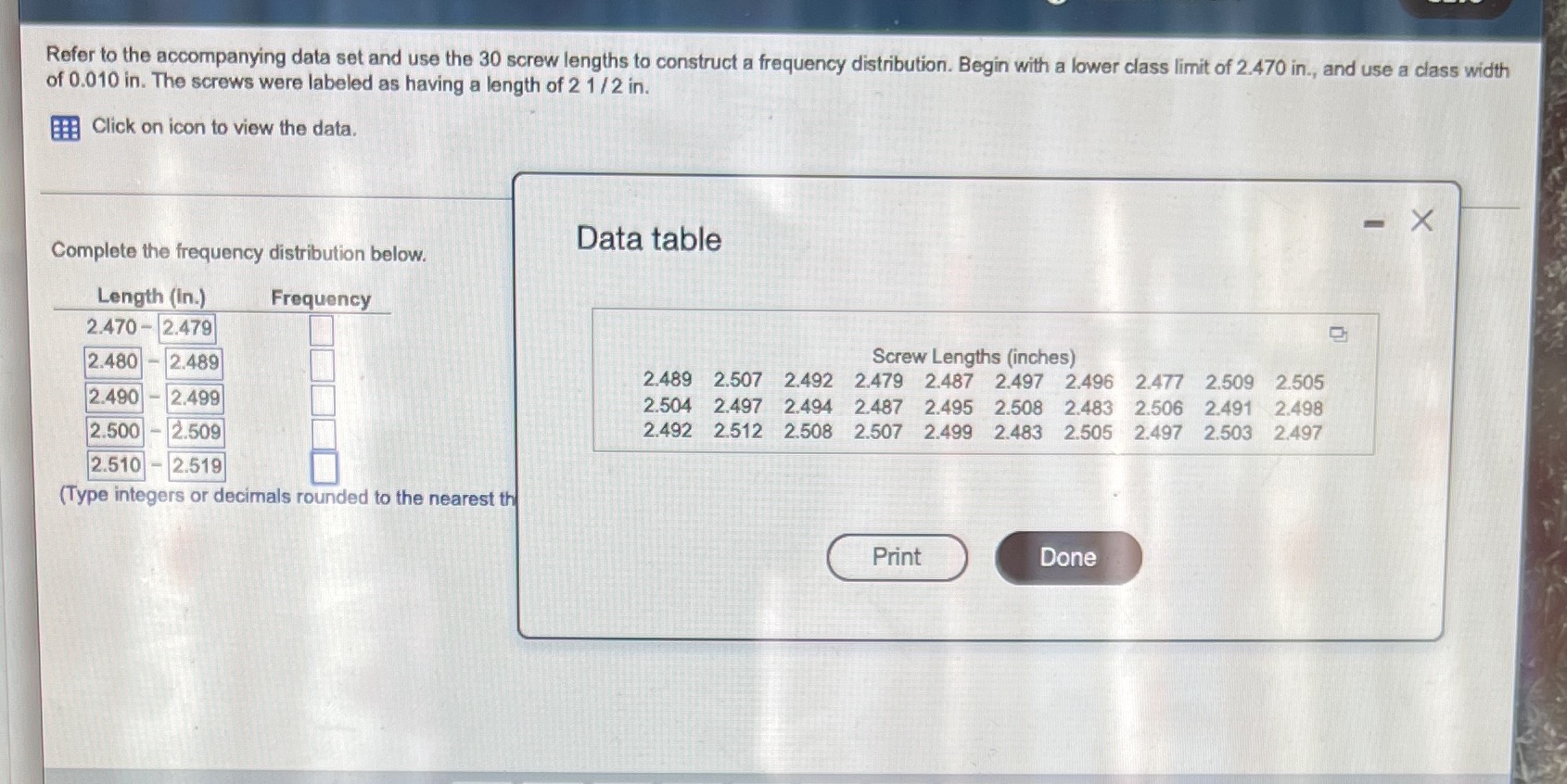
Refer to the accompanying data set and use the 30 screw lengths to construct a frequency distribution. Begin with a lower class limit of 2.470 in., and use a class width of 0.010 in. The screws were labeled as having a length of 2 1 /2 in. Click on icon to view the data. = X Data table Complete the frequency distribution below. Length (In.) Frequency 2.470 - 2.479 2.480 2.489 Screw Lengths (inches) 2.489 2.507 2.492 2.479 2.487 2.497 2.496 2.477 2.509 2.505 2.490 2.499 2.504 2.497 2.494 2.487 2.495 2.508 2.483 2.506 2.491 2.498 2.500 2.509 2.492 2.512 2.508 2.507 2.499 2.483 2.505 2.497 2.503 2.497 2.510 2.519 (Type integers or decimals rounded to the nearest the Print Done
Step by Step Solution
There are 3 Steps involved in it

Get step-by-step solutions from verified subject matter experts
 Study Help